The signs of economic slowdown in Germany and China, the two driving forces of the global economy, are becoming increasingly serious. While Germany is facing stagflation, characterized by high inflation and economic slowdown, China has recently seen major economic indicators fall significantly short of expectations, raising concerns about its economic resilience. The United States, which has somewhat avoided recession debates, is facing headwinds due to the rapidly emerging debt ceiling risk, banking sector failures, and the resulting credit crunch crisis.
On the 16th (local time), Bloomberg reported that the global economy is showing signs of recession as China's reopening rebound falters and Germany, a European powerhouse, experiences deepening weakness in its industrial sector. Although the U.S. has slightly avoided recession pessimism due to easing inflation pressures and strong employment data, warning signals are growing amid congressional deadlock over raising the debt ceiling.
U.S. Treasury Secretary Janet Yellen reiterated her warning that a default resulting from failed negotiations could lead to a severe recession akin to the Great Depression, considering the market influence of U.S. Treasury securities. At an event hosted by the Independent Community Bankers of America (ICBA), she stated, "A default would cause economic and financial catastrophe and roll back the historic economic recovery the U.S. has achieved over recent years," emphasizing again, "There is no time to waste."
Concerns about recession are also deepening in Germany as expectations for economic recovery weaken. On the same day, the German Centre for European Economic Research (ZEW) announced that the May economic sentiment index was recorded at minus 10.7. This figure is significantly below market expectations (-5.0) and has rapidly declined since February (28.1), March (13), and April (4.1). With already unfavorable economic conditions such as persistent high inflation expected to worsen in the second half of the year, there are forecasts that Germany could fall into a recession.
Germany's inflation rate in April soared to 7.2% year-on-year. This is a sharp increase compared to the 0.5% range during the height of the pandemic in 2020. After contracting by 0.5% in the fourth quarter of last year, if the finalized first-quarter gross domestic product (GDP) growth rate, to be announced on the 25th, also shows contraction, Germany will enter a technical recession with two consecutive quarters of negative growth.
The International Monetary Fund (IMF) said on the same day that the European Union's (EU) austerity policies and energy price instability are weighing on the German economy, predicting that Germany's economic growth rate will remain at zero this year.
China's recently released real economy indicators are also bleak. After the abolition of the 'zero COVID' policy, the recovery momentum that had surged sharply has faltered, with major economic indicators for April all falling short of expectations. Retail sales, which gauge domestic demand in China, increased by 18.4% year-on-year, below the market forecast of 20.1%. Industrial production grew by only 5.6% during the same period, significantly below the market expectation of 10.9%, showing a weaker trend than consumption. The most serious indicator was the unemployment rate, with youth (ages 16-24) unemployment soaring to a record high of 20.4%, indicating severe employment insecurity among young people.
Bloomberg pointed out that industrial production, reflecting manufacturing trends, reaching only about half of the forecast and the continued sluggishness of the real estate market raise doubts about economic resilience. Hao Hong, Chief Economist at Grow Investment Group, analyzed, "This economic data confirms that China's reopening has failed to accelerate and has not boosted global demand as much as expected."
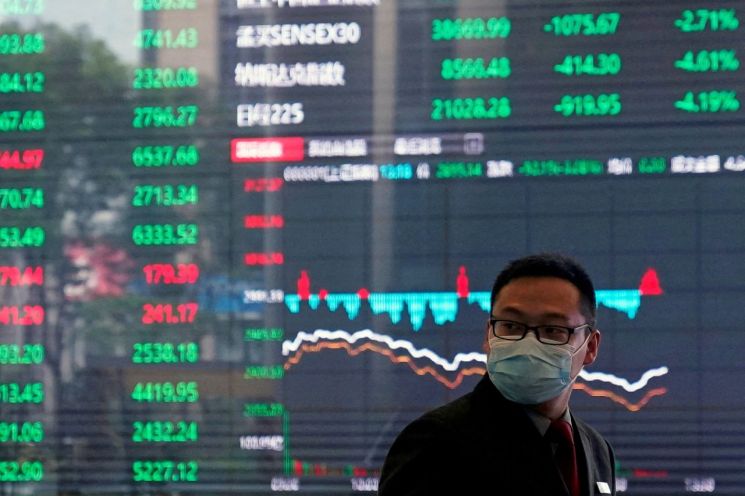
This poor performance in indicators means that Germany and China are not exerting as much strength in economic resilience as expected. China's 'economic reopening' momentum has already lost steam, and Germany's economic engine is rapidly cooling due to high inflation and a manufacturing shock.
Bloomberg reported that according to an economist survey, there is a 65% chance that the global economy will enter a recession within the next 12 months. Mark Zandi, Chief Economist at Moody's Analytics, predicted, "This year will be the most difficult year for the global economy." According to a recent Bank of America survey, investors' economic outlook is negative, and fund managers expect investment sentiment to be the weakest this year.
© The Asia Business Daily(www.asiae.co.kr). All rights reserved.
![Clutching a Stolen Dior Bag, Saying "I Hate Being Poor but Real"... The Grotesque Con of a "Human Knockoff" [Slate]](https://cwcontent.asiae.co.kr/asiaresize/183/2026021902243444107_1771435474.jpg)















