Load Measurement Based on 160-Person Capacity per Subway Car
Congestion Levels Vary Due to Non-Application of National Average Body Weight
To address the overcrowding phenomenon in the Seoul metropolitan subway, which turns into the so-called 'hell train' during weekday rush hours, a train congestion information system was introduced. However, this system is causing confusion among passengers. As subway overcrowding issues, such as those on the Gimpo Gold Line, become a hot topic, there are calls for a reexamination of congestion management within trains.
According to Seoul Metro and others on the 21st, subway congestion is calculated based on a capacity of 160 passengers per car (60.84㎡). When 160 passengers board, congestion is considered 100%. The stages are defined as follows: a relaxed stage (80% or less) and normal stage (80-130%) allow comfortable movement; a caution stage (130-150%) causes discomfort when moving; and a congested stage (150% or more) means movement inside the train is impossible.
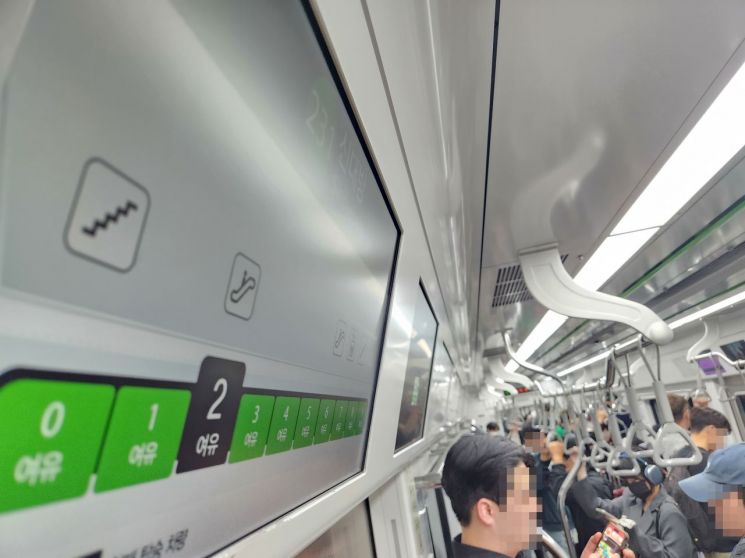 The scene inside the subway train bound for Jamsil on Line 2 on the afternoon of the 16th. It was so cramped that contact with other passengers was unavoidable when moving to another car, but the congestion level displayed on the train monitor was "comfortable."
 /Photo by Byeongdon Yoo tamond@
Recently, safety concerns have been raised due to congestion levels exceeding 200% on lines like the Gimpo Gold Line, bringing renewed attention to subway congestion. In fact, there have been repeated cases of passengers experiencing breathing difficulties on the Gimpo Gold Line. On the 11th of last month, a teenage high school student and a woman in her 30s collapsed at Gimpo Airport Station due to breathing difficulties, prompting a 119 emergency response. Similarly, on December 21 last year, a woman on a train also suffered breathing difficulties and was transported to a hospital.
Accordingly, passenger interest in systems that allow checking congestion levels by car before boarding is increasing. In particular, Line 2 has been operating new trains displaying congestion levels by car since 2019. Although this system has not yet been applied to other lines besides Line 2, congestion can be checked using smartphone applications.
However, there are many cases where congestion measurements are inaccurate, and complaints arise that the criteria themselves do not properly reflect density. For example, on the 16th, when boarding a train bound for Jamsil on Line 2, the car was already full with all seats occupied and standing passengers crowded. Even when moving to another car, it was so cramped that contact with other passengers was unavoidable, yet the congestion displayed on the train monitor was 'relaxed.'
This error is analyzed to stem from the congestion measurement method. Each car is equipped with load sensors that detect weight in real time to measure the boarding weight inside the car, but this method is not suitable for measuring congestion. Seoul Metro explained that the load measured per car is divided by the average weight per person of 65 kg to calculate the number of passengers. However, according to the National Statistical Portal, as of 2020, the average weight of Koreans is 74.5 kg for men and 58 kg for women, showing a large margin of error based on gender alone. Adding elderly and obese populations further increases this margin of error.
Professor Lee Young-joo of the Department of Fire and Disaster Prevention at the University of Seoul said, "The most reliable way to measure how many people are in a train car is visual judgment, but this is practically impossible." She added, "I understand that various technologies to assess density through video methods are being researched and developed." Professor Lee also pointed out, "While providing real-time congestion information is meaningful, it would be more efficient to quickly inform passengers of such risk factors when unusual and exceptional overcrowding occurs."
In response, Seoul Metro stated, "Since the congestion displayed in real time for each train car is based on weight detection, there may be differences from visual congestion." They added, "We also operate a method that analyzes congestion by linking total boarding information obtained from transportation card data with mobile communication device data installed in each subway car."
© The Asia Business Daily(www.asiae.co.kr). All rights reserved.
![Clutching a Stolen Dior Bag, Saying "I Hate Being Poor but Real"... The Grotesque Con of a "Human Knockoff" [Slate]](https://cwcontent.asiae.co.kr/asiaresize/183/2026021902243444107_1771435474.jpg)















