Amid growing concerns that the United States could face an unprecedented debt default as early as early June, the second meeting between President Joe Biden and House Speaker Kevin McCarthy ended 'empty-handed.' However, both the White House and congressional leaders agreed that "default is a terrible option" and showed strong willingness to negotiate. President Biden has decided to shorten his upcoming overseas trip schedule to focus on reaching a negotiation agreement.
On the 16th (local time), President Biden met at the White House with Republican House Speaker McCarthy, Senate Minority Leader Mitch McConnell, Democratic House Majority Leader Hakeem Jeffries, and Senate Majority Leader Chuck Schumer to discuss raising the debt ceiling. This was the second meeting following the first on the 9th, which ended with only confirmation of the differences between the two sides.
With concerns that a default could become a reality, the meeting ended in just one hour. House Speaker McCarthy told reporters afterward that "we are still far apart," confirming the gap in positions, but also expressed hope for a negotiation agreement by saying "we are in a better process." He also mentioned that "it is possible to reach an agreement by this weekend." Senate Majority Leader Schumer also positively evaluated the meeting, saying, "We don't have much time, but we all agreed that default is a terrible option."
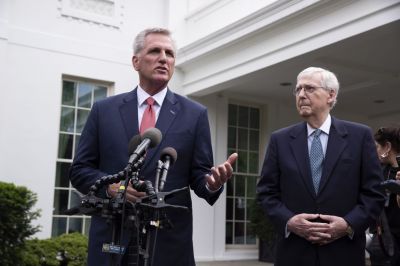
The United States exhausted its $31.4 trillion debt ceiling on January 31 and has been buying time through special measures, but even those are reaching their limits. The X-day, warned by Treasury Secretary Janet Yellen, is June 1. Especially considering that President Biden is scheduled to begin an overseas trip to Japan and other countries for the Group of Seven (G7) summit starting on the 17th, concerns have been mounting that if no breakthrough is found at this second meeting, the risk of default will rise further.
Currently, the Republican Party, which holds the majority in the House, is demanding large-scale government spending cuts as a precondition, while the White House and Democrats insist that the debt ceiling is not negotiable and demand an unconditional increase. Local media, including The Washington Post (WP), reported that both sides agree on preventing a default but are at an impasse over which government programs to cut spending from. Ahead of the meeting, aides from both sides reportedly discussed increasing mandatory work requirements for low-income individuals receiving government support such as food purchases.
The Wall Street Journal (WSJ) reported that staff-level talks are being held on several topics where agreement might be possible, including reclaiming unused COVID-19 funds, streamlining energy project approval processes, setting government spending caps, and tightening work requirements for certain government programs.
In the market, even if the worst-case scenario of default is avoided, it is widely expected that as the X-day approaches, there will inevitably be repercussions such as a sharp stock market decline. Moreover, the U.S. economy is already facing recession concerns due to over a year of aggressive Federal Reserve tightening and recent events like the Silicon Valley Bank (SVB) collapse.
Secretary Yellen reiterated her default warnings on the same day. Speaking at the Independent Community Bankers of America (ICBA) event, she said, "A U.S. default would cause economic and financial disaster," urging, "There is no time to waste. Congress must resolve the debt ceiling issue as soon as possible." She cited an analysis from the White House Council of Economic Advisers that if a default lasts more than three months, the stock market could plunge 45% and up to 8.3 million jobs could be lost, warning that it could lead to a severe recession comparable to the Great Depression.
With the Senate scheduled to recess for Memorial Day from the 22nd to the 29th, the negotiation deadline is even tighter. The White House announced that President Biden has shortened his planned overseas trip to focus on debt ceiling discussions. Originally, Biden was to depart for Japan on the 17th to attend the G7 summit and then visit Papua New Guinea and Australia. However, to secure time for debt ceiling negotiations, he will skip visits to Papua New Guinea and Australia and return on the 21st.
© The Asia Business Daily(www.asiae.co.kr). All rights reserved.
![Clutching a Stolen Dior Bag, Saying "I Hate Being Poor but Real"... The Grotesque Con of a "Human Knockoff" [Slate]](https://cwcontent.asiae.co.kr/asiaresize/183/2026021902243444107_1771435474.jpg)















