Nursing Act Bill "Causing Public Anxiety and Conflict"
Emphasizing the Need for Sound Finances for Future Generations and Three Major Reforms
Presidential Office Faces Backlash Over Communication Breakdown After Second Veto in About 40 Days
President Yoon Suk-yeol pointed out on the 16th that "passing on unbearable debt to future generations due to reckless spending is a plunder of future generations." He especially emphasized the three major reforms (labor, education, and pensions), which are key national agenda items of the Yoon administration, promising that "we will not waver for the benefit of the people." Just before exercising the veto on the Nursing Act bill, he reiterated the policy principle of 'law and principle,' highlighting the lack of consultation and deliberation.
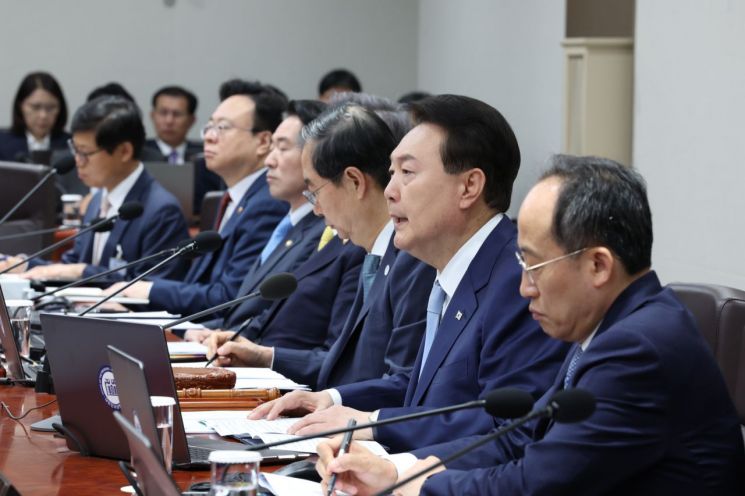
On the same day, President Yoon presided over a Cabinet meeting at the Presidential Office in Yongsan, Seoul, stating, "We will firmly reject indiscriminate cash handouts and election populism, and strictly investigate illegal and improper use of subsidies to ensure that not a single penny of the people's tax money is wasted."
He also reiterated the necessity of the three major reforms for future generations. President Yoon explained, "They are for the sustainable development of future generations and our country," adding, "They can no longer be delayed, nor should they be delayed." He further stated, "Illegal collective agreements such as employment inheritance that deprive future generations of opportunities will be corrected, and we will propose amendments to the Fair Hiring Act to abolish inherited vested interests," emphasizing, "Reforms always face resistance from vested interest cartels, but we will only look to the people and will not waver for the benefit of the people."
There were also remarks targeting the Moon Jae-in administration's real estate policies and nuclear phase-out. President Yoon described them as "ideological, anti-market, and political policies," and said that normalization has been pursued during his first year in office. He explained, "During the previous administration's five years, Seoul housing prices doubled, and those owning a single house had to bear taxes more than ten times higher," adding, "Anti-market policies became the soil for large-scale jeonse (long-term lease) fraud. The current government has normalized ideological and anti-market real estate policies."
Regarding the 5.3% increase in electricity rates the day before, he criticized the Moon administration again, saying, "The financial deterioration of Korea Electric Power Corporation (KEPCO) caused by nuclear phase-out and reckless spending has reached a point where we can no longer allow KEPCO bonds to disrupt the financial market," and "It clearly shows the damage that national policies, which are not based on science but are obsessed with political ideology, cause to the people." He added, "We are completely discarding ideological and political policies and restoring the world's top-level nuclear power industry ecosystem," explaining achievements such as the resumption of construction of Shin Hanul Units 3 and 4, signing a 2.9 trillion won supply contract for main equipment, providing 200 billion won in special financial support, securing a 3 trillion won nuclear power plant order from Egypt, and launching a 400 billion won small modular reactor (SMR) development project.
Veto on Nursing Act Bill Judged to 'Cause Conflict Regardless of Treatment Improvement'... Sent Back to the National Assembly Despite Concerns Over Declining Approval Ratings
At the Cabinet meeting on the same day, President Yoon reviewed and decided to exercise the veto on the Nursing Act bill. He criticized, "The Nursing Act bill is causing excessive conflict among related professions, and the deinstitutionalization of nursing work is causing public anxiety about health." He continued, "It is regrettable that such social conflicts and anxieties were not resolved through sufficient consultation among professions and thorough deliberation in the National Assembly," emphasizing, "Politics, diplomacy, and economic industrial policies all take a backseat to public health, which can only be properly protected through collaboration among various medical professional fields." President Yoon's veto exercise came about 40 days after his veto on the amendment to the Grain Management Act in April. The Nursing Act bill passed the National Assembly on the 4th solely by opposition parties.
The background to President Yoon's exercise of the reconsideration request right on the Nursing Act bill lies in the judgment that the bill increases conflicts among professions regardless of improving nurses' treatment. Even at the risk of further lowering his approval ratings due to an image of 'lack of communication' and 'arbitrariness,' this is why President Yoon exercised his second veto.
As a result of President Yoon's decision, the Nursing Act bill has returned to the National Assembly, but the political burden remains. There are concerns that the image of being uncommunicative may solidify as the president consecutively exercises vetoes on opposition-led bills at one-month intervals, following the Grain Management Act amendment.
Public opinion was also unfavorable at the time of the veto on the Grain Management Act amendment last month. A poll conducted three days after President Yoon exercised the veto showed that 48% responded negatively to his veto, compared to 33% who responded positively. Regarding the bill itself, 60% supported the amendment to stabilize rice prices and guarantee farmers' income, while 28% opposed it, citing oversupply and increased government financial burden. The first veto also affected party approval ratings: the People Power Party dropped by 1 percentage point to 32%, while the Democratic Party remained at 33%.
Therefore, the Presidential Office appears to be gauging public sentiment regarding the second veto. The Democratic Party has criticized the president's lack of communication, calling repeated vetoes "an outrage rejecting the will of the people." Meanwhile, other bills such as the Yellow Envelope Act and the Broadcasting Act are also lined up. The collective action of the Korean Nurses Association is likely to directly impact President Yoon's approval ratings. Although political circles analyze that nurses will not immediately strike, if they return their licenses or expand political influence through party membership, the government and ruling party will face more variables to manage.
Compromise Needed Due to Opposition's Unilateral Passage... Yoon Also Expressed Concerns Over 'Unilateral Passage Without Debate' During Grain Management Act
However, the Presidential Office maintains its stance to steadfastly uphold the national policy principle based on law and principle. Regarding President Yoon's veto exercise on the Nursing Act bill, the office foresees increased conflicts in the medical field and setbacks in the public's health rights. While acknowledging the need to improve nurses' working conditions and treatment, they argue that since the bill passed the National Assembly through the opposition's unilateral action, a compromise must be discussed.
They also pointed out that the bill failed to sufficiently reflect the interests and opinions among professions. Since the Nursing Act bill separates nursing-related content from the Medical Service Act and defines the scope of work for nurses, specialized nurses, and nursing assistants, it is argued that trust and collaboration among medical professionals will be undermined. President Yoon applied the same principle when vetoing the Grain Management Act amendment last month. At that time, he stated, "The government continuously explained the bill's side effects to the National Assembly, but it was regrettable that it was passed unilaterally without proper debate."
However, there is some difference in approach between the Nursing Act bill and the Grain Management Act amendment. President Yoon opposed the Grain Management Act amendment as a "forced purchase law for surplus rice," calling it a "typical populist bill," whereas the core issue with the Nursing Act bill lies in disagreements among stakeholders. Unlike the Grain Management Act amendment, which had opposition from the president's office and government ruling party even before reaching the National Assembly, the Nursing Act bill was approached cautiously. A Presidential Office official said, "Since the bill has returned to the National Assembly by the president's decision, it will undergo revision and supplementation rather than abolition," adding, "As the government and ruling party plan to actively negotiate, we expect a compromise that reflects all stakeholders' opinions."
© The Asia Business Daily(www.asiae.co.kr). All rights reserved.