Recently, so-called 'hyper-end' residential products, priced well over 10 billion won per unit, have been emerging one after another, mainly in Gangnam, dispelling the recent stagnation in the real estate market. These products each boast their own locational advantages and product differentiation, presenting new trends in Korea's top-tier residential culture. Among them, the appearance of world-renowned architects is particularly noteworthy.
The hyper-end residential market, true to its name, caters to buyers with exceptionally refined tastes and perspectives. Developers, recognizing that mediocre product quality cannot satisfy these discerning buyers, are competing to recruit world-class masters?architects typically seen in large-scale global architectural projects?as designers.
The market response is enthusiastic. In the high-end sector, where the pursuit goes beyond mere living spaces to collectible works, the reputation of the creator, i.e., the architect, becomes a very important selection factor. The fact that a world-renowned master personally designed the project serves as a key product differentiator and a marketing point.
However, when examining whether the architectural concepts and intentions of these world-class masters are truly realized in these products, it is clear that many do not fully embody them. Korea's architectural regulations are among the strictest worldwide, making it challenging to implement the initial designs of foreign architects under domestic conditions.
Additionally, due to a lack of understanding of Korean sensibilities, difficulties in construction methods, and rising construction costs, many projects see the architects' initial concepts fade, with only the names of the world-renowned masters becoming a topic of discussion. Until now, the participation of foreign architects has mostly been limited to the exterior (facade).
Therefore, it is questionable whether the interior floor plans?the actual living spaces of residents?can be called the architects' works if they have not been touched by the creators themselves. As Givenchy said, "Luxury is in the details," and since the ultimate competitiveness of hyper-end lies in the details, it is difficult to call a work that fails to preserve the most important details a genuine collectible masterpiece. True hyper-end means that, just as an artist proudly puts their name on a work, the architect must personally refine every detail from start to finish for it to be meaningful.
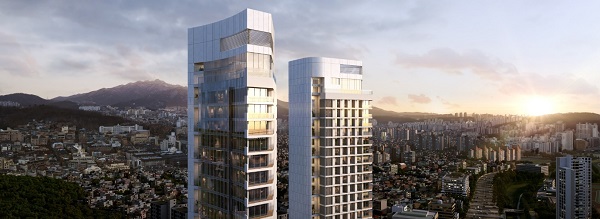
In this regard, the newly introduced hyper-end residential complex in Banpo, THE PALACE 73, is special. It is significant as the first residential product in Korea designed by Richard Meier, a world-renowned architectural master and recipient of the Pritzker Prize, often called the Nobel Prize of architecture.
Moreover, not only the building's interior and exterior design but also the floor plans, finishing materials, and circulation planning are based on Richard Meier's concepts and designs. Meier Partners, Richard Meier's architectural office, directly executes all design details and will be involved throughout the construction process, setting this project apart from existing products claiming to be hyper-end.
Richard Meier is widely known as the "architect of white aesthetics," favoring spatial compositions using light and color schemes centered on white. Looking at the revealed exterior of THE PALACE 73, the aesthetic design, including the colorful and harmonious facade and the sculptural beauty emphasized in white, stands out prominently.
Furthermore, despite being a high-rise, the boldly exposed foyer spaces and terraces, the unique curved floor plans that dramatically leverage the advantage of one unit per floor, offering panoramic views, and terraces for every unit deeply embody the master's philosophy and artistic sensibility in every detail.
It took about two years to complete the design of the complex. During this period, Meier Partners and the domestic developer The Land bridged their differences through a rigorous schedule of 2 to 3 video conferences per week, overcoming a 14-hour time difference. Meier Partners created designs that understand Korea's stringent building codes while maintaining New York sensibilities and not losing Korean cultural nuances. The Land also regarded this as an opportunity to confirm the essence of hyper-end, which is rarely experienced domestically.
In April, the vice president of Meier Partners, who visited Korea, confidently stated, "THE PALACE 73 will be not just a residential space but an 'art collection' embodying artistic value and a representative 'Masterpiece' of Richard Meier's architecture," adding, "Every detail of the promotional center perfectly expresses the architect's intentions, which is very satisfying," offering high praise.
Cho Hyeong-jin, Executive Director of The Land, who oversees THE PALACE 73 marketing, also said, "The design know-how and details of a world-class architectural master are the very differentiators that make THE PALACE 73 a true hyper-end incomparable to any other," and added, "THE PALACE 73, which combines architectural details evolved into art and an unparalleled scale, will set a new standard and definition for Korea's hyper-end market."
© The Asia Business Daily(www.asiae.co.kr). All rights reserved.