Abolishing Hair and Dress Codes, 'De-Management' Education
Major Shock to Japan's Conservative Education System
A high school that declared 'zero school rules' in the conservative Japanese education sector is becoming a hot topic. This school has completely abolished regulations on hair dyeing, piercings, nails, and clothing, allowing even high school students to attend school with blonde hair and casual clothes. While many schools still enforce strict rules such as hair regulations, Japanese media are paying attention to the implications of this kind of 'de-management education.'
On the 15th, Mainichi Shimbun reported on Tokyo Chuo Daifuzoku High School, a 'zero school rules' school. Since this school has completely eliminated hair and clothing regulations, dyeing hair, wearing makeup, and attending school in casual clothes are all freely allowed. The school's only rule is a basic rule called the '126-character rule.' It begins with the sentence, 'True freedom is obtained by governing oneself,' and instructs students to recognize others' freedom and rights and fulfill their duties.
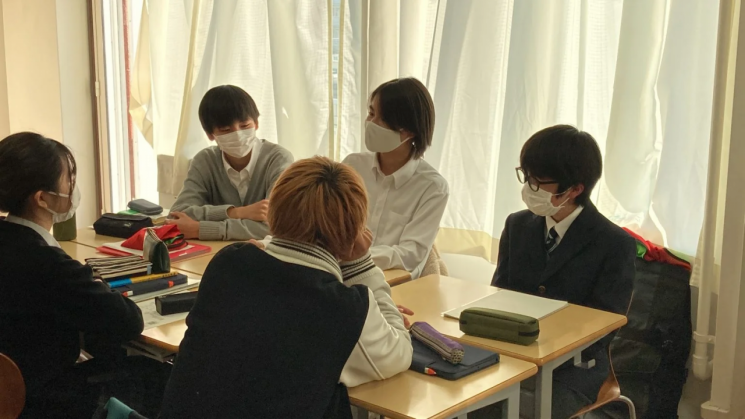 Students of Chuo Daebu High School engaged in group activities. Their attire and hairstyles are casual. (Photo by Chuo Daebu High School website)
The reason the school abolished school rules is to guarantee students' autonomy. This is in line with the school's educational philosophy of 'independence, autonomy, and self-governance.' It is important for students to make their own judgments, and the same applies to their appearance. Principal Ishida stated, "When adults around interfere by telling students what to do, it actually takes away their opportunity to think."
He said, "When you become an adult, it becomes important to know what kind of attire is advantageous for you and what clothes you should wear to certain places. There can be various judgments about whether to wear appropriate clothes for the situation or to express what you want to express. This is something that should be learned from high school."
The school did not maintain a free school culture from the beginning. When it was an all-boys school, there were strict rules such as uniforms, hair regulations, and saluting teachers when meeting them on the way to and from school. However, in the 1970s, when students held protests demanding the abolition of regulations, the school accepted this and decided to abolish the norms. After transitioning to coeducation in 2001, the number of students with strong self-assertion increased, but Principal Ishida emphasized that the school respects and accepts the students.
Students also anonymously told Mainichi in interviews, "I have blonde hair and piercings, but it does not interfere with my studies. Since university students will be free in terms of clothing anyway, it is good to be able to decide this by myself from high school," and "You need to have individuality to survive in society. It is good to be able to cultivate individuality here."
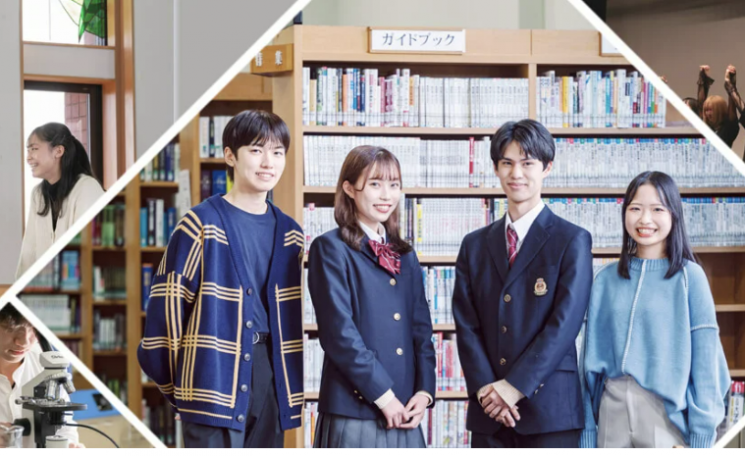 Promotional photo of Chuo University High School Attached to Junior High School in Japan. (Photo by Chuo University High School Attached to Junior High School website)
However, such schools are a minority in Japan. This is because rules still exist, such as requiring a certificate to prove that one's hair is naturally light brown. In 2017, a student filed a lawsuit against a high school in Osaka, claiming they were forced to dye their naturally brown hair black. In February, at a high school graduation ceremony, a male student with dreadlocks was isolated and not allowed to enter the venue. The school said the student's hairstyle violated the "cleanliness appropriate for high school students," which sparked controversy.
Because of this, there have been increasing calls in Japan to move away from a culture of managing students with strict school rules. According to a public opinion survey conducted last year by the Japan Foundation, a Japanese think tank, targeting 17- to 19-year-olds in six countries worldwide, only 26.9% of Japanese respondents answered "yes" to the question "Do you think your actions can change your country or society?" This was the lowest among the countries surveyed. In contrast, positive responses from youth overseas were all above half, such as 61.5% in South Korea and 58.5% in the United States. Additionally, only 27.3% of Japanese respondents answered "I consider myself an adult," which was significantly lower than other countries.
Japanese educators advocating de-management education see the schools' uniform and limited-choice education as a major factor causing the young generation's sense of helplessness. Similarly, Takahiko Saigo, former principal of Sakuraoka Junior High School, who abolished school rules and even opened his principal's office to students, told Mainichi, "Young people these days think it's useless to say anything and give up. But if they can express their opinions instead of just accepting things, they can change the world. I abolished school rules hoping they would gain experience of becoming sovereigns themselves."
Principal Ishida also emphasized, "We live in an era where yesterday's common sense is no longer today's common sense. We need free thinking that is not bound by common sense," and "The school should be one that supports young people who move the times."
© The Asia Business Daily(www.asiae.co.kr). All rights reserved.
![Clutching a Stolen Dior Bag, Saying "I Hate Being Poor but Real"... The Grotesque Con of a "Human Knockoff" [Slate]](https://cwcontent.asiae.co.kr/asiaresize/183/2026021902243444107_1771435474.jpg)

















