Wade Allison, Honorary Professor at Oxford University, UK
Press Briefing Hosted by Korea Atomic Energy Research Institute and Korean Nuclear Society on the Morning of the 15th
"Treated Water Safe to Drink," Emphasizing Same Position as Japan
Controversy Expected Ahead of Government Inspection Team Dispatch
As Japan prepares to discharge contaminated water from the Fukushima nuclear power plant, the Korea Atomic Energy Research Institute (KAERI), a national research institution, is expected to face controversy for holding an event that unilaterally supports Japan's position under the pretext of an "Overseas Scholars Invitation Meeting."
On the morning of the 15th, KAERI, together with the Korean Nuclear Society, invited Professor Wade Allison, Emeritus Professor at the University of Oxford, UK, to hold a press briefing at the HJ Business Center Gwanghwamun branch in Seoul, under the theme "Low-dose Radiation Effects and the Fukushima Contaminated Water Controversy ? Science Swallowed by Fear."
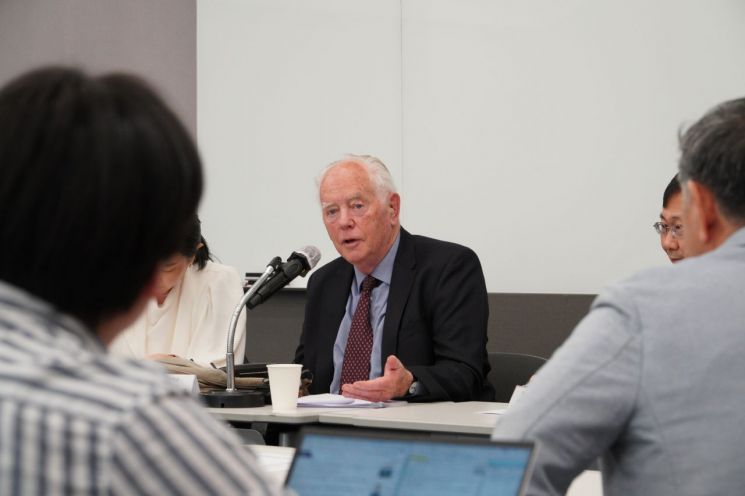
Professor Allison stated that "If I had contaminated water stored in tanks after passing through the Advanced Liquid Processing System (ALPS), I could drink about one liter of it immediately even without dilution," adding, "Even if you drink such water, calculations show that the radiation level would only rise to about 80% of natural background levels." He further emphasized, "This is only a fraction of the radiation exposure one receives when visiting countries like Iran or India," and "We do not believe that people living in areas with high radiation levels suffer from cancer, and they might actually be safer than us."
When reporters asked for specific evidence, Professor Allison explained, "Our bodies naturally contain a certain amount of radiation," elaborating, "Typically, it is about 60 to 100 becquerels (Bq) per kilogram, mainly from potassium-40 as a radiation source. Drinking one liter of Fukushima contaminated water would increase the baseline level by about 80%."
Regarding the risk of tritium, which is not filtered out by ALPS, he argued, "Tritium is a form of hydrogen, so it will be flushed out of the body along with water, and it only remains in the body for about 12 to 14 days," adding, "After 12 to 14 days, it will be completely eliminated."
Professor Allison expressed no reason to doubt the safety of Fukushima contaminated water, stating, "Just as we recognize the risks of fire or vehicles and have practically demonstrated that they can be sufficiently safe, the same applies to nuclear power." He cited the fact that in regions like Iran, where people are exposed to much higher radiation levels, no deaths from cancer or diseases caused by radiation have been reported. Regarding the dispatch of inspection teams by the Korean government, he advised, "We need to check whether there are any contaminants other than tritium in the contaminated water," and added, "While tritium can be considered harmless, it is necessary to verify whether strontium or cesium have been properly filtered."
He also actively expressed trust in the Japanese government. When asked why Japan insists on discharging the water instead of using it for drinking or agricultural purposes, he replied, "Discharging into the ocean is the easiest and least costly method," and said, "Since the Japanese government is providing sufficient information, I believe the inspection period by the Korean government will not be a major issue."
Regarding concerns that marine life such as fish might accumulate contaminants causing side effects, he dismissed these by saying, "Tritium does not accumulate in the body. Even if it does, it can be easily separated. Marine life is similar to humans, so if accumulation occurs, it can be easily separated." On some studies suggesting that low-dose radiation exposure might be harmful, he countered, "Our bodies have evolved mechanisms to repair damaged cells," and explained, "We have been continuously exposed to natural radiation, and our bodies know how to cope with it. Biologically, we are designed to repair damage from low-dose radiation within hours or days."

In response to criticisms that the Japanese government is not providing information about Fukushima contaminated water, he reiterated, "I believe the contaminated water stored in tanks after passing through ALPS is safe enough even without dilution," and added, "Since it will be diluted in the ocean, it will not pose a threat to our lives."
When asked again about scientific evidence supporting the claim that the contaminated water is drinkable, Professor Allison asserted, "I can provide sufficient evidence," and claimed, "I said about one liter can be drunk, and considering people living in high radiation areas, it might be possible to drink hundreds of liters."
According to KAERI, Professor Allison, born in 1941, is an experimental particle physicist interested in electromagnetic radiation, particle and nuclear physics, and medical physics. He has researched and taught physics, especially in the field of radiation, for over 40 years.
On the day, he actively advocated for nuclear energy, stating that removing unnecessary bureaucratic safety regulations could reduce costs, and that other industries also produce waste. Professor Allison said, "Nuclear energy, like chemical energy, is part of the natural world, and we benefit greatly from it. Radiation is widely used for medical purposes to maintain healthy lives," and argued, "Wind and solar power do not generate much energy and have utilization rates of only about 20 to 30% due to intermittency." He added, "What industry needs is an energy source that can be supplied 24 hours a day."
© The Asia Business Daily(www.asiae.co.kr). All rights reserved.
![Clutching a Stolen Dior Bag, Saying "I Hate Being Poor but Real"... The Grotesque Con of a "Human Knockoff" [Slate]](https://cwcontent.asiae.co.kr/asiaresize/183/2026021902243444107_1771435474.jpg)
















