The government and the ruling party's official recommendation to President Yoon Seok-yeol to exercise the veto power on the Nursing Act bill is expected to trigger a strong backlash. The nursing community immediately condemned the move, and opposition is anticipated from the medical community, which had demanded the veto on both the Nursing Act and the 'Medical License Revocation Act' (Medical Service Act amendment), as the latter was excluded from the veto recommendation.
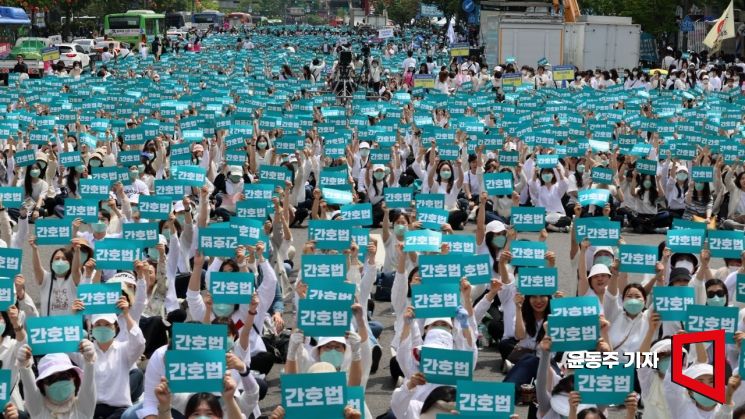 On the 12th, Nurses attending the commemorative celebration held on Sejong-daero, Jongno-gu, Seoul, in honor of International Nurses Day 2023, raised placards and shouted slogans urging the enactment of the Nursing Act. Photo by Dongju Yoon doso7@
The Korean Nurses Association issued a statement on the 14th, saying, "We will never forget the act of slandering nurses by branding the Nursing Act as a 'legislative dictatorship law' that holds the lives of the people hostage," and added, "Through the total mobilization of 620,000 nurses, we will correct this humiliating slander and punish those responsible for these remarks." The association also criticized, "The Nursing Act was deliberated and approved through proper procedures, including four rounds of bill review over two years in accordance with the National Assembly Act," and accused the People Power Party and the Ministry of Health and Welfare of officially announcing the veto recommendation by listing false information.
Since the 8th, the Korean Nurses Association has been conducting a survey among its members regarding collective action in the event of the president exercising the veto power. The interim results showed that 98.4% agreed that collective action is necessary. Previously, the association stated that, unlike the doctors' group, they would not engage in collective actions that jeopardize the lives and safety of the public, so it is unlikely that they will immediately proceed with the highest level of collective activities such as a general strike. The survey mentioned major collective actions such as returning nursing licenses and a campaign for one nurse to join one political party. However, it is reported that there is internal consensus within the nursing community that active measures have become inevitable given the worst-case scenario.
On the other hand, the Medical License Revocation Act, which had also sparked opposition from the health and medical sectors along with the Nursing Act, was reportedly excluded from the veto recommendation this time, so backlash is expected mainly from medical organizations. The Korean Medical Association immediately held an emergency meeting to prepare countermeasures. This bill, which passed the National Assembly plenary session led by the opposition party along with the Nursing Act, expands the grounds for disqualification and license revocation of medical personnel from criminal acts violating medical-related laws to cases where a sentence of imprisonment or higher is imposed regardless of the type of crime.
In response, the government and the medical community have voiced opposition, citing concerns about excessive legislation. Kang Min-gu, president of the Korean Intern Resident Association, pointed out at a press conference on the 2nd, "Since doctors must be prepared for license revocation if they fail to comply with work commencement orders during strikes, the License Revocation Act severely restricts the labor rights of residents, who already face excessive working hours, and is essentially a 'doctor strike prevention law.'" Meanwhile, on the afternoon of the 15th, Cho Kyu-hong, Minister of Health and Welfare, is scheduled to hold a briefing at the Government Seoul Office to convey the Ministry's position regarding the Nursing Act bill.
© The Asia Business Daily(www.asiae.co.kr). All rights reserved.
![Clutching a Stolen Dior Bag, Saying "I Hate Being Poor but Real"... The Grotesque Con of a "Human Knockoff" [Slate]](https://cwcontent.asiae.co.kr/asiaresize/183/2026021902243444107_1771435474.jpg)















