Kim Tae-hyo: "An Opportunity to Upgrade Korea-US-Japan Cooperation"
Attended Expanded G7 Summit Meeting for Open Discussion
Only Australia, Korea, and India Invited More Than Five Times
"Expect Korea's Role in Sharing Universal Values"
Yoon and Kishida Visit Memorial Monument... "A Moment to Pledge Peace and Prosperity"
President Yoon Suk-yeol will attend the Group of Seven (G7) Summit held in Hiroshima, Japan, from the 19th to the 21st, and hold a trilateral summit with the leaders of the United States and Japan.
Kim Tae-hyo, First Deputy Director of the National Security Office, announced at a briefing held at the Yongsan Presidential Office on the afternoon of the 14th that President Yoon will attend the G7 Summit from the 19th to the 21st upon the invitation of Japan, the G7 chair country this year, and will participate in the Korea-U.S.-Japan trilateral summit.
Deputy Director Kim explained, "The G7 meetings are divided into those attended only by member countries and expanded meetings including invited countries and organizations. President Yoon will attend the expanded meeting," adding, "At the expanded meeting, discussions will be held with representatives of invited countries and organizations on topics such as food, health, climate, energy, and development. There will also be free discussions on the rule-based international order and related policies for emerging developing countries, which are key themes raised by this year’s chair country."
If President Yoon attends this G7 Summit, he will be the fifth Korean president to be invited and the fourth to attend. Among non-G7 member countries (United States, Canada, United Kingdom, France, Germany, Italy, Japan), only Australia (6 times), South Korea, and India (5 times each) have been frequently invited more than five times. The G7 invited South Korea in 2007, 2009, 2010, 2020, and 2021. However, the 2020 meeting was canceled due to the COVID-19 pandemic.
Along with South Korea, the countries invited to this G7 Summit include Australia, Vietnam, India, Indonesia, the Cook Islands, Comoros, and Brazil, totaling eight countries. Among them, Comoros is the chair of the African Union, the Cook Islands is the chair of the Pacific Islands Forum (PIF), Indonesia is the chair of the Association of Southeast Asian Nations (ASEAN), India is the chair of the Group of Twenty (G20) this year, and Brazil will be the G20 chair next year.
Deputy Director Kim explained the reason for South Korea’s invitation to the G7 Summit, saying, "I think it reflects South Korea’s role and expectations as a country that shares universal values with the G7 and has joined the 3050 Club (with a national income of $30,000 and a population of over 50 million)."
He added, "President Yoon was the first Korean president to be invited to a NATO summit after his inauguration, and being invited to the G7 this year confirms our country’s status as a partner in upholding the rules-based international order and responding to global challenges. It can also be seen as a trend of expanding the strengthened relationships with key allies into multilateral diplomacy."
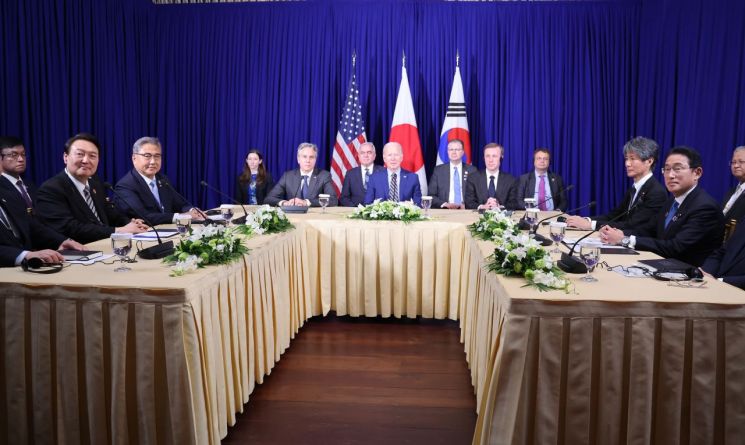
He continued, "At the G7 Summit, we expect to present ways for South Korea to contribute to global solidarity and cooperation amid the complex global crises and to strengthen ties with key allied leaders. We hope to participate in discussions on various agendas and send a message of solidarity with other leaders to overcome these complex crises," he emphasized.
Taking advantage of his attendance at the G7 Summit, President Yoon will hold a Korea-U.S.-Japan trilateral summit in Hiroshima with U.S. President Joe Biden and Japanese Prime Minister Kishida. Since President Yoon’s inauguration, this will be the third Korea-U.S.-Japan summit, following the NATO summit in Madrid, Spain, in June last year and the ASEAN summit in Phnom Penh, Cambodia, in November last year.
Deputy Director Kim introduced, "This Korea-U.S.-Japan summit will take place after two Korea-Japan summits this year and President Yoon’s visit to the U.S. It will discuss cooperation measures to upgrade trilateral cooperation in response to common challenges such as North Korea’s nuclear and missile threats, regional supply chain instability, and the energy crisis."
President Yoon is also scheduled to pay respects at the memorial monument for Korean atomic bomb victims located in Hiroshima Peace Memorial Park with Prime Minister Kishida, as announced during the Korea-Japan summit on the 7th. Deputy Director Kim said, "If realized, this will be the first time a Korean president visits the memorial monument for Korean victims, and it will be the first joint visit by the two leaders. Their visit will be a moment to honor the victims of the atomic bomb and to pledge that South Korea and Japan will prepare for peace and prosperity together."
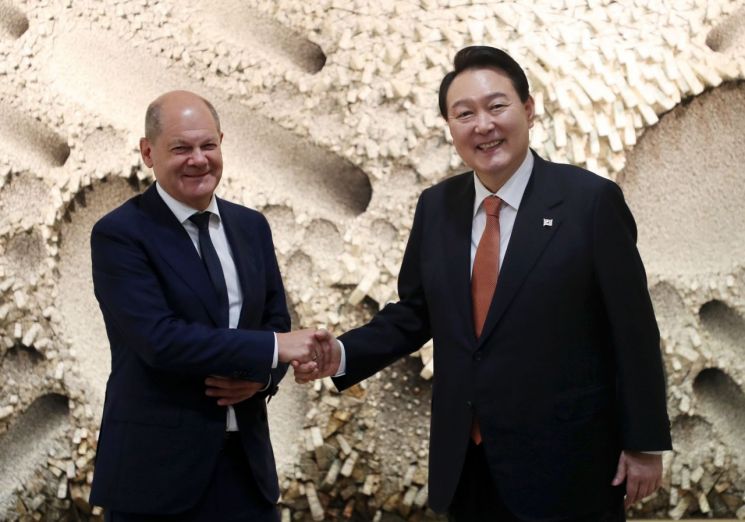 President Yoon Suk-yeol shakes hands with German Chancellor Olaf Scholz at the South Korea-Germany summit held at the South Korean Mission to the United Nations in New York, USA, on the 21st (local time). [Image source=Yonhap News]
Just before his visit to Hiroshima, President Yoon will hold a summit with Canadian Prime Minister Justin Trudeau, who is making an official visit to South Korea from the 16th to the 18th, on the 17th. After returning home, he will hold summits with German Chancellor Olaf Scholz on the 21st, European Union (EU) Council President Charles Michel, and European Commission President Ursula von der Leyen on the 22nd.
At the Korea-Canada summit, discussions will cover establishing international norms based on rules, including North Korean human rights issues, launching the 2+2 high-level economic and security dialogue, strengthening cooperation on critical minerals, and issues related to exchanges with future generations. With Germany, the largest economy in Europe, they will seek strategic solidarity to strengthen supply chain cooperation and economic security. At the Korea-EU summit, existing cooperation agreements such as the Framework Agreement, Free Trade Agreement (FTA), and crisis management agreement will be expanded to three new cooperation areas: green, health, and digital sectors.
Regarding speculation that the G8 could be formed based on this summit, a presidential office official said, "There were discussions about G10 during the Trump administration, and there are a few countries frequently invited. Such discussions are not simple. There is no exclusive discussion about adding just one country. However, if we proceed with principles, discussions may arise, but since Russia was expelled from the G8 after invading Ukraine in 2014, the G7 structure has continued. There are no ongoing discussions to change this."
In response to a reporter’s question about whether a document addressing food security issues will be adopted at the G7 Summit and whether discussions on food supply and overseas food hubs will take place, the official said, "Food security is a major topic in a separate session of the expanded meeting. Many leaders will discuss food and energy issues worsened by the Ukraine war. South Korea has contributed internationally so far and will make statements on future plans."
When asked if the Korea-U.S.-Japan summit will result in the establishment of a new consultative body, the official explained, "The trilateral joint statement from Phnom Penh last year specified North Korean missile warning information. In March, military officials from the three countries held working-level talks on sharing detailed North Korean nuclear and missile warning information and cooperation. At Hiroshima, rather than new agreements, the leaders will be briefed on ongoing matters and announce coordinated outcomes individually."
Regarding separate bilateral meetings with observer countries, the official said, "Germany and Canada among the G7 members have actively proposed direct visits to South Korea for a long time, and the EU also agreed to hold talks in Korea. Many other member and invited countries want to hold meetings in Hiroshima, but due to the tight schedule, it is difficult to find mutually convenient times. We expect separate bilateral meetings with about four countries."
In response to questions about reports that Samsung Electronics is investing 30 billion yen to build a semiconductor facility in Yokohama and may receive about 10 billion yen in subsidies from the Japanese government, and whether there have been discussions at the Korea-Japan government level and how it is evaluated, the official said, "The synergy between Japanese specialized companies in materials, parts, and equipment and Korean semiconductor manufacturing companies was agreed upon by the leaders. This seems to be a follow-up action plan to strengthen cooperation."
Regarding working-level consultations between South Korea and Japan for an on-site inspection of contaminated water in Fukushima, the official said, "A rough agreement has been reached on how to divide the schedule over three nights and four days and what topics to cover. Japan has been very cooperative so far. Further consultations will be held and announced later."
© The Asia Business Daily(www.asiae.co.kr). All rights reserved.
![Clutching a Stolen Dior Bag, Saying "I Hate Being Poor but Real"... The Grotesque Con of a "Human Knockoff" [Slate]](https://cwcontent.asiae.co.kr/asiaresize/183/2026021902243444107_1771435474.jpg)

















