Hanmac Investment & Securities Bankruptcy Trustee Korea Deposit Insurance Corporation
Lost Lawsuit Over 10 Billion Won Unjust Profits Against Overseas Investment Company
Also Lost Reimbursement Claim Lawsuit Filed by Korea Exchange
The Korea Deposit Insurance Corporation (KDIC), the bankruptcy trustee of Hanmaek Investment & Securities, which went bankrupt after incurring losses of approximately 46 billion won due to a derivative order error at the end of 2013, has lost a lawsuit against an overseas investment company that made gains of around 36 billion won after nine years.
KDIC also lost a 41.1 billion won subrogation claim lawsuit filed by the Korea Exchange (KRX), resulting in a large compensation payment.
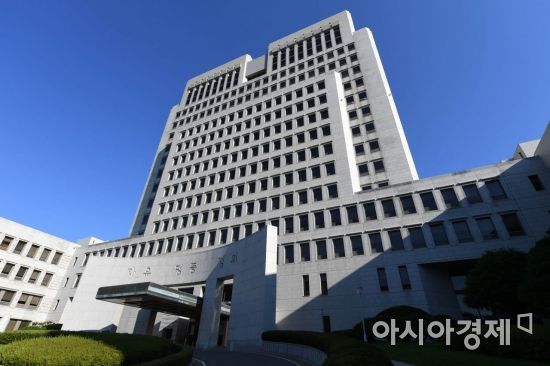
According to the legal community on the 14th, the Supreme Court's First Division (Presiding Justice Oh Kyung-mi) affirmed the lower court's ruling on the 27th of last month, which dismissed the appeal in the 10 billion won unjust enrichment refund claim lawsuit filed by Hanmaek Investment & Securities against the U.S. hedge fund Casia Capital.
Hanmaek Investment & Securities, which purchased the software license for the Korea Exchange's derivative financial product automated trading program in March 2013, suffered a loss of about 46.2 billion won on December 12 of the same year due to an error made by an employee entrusted with inputting variables for the software operation.
At that time, Hanmaek Investment & Securities placed derivative orders by inputting variables such as interest rates before the market opened, and after the market opened, automatic orders were executed according to the pre-entered conditions. However, the entrusted employee mistakenly entered the setting value for calculating the interest rate variable as 'remaining days/0' instead of 'remaining days/365,' resulting in a large number of orders that deviated significantly from the market transaction prices.
The software submitted unusual quotes by reviewing only the previous transaction quotes and the best bid quotes without setting the upper limit of the bid price and the lower limit of the ask price that should have been presented.
For example, the KOSPI 200 call option with an exercise price of 225 points could be sold at 32.5 points and bought at 34.55 points immediately after the market opened, but orders were placed to sell the call option at 0.51 points or buy it at 62.65 points.
Hanmaek Investment & Securities requested a settlement hold, claiming it was a transaction error, but the Korea Exchange paid the settlement amount to the counterparty from the joint compensation fund the next day. Although most firms returned the damages to Hanmaek Investment & Securities, Casia Capital in Singapore did not. After Hanmaek Investment & Securities' bankruptcy, the lawsuit was continued by KDIC as the bankruptcy trustee. KDIC filed a lawsuit claiming 10 billion won first from the 36 billion won profit Casia Capital gained.
KDIC argued primarily that the declaration of intention should be canceled due to error. They also claimed that Casia Capital's placing of about 100 orders at low prices, where transactions would be difficult to conclude logically, could be seen as 'predatory orders' intended to exploit the counterparty making erroneous orders. Alternatively, they argued that the declaration was invalid under civil law if the other party knew or could have known that the declaration was not the true intention.
However, the first and second instance courts rejected all these claims by KDIC.
The lower courts acknowledged that Hanmaek Investment & Securities' transaction proposal was made by mistake but ruled that it could not be canceled due to gross negligence.
Under Korean civil law, a declaration of intention made by mistake can be canceled if the mistake concerns an essential part of the legal act. However, cancellation is not allowed if the mistake is due to the declarant's gross negligence.
Meanwhile, the Supreme Court holds the position that cancellation is possible if the other party knew and exploited the mistake even when the mistake was due to the declarant's gross negligence.
The Supreme Court stated, "Article 109, Paragraph 1 of the Civil Act stipulates that a declaration of intention made by mistake due to the declarant's gross negligence cannot be canceled. However, this provision is intended to protect the interests of the other party. Therefore, if the other party knew and exploited the declarant's mistake, the declarant may cancel the declaration even if the mistake was due to gross negligence."
KDIC argued that Casia Capital placed four orders at every price level from the expected price range to induce price declines in stocks with presumably low trading volumes at the time of the accident, and placed about 100 orders at low prices where transactions would be difficult to conclude logically, which appeared to be 'predatory orders' exploiting the counterparty's erroneous orders. They emphasized that Casia Capital gained enormous profits exceeding 34 billion won by exploiting the mistake, thus lacking protection value.
However, the court did not accept these claims.
The court reasoned that Casia Capital submitted quotes before the market opened for a significant portion of the concluded trades, and that Casia Capital traded in the same manner before and after the incident, making it difficult to conclude that Casia Capital confirmed Hanmaek Investment & Securities' unusual quote submissions and then submitted corresponding orders.
The court also took into account Casia Capital's claim that the actions were part of an investment strategy to minimize losses in cases of unexpected sharp price fluctuations.
Regarding KDIC's alternative claim that the declaration was invalid due to lack of true intention, the court rejected it, stating, "Even considering KDIC's claim, it cannot be seen that Hanmaek Investment & Securities recognized the discrepancy between its intention and declaration when making the declaration in this transaction."
The Supreme Court also found no problem with the lower courts' judgment.
On the same day, the Supreme Court's Second Division (Presiding Justice Cho Jae-yeon) dismissed KDIC's appeal in the subrogation claim lawsuit filed by the Korea Exchange against KDIC as the bankruptcy trustee of Hanmaek and affirmed the lower court's ruling in favor of the plaintiff.
In March 2014, the Korea Exchange filed a lawsuit against KDIC, which manages Hanmaek Investment & Securities' bankruptcy assets, claiming subrogation of 41.1 billion won, which is the amount paid on behalf of Hanmaek minus the joint compensation fund deposited by Hanmaek with the exchange.
KDIC filed a counterclaim seeking 6 billion won in damages, arguing that the Korea Exchange was negligent in market surveillance and management.
The key issue in this trial was whether the transaction by Hanmaek Investment & Securities could be canceled due to error, given that it was caused by gross negligence.
The first and second instance courts, like the unjust enrichment refund claim trial, found that Hanmaek Investment & Securities was grossly negligent and ruled that KDIC must pay the subrogation to the Korea Exchange. However, they dismissed KDIC's damage claim.
The Supreme Court reached the same conclusion.
The appellate court for the two cases stated, "When determining whether the counterparty or its agent in derivative transactions on the Korea Exchange's derivative market knew and exploited the declarant's mistake, it is necessary to comprehensively consider the method of price determination and contract conclusion in the derivative market, the market situation and trading practices at the time, trading volume, specific transaction forms between the parties, and the sequence of quote submissions. It is not sufficient to conclude that the counterparty knew and exploited the mistake solely because the declarant's quotes were unusual compared to the market price at the time."
A Supreme Court official explained the significance of this ruling, saying, "This is the first ruling to establish the standard for determining whether the counterparty in derivative transactions knew and exploited the declarant's mistake."
These two cases took nine years and two months from the filing of the first instance complaints in March 2014 to the Supreme Court's final ruling on April 27, 2023. Notably, the Supreme Court's appellate hearings, which began in May and June 2017, alone took six years.
© The Asia Business Daily(www.asiae.co.kr). All rights reserved.
![Clutching a Stolen Dior Bag, Saying "I Hate Being Poor but Real"... The Grotesque Con of a "Human Knockoff" [Slate]](https://cwcontent.asiae.co.kr/asiaresize/183/2026021902243444107_1771435474.jpg)















