"Lovebug" Large-Scale Appearance Reminiscent
"Naturally Disappears After Mating Season Passes in May-June"
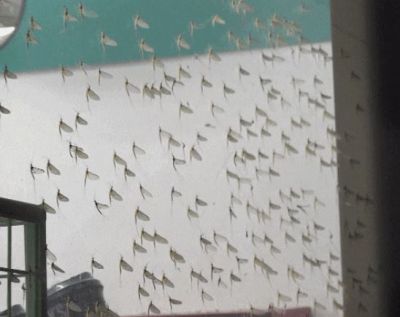
Recently, swarms of mayflies have gathered in the Seongsu-dong area of Seongdong-gu, Seoul, causing distress among residents.
According to Seongdong-gu Office on the 12th, a large number of Oriental mayflies have appeared in the Seongsu-dong and Eungbong-dong areas near the Han River since the beginning of this month.
Oriental mayflies are aquatic insects that inhabit clean waters such as second-grade or higher rivers. Their mouths are degenerated, so they cannot bite and do not transmit infectious diseases. However, since their wingspan reaches 4 to 5 cm and they swarm in groups, residents are complaining about the inconvenience.
Due to their preference for bright light, they seem to be particularly attracted to the Seongsu-dong area, where local businesses have recently developed significantly and bright lighting has increased. Besides Seongsu-dong, they have been observed annually in areas around the Namhan River, such as Namyangju-si, Gyeonggi-do.
However, there are limits to local government pest control efforts. The Han River basin, where larvae live, is a water source protection area, making pesticide spraying difficult. Therefore, pest control operations are being carried out mainly in grassy areas and residential neighborhoods near the Han River border.
This situation recalls the Love Bug (Cinnamon Woolly Fly) outbreak that covered Eunpyeong-gu, Seoul, in June and July last year. After a spring drought continued and the rainy season began, an environment suitable for 'emergence' was created, causing larvae to simultaneously become adults and swarms of woolly flies to appear in the city. Woolly fly larvae require a hot and humid environment to emerge as adults.
The Cinnamon Woolly Fly is closer to a beneficial insect than a pest. It does not transmit diseases or harm crops, and since it feeds on floral nectar from various plants, it actually helps pollinate flowers.
At that time, despite numerous complaints from residents about the large-scale appearance of woolly flies being unsightly, local governments worked hard on pest control. However, many experts believed pest control was unnecessary because woolly flies lose activity when exposed to sunlight and naturally disappear gradually after the rainy season.
The Oriental mayflies spreading in the Seongsu-dong area are also expected to disappear naturally. Since mayflies have a lifespan of only 4 to 5 days, they are predicted to naturally vanish after their mating season in May and June.
Seongdong-gu Office advised, "Oriental mayflies like bright lights, so please minimize lighting brightness after 8 p.m., and if unavoidable, use yellow-toned lights or sodium lamps. Install mosquito nets or screens to prevent them from entering indoors, and if they stick to windows or glass, spraying water with a sprayer will cause them to fall off weakly."
© The Asia Business Daily(www.asiae.co.kr). All rights reserved.

















