"The market will be thrown into panic even by the mere prospect of default."
As concerns grow that the U.S. federal government could face an unprecedented default as early as June, warnings are pouring in from various quarters. Jamie Dimon, chairman of JP Morgan Chase, known as the "Emperor of Wall Street," revealed that he is operating a so-called "war room" in preparation for the possibility of default. The International Monetary Fund (IMF) also predicted that it would have very serious repercussions on the global economy.
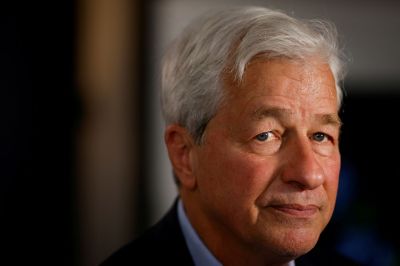
In an interview with Bloomberg TV on the 11th (local time), Dimon said that if the U.S. federal government’s debt ceiling is not raised and a default occurs, it would be a "potential disaster" for the United States. He expressed optimism that the "worst-case scenario" could be avoided as the U.S. Congress responds to growing default concerns. However, he warned that as the so-called X-day, when the federal government’s cash reserves run out, approaches, "volatility in the stock and bond markets will increase, leading to panic."
The U.S. exhausted its $31.4 trillion debt ceiling in January and has been holding on through special measures by the Treasury Department, but these are also nearing their limits. The X-day proposed by Treasury Secretary Janet Yellen, urging a debt ceiling increase, is June 1. Dimon agreed with Yellen’s warning that economic damage will occur before the X-day default. He expressed concern that it would "affect contracts, collateral, and settlements, and impact customers worldwide."
JP Morgan, the largest asset holder, is already preparing for the risk of default. Dimon explained that JP Morgan convenes weekly war room meetings to prepare for the possibility of default and will hold daily meetings starting around the 21st. As X-day approaches, emergency meetings will be expanded to three times a day. He reiterated his urgent call for Congress to quickly reach an agreement on raising the debt ceiling, saying that even the thought of the country falling into default inevitably causes negative effects.
The IMF also warned of the serious impact this crisis could have on the global economy. IMF spokesperson Julie Kozack said at a briefing that "if the U.S. defaults, it would have very serious effects not only on the U.S. but also on the global economy, including the possibility of increased borrowing costs," and urged "all parties to urgently resolve this issue."
Experts are particularly noting that this debt ceiling standoff is occurring at a time when the economy is vulnerable due to the Federal Reserve’s rapid tightening. Earlier this month, the White House Council of Economic Advisers released an economic damage scenario from a default, estimating that if it lasts more than three months, the stock market could plunge 45% and up to 8.3 million jobs could be lost. Moody’s also warned that GDP could shrink by 4% and 6 million jobs could be lost. Even a short-term default is expected to negatively affect more than 2 million jobs.
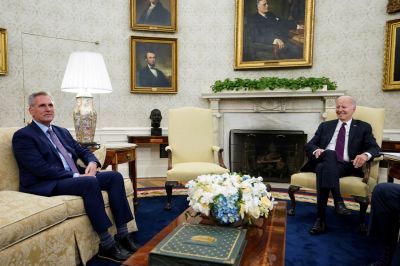 President Joe Biden of the United States and Kevin McCarthy, Speaker of the House from the Republican Party
 [Image source=Reuters Yonhap News]
Earlier, President Joe Biden met with congressional leaders including House Speaker Kevin McCarthy but failed to find a breakthrough. The Republicans are demanding large government spending cuts as a precondition, while President Biden and the Democrats insist on a debt ceiling increase without conditions, continuing the standoff. They are scheduled to meet again on the 12th, but expectations for a solution at that meeting are low. Ultimately, even if the worst default is avoided, uncertainty will escalate until the last moment, inevitably harming the overall market.
Amid growing concerns over default risk, worries stemming from regional banks have not subsided. On this day, PacWest Bancorp announced that deposits fell 9.5% last week, causing regional bank stocks to plunge across the New York Stock Exchange. PacWest immediately announced it could provide $15 billion in liquidity support, but the already ignited concerns have not eased. PacWest’s deposits fell 16.9% in the first quarter, with most withdrawals occurring after reports about PacWest’s potential sale surfaced.
On this day, Dimon commented on the banking crisis following the Silicon Valley Bank (SVB) incident, saying that "regional banks are strong," but he still expressed concern about the possibility of large-scale bank runs. Having decided to acquire First Republic Bank, Dimon said, "We have to assume the regional banking crisis will continue for a while." The IMF also advised that the U.S. should not let its guard down regarding new vulnerabilities in the U.S. banking sector, including regional banks, as it transitions to a high-interest-rate era.
© The Asia Business Daily(www.asiae.co.kr). All rights reserved.
![Clutching a Stolen Dior Bag, Saying "I Hate Being Poor but Real"... The Grotesque Con of a "Human Knockoff" [Slate]](https://cwcontent.asiae.co.kr/asiaresize/183/2026021902243444107_1771435474.jpg)

















