FDA-Approved Treatments Emerging One After Another
But May Be Difficult to Achieve Effectiveness Unless Early Stage Patient
Expensive and Inconvenient Tests... Blood Diagnostics Gaining Attention as Alternatives
Developed by PeopleBio, Quantamatrix, Imocog, and Others
The emergence of innovative treatments is increasing the possibility of conquering dementia. However, the currently available treatments have been developed for early-stage dementia patients, so if the diagnosis is missed, there is a high risk of missing the treatment window as well. Accordingly, the diagnostic market is also expected to grow rapidly, and technologies that can easily check for dementia through blood tests are being developed one after another in Korea.
Recently, the U.S. Food and Drug Administration (FDA) approved 'Aduhelm' (generic name aducanumab), jointly developed by Biogen and Eisai last year, followed by 'Leqembi' (generic name lecanemab), also developed by them. In addition, 'Donanemab,' developed by Eli Lilly, recently succeeded in clinical trials by delaying cognitive and daily living ability decline by 35% in phase 3 trials, raising expectations for its approval.
The problem is that these antibody treatments are intended for early-stage dementia patients, including mild cognitive impairment (MCI), which is a pre-dementia stage. This is because the accumulation of amyloid beta (Aβ) protein is currently the most strongly suspected mechanism of dementia. It is explained that as Aβ accumulates, oxidative stress and neuroinflammation occur, affecting brain cells and causing dementia. However, these treatments only remove Aβ, and if excessive accumulation has already begun to destroy brain cells, they cannot reverse the damage. Therefore, there are concerns that if the disease has already progressed to severe dementia, the efficacy of the treatments may not be properly manifested.
Accordingly, alongside the blossoming dementia treatment market, the importance of early diagnosis is also emerging. It is because confirming the onset in the early stages of symptoms quickly and using medication timely is necessary to see proper effects. Accordingly, global market research firm Inkwood Research has forecasted that the dementia diagnostic market will grow from $1.598 billion in 2020 at an average annual growth rate of 4.5%, reaching $1.989 billion (approximately 2.65 trillion KRW) by 2025.
Currently, dementia diagnostic methods mainly use positron emission tomography (PET) or cerebrospinal fluid tests. However, PET is a non-reimbursed item, so patients have to bear costs exceeding 1 million KRW. Cerebrospinal fluid tests cost about 500,000 KRW, roughly half the price, but obtaining samples is difficult and causes significant discomfort to patients.
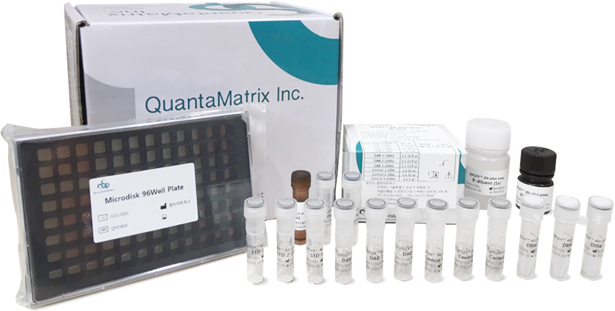 Quantamatrix's Alzheimer's Disease Blood Diagnostic Technology 'QPLEX Alz Plus Assay'
 [Photo by Quantamatrix]
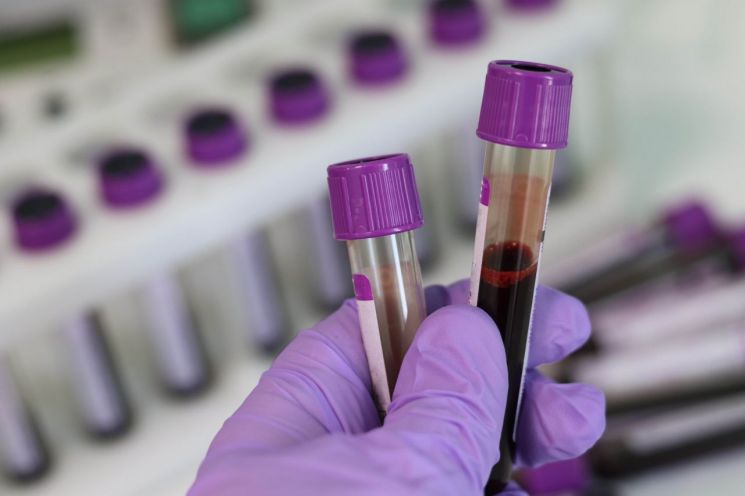
Recently, techniques for diagnosing Alzheimer's disease through blood tests have been developed, attracting attention. Cases of dementia treatment developers partnering with diagnostic companies to create synergy with diagnostics are also increasing. Lilly is collaborating with Roche, and Eisai is cooperating with Sysmex on blood diagnostic technologies. In Korea, PeopleBio, Quantamatrix-Medipron, and Imocog are developing and commercializing blood-based diagnostic technologies. By analyzing blood samples to measure Aβ, a major biomarker of dementia, the price is significantly lower at around 100,000 KRW compared to existing tests, and convenience is also improved.
PeopleBio launched the Alzheimer's blood diagnostic brand 'AlzOn' last year and has already commercialized it. They claim to have confirmed 100% sensitivity and 92% specificity in clinical trials. They are also promoting expansion into overseas markets such as Japan and the United States. The company's sales have grown rapidly, achieving 4.4 billion KRW in annual sales last year and aiming for 10 billion KRW this year.
Quantamatrix, together with dementia treatment developer Medipron, expanded biomarkers beyond Aβ to include galectin-3 binding protein (LGALS3BP), angiotensin-converting enzyme (ACE), periostin, and others, analyzing combinations of these proteins to improve accuracy. Their 'QPLEX Alz plus assay' was approved by the Ministry of Food and Drug Safety in 2020. Additionally, they have enhanced speed by performing large-scale tests through fully automated dedicated testing equipment. They are currently preparing for commercialization through new medical technology evaluation.
Digital therapeutic device (DTx) developer Imocog is developing the blood-based 'Cogcheck' alongside the digital-based non-face-to-face early screening tool 'Cogscreen.' Noh Yooheon, co-CEO of Imocog, explained, "Cogcheck is currently at the development completion stage," adding, "We are preparing for validation through clinical trials." Imocog also plans to provide solutions covering the entire dementia-related cycle from diagnosis to treatment by developing DTx 'Cogthera' and diagnostic tool 'Cognosis' together.
© The Asia Business Daily(www.asiae.co.kr). All rights reserved.
![Clutching a Stolen Dior Bag, Saying "I Hate Being Poor but Real"... The Grotesque Con of a "Human Knockoff" [Slate]](https://cwcontent.asiae.co.kr/asiaresize/183/2026021902243444107_1771435474.jpg)
















