Existing precedent "Changes without worker consent allowed if rationality recognized by social norms"
En Banc "Validity cannot be recognized solely because of rationality"
The Supreme Court en banc has ruled that employment rules such as abolishing monthly leave for Hyundai Motor Company managers at the assistant manager level and above and setting a cap on annual leave days are invalid without the workers' "collective consent."
Previously, the en banc had recognized the application of employment rules even if they were created or changed without collective consent and resulted in less favorable working conditions for workers, provided that the creation or change of such rules was deemed socially reasonable.
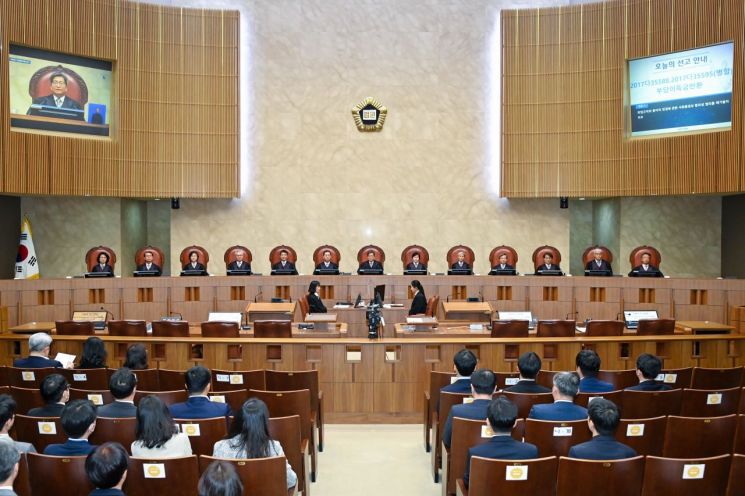 Chief Justice Kim Myung-soo and the Supreme Court justices are seated in the Grand Bench of the Supreme Court in Seocho-gu, Seoul, on the afternoon of the 11th for the plenary session ruling. Photo by Supreme Court
On the 11th, the Supreme Court en banc (Presiding Justice Oh Kyung-mi) overturned the lower court's ruling in part in the appeal trial of an unjust enrichment refund lawsuit filed by Hyundai Motor managers against the company and remanded the case to the Seoul High Court.
When the revised Labor Standards Act, which shortened the statutory working hours to 40 hours per week and introduced a five-day workweek, was enforced in 2003, Hyundai Motor separately created and implemented employment rules from July 2004 applicable to general staff at the assistant manager level and above, senior researchers in research positions, and chief workers in production positions.
The new employment rules included provisions such as abolishing monthly leave and setting a cap on annual leave days. Hyundai Motor obtained consent from 89% of the managers when creating these rules but did not obtain consent from the Hyundai Motor Labor Union, the majority union.
In response, some managers filed a lawsuit claiming unpaid annual and monthly leave allowances, arguing that the employment rules were invalid due to the lack of union consent during the amendment process and that the changes were disadvantageous.
The first trial court ruled against the plaintiffs, stating that managers could directly claim unpaid annual and monthly leave allowances under the previous employment rules, so unjust enrichment was not established.
However, the second trial court partially accepted the plaintiffs' claims, ruling that since collective consent was not obtained and social reasonableness was not recognized, the parts of the employment rules related to annual and monthly leave constituted disadvantageous changes.
The en banc changed the previous precedent, which allowed employers to create or change employment rules disadvantageously to workers without their consent if social reasonableness was recognized.
The en banc ruled, "If an employer changes employment rules disadvantageously to workers without obtaining their collective consent, the validity of such rules cannot be recognized solely on the grounds of social reasonableness unless there are special circumstances indicating that the labor union or workers abused their collective consent rights."
It added, "The concept of social reasonableness in previous precedents is not definitive, and it is difficult for parties to know when social reasonableness is recognized. Legal disputes over the effectiveness of employment rule changes continue, causing legal instability, and such changes should be made through the employer's persuasion and efforts to obtain workers' consent."
In changing the precedent, the en banc also presented the doctrine on abuse of collective consent rights. It stated that "abuse of collective consent rights occurs when the necessity of changing employment rules is objectively clear, the employer has made sincere efforts to persuade workers to obtain collective consent, but the workers oppose the change without reasonable grounds or reasons."
On the other hand, Justices Cho Jae-yeon, Ahn Cheol-sang, Lee Dong-won, Noh Tae-ak, Chun Dae-yeop, and Oh Seok-jun issued separate opinions opposing the majority view that "the previous precedent, which the Supreme Court has long recognized as valid, remains valid and should be maintained." They argued that legal stability and predictability are secured, and the precedent has been trusted by society for a long time, making it difficult to accept the need to change the previous precedent.
© The Asia Business Daily(www.asiae.co.kr). All rights reserved.
![Clutching a Stolen Dior Bag, Saying "I Hate Being Poor but Real"... The Grotesque Con of a "Human Knockoff" [Slate]](https://cwcontent.asiae.co.kr/asiaresize/183/2026021902243444107_1771435474.jpg)















