Office of Assemblyman Kwon Chil-seung Promotes Company Law Legislation
Ministry of Justice Also Agrees on Improving Corporate Regulations
Legislation is being promoted to reorganize company-related laws, which are currently dispersed across various special laws in addition to the Commercial Act, into a unified "Company Act." As Kwon Chil-seung, a member of the Democratic Party of Korea, pushes for the enactment of the Company Act, the Democratic Party leadership also appears to agree, emphasizing the need to improve the corporate environment. The Ministry of Justice, which oversees the Commercial Act, has also expressed sympathy with the awareness of the problem that the current situation of mixed corporate regulations needs improvement, drawing attention to whether it will accelerate related legislation.
On the 11th, a "Discussion Forum on the Enactment of the Company Act for Enhancing National Competitiveness" was held at the National Assembly Members' Office Building, hosted by Representative Kwon. Currently, South Korea's company-related laws are dispersed with the Commercial Act as the basic framework, alongside the Capital Markets Act, the External Audit Act, the Venture Business Act, and others. On this day, Representative Kwon stated, "While regulations on governance are in the Commercial Act, regulations on financial management are in the Capital Markets Act, resulting in a dual legal system and naturally divided overseeing ministries. It is difficult to maintain consistency and coherence when promoting legislative policies or amendments related to companies. For these reasons, amending the Company Act is not easy, making it difficult to respond flexibly to the rapidly changing economic environment, and there is a significant gap between reality and the law, as voiced by academia and the field."
The forum continued with criticisms of the current Commercial Act-centered company law system. Hwang Hyun-young, a research fellow at the Korea Capital Market Institute, pointed out, "The current structure of the Commercial Act prioritizes limited partnerships (unified organizations composed of two or more unlimited partners), which account for only 0.1%, and requires joint-stock companies, which make up 95.1%, to follow the regulations for limited partnerships. The Commercial Act has the character of a fundamental law, making it difficult to amend in response to changes in the economic environment, and there are problems with the enactment of various special laws and the application of laws."
He noted, "For example, the Commercial Act requires a two-week prior notice for third-party allotment of new shares, but the Capital Markets Act substitutes this with a one-week prior disclosure. The Commercial Act allows business opportunity usurpation through board resolution, but the Fair Trade Act prohibits it and even includes criminal penalties." Due to differences in legal provisions and coherence issues, companies inevitably face difficulties.
Regarding this, Researcher Hwang proposed a phased direction for legal amendments. He argued, "Separate the company chapter from the Commercial Act and legislate it independently, reorganize the company chapter focusing on joint-stock companies, and incorporate the special provisions for listed companies from the Capital Markets Act into the Company Act." He added, "In the long term, governance, finance, and merger and acquisition (M&A) regulations should be revised, and special laws such as the External Audit Act should also be reviewed, along with reconsidering the distribution of overseeing ministries and standing committees." The idea is to first create the Company Act, then expand its scope and resolve sensitive issues such as overseeing ministries.
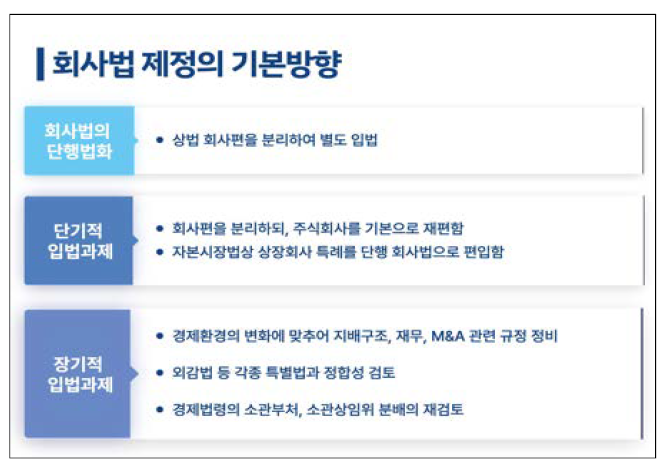 Excerpt from the presentation paper by Hyunyoung Hwang, Research Fellow at the Korea Capital Market Institute
The Democratic Party leadership also expressed agreement with Representative Kwon's awareness of the need to organize corporate-related laws and create a Company Act. Lee Jae-myung, the leader of the Democratic Party, said in a congratulatory speech, "Especially since the Commercial Act is a 'fundamental law' and difficult to amend, corporate operation laws are dispersed. There is a need to organize a unified system of the Company Act that keeps pace with the changing corporate environment." Kim Min-seok, chairman of the Democratic Party Policy Committee, explained, "As the economic environment changes, individual laws such as the Capital Markets Act and the External Audit Act have been enacted to regulate accordingly, but since they are managed separately under various laws, there are inefficiencies in enforcement and obstacles to actual corporate activities. As the chairman of the Democratic Party Policy Committee, I will continue to consider creating good systems that allow Korean entrepreneurs to engage in more innovative corporate activities."
The Ministry of Justice also cautiously showed sympathy for the discussion on enacting the Company Act. Han Dong-hoon, Minister of Justice, said in a congratulatory speech, "Regulations on corporate organization and operation are scattered across the Commercial Act and various other laws, and frequent amendments depending on policy situations have led to a lack of consistency and coherence, causing confusion among the public. Today's forum will be a good opportunity to share diverse perspectives and opinions on the necessity and importance of a single Company Act."
Jung Sung-doo, a prosecutor from the Ministry of Justice's Commercial Law Division who participated as a panelist, said, "Since the 2009 amendment of the Commercial Act and the enforcement of the Capital Markets Act, special provisions for listed companies have been dually stipulated in the Commercial Act and the Capital Markets Act, raising issues of coherence, mixed regulatory and judicial provisions, and confusion in interpretation and application in corporate practice." He added, "I agree with the purpose of integrating Company Act provisions to improve systematic coherence." However, Prosecutor Jung also noted, "Considering that related policies have been carried out by dividing ministries over the past several decades, we must also consider whether there are any concerns if a single Company Act is enacted without sufficient review."
Representative Kwon's office, which prepared this forum, said, "Based on experts' opinions, we plan to propose a bill to reorganize the existing dispersed laws into a single fundamental law to improve the efficiency of the current legal system concerning listed companies." They added, "We are preparing the bill with the goal of proposing it around July."
© The Asia Business Daily(www.asiae.co.kr). All rights reserved.
![Clutching a Stolen Dior Bag, Saying "I Hate Being Poor but Real"... The Grotesque Con of a "Human Knockoff" [Slate]](https://cwcontent.asiae.co.kr/asiaresize/183/2026021902243444107_1771435474.jpg)
















