Operation of Dedicated Teams, Expansion of Radiation Testing, and Special Inspections, etc.
Gyeongsangnam-do announced a fisheries safety management plan on the 11th ahead of Japan's Fukushima nuclear power plant contaminated water discharge.
Gyeongnam Province stated that it is strengthening radioactive inspections of seafood at the production, shipment, and distribution stages.
According to the announcement, Gyeongnam Province is operating a dedicated organization for contaminated water discharge, including establishing a seafood safety officer in the Marine and Port Department.
At the Seafood Safety Management Center of the Fisheries Safety Technology Institute, which opened in September 2021, more than 1,000 radioactive inspections of seafood at the production stage, including aquaculture and catch, are planned to be conducted this year alone.
The number of radioactive analysis devices will be expanded from one to four, and the number of specialists will be increased from one to three, increasing the amount of radioactive inspections for iodine, cesium, and others.
The posting frequency of results on the provincial website will be shortened from once a week to twice a week to provide seafood safety information.
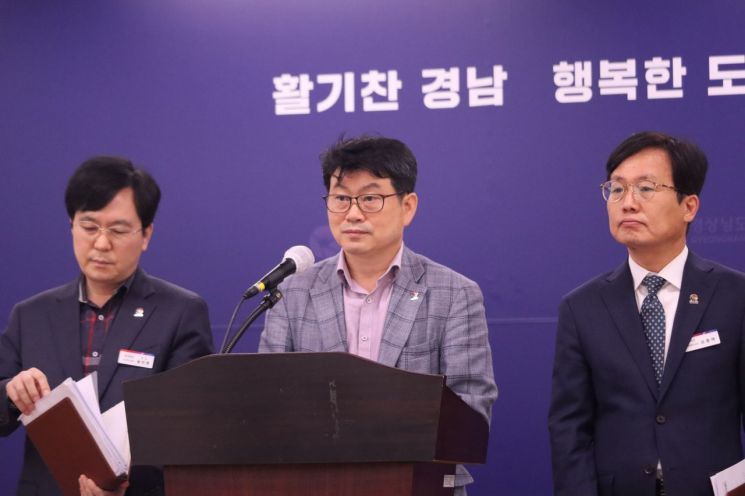 Kim Je-hong, Director of the Marine and Fisheries Bureau of Gyeongnam Province (center), is listening attentively to the questions from reporters attending the briefing.
 [Photo by Lee Se-ryeong]
Through recommendations from the Ministry of Oceans and Fisheries and the Nuclear Safety and Security Commission, the number of radioactive material investigation points has been expanded from five to eight, and radioactive investigations on seawater, sediment, and marine organisms are underway.
To strengthen radioactive monitoring of seafood at the shipment stage, portable radioactive measurement devices were provided to 10 Suhyup auction sites, the first among metropolitan local governments.
The Provincial Health and Environment Research Institute is responsible for conducting radioactive inspections on 10 seafood items at the distribution stage.
Imports of seafood from Fukushima and seven other neighboring prefectures in Japan are completely banned.
Additionally, since January this year, the number of seafood items subject to import distribution history reporting has expanded from 17 to 21, and starting in July, five items?sea squirt, yellowtail, scallop, abalone, and flatfish?will be added to the list of items requiring origin labeling at restaurants, making a total of 20 items.
The province will conduct focused inspections by verifying the distribution history of imported seafood by period and will carry out special intensive inspections on Japanese imported seafood for two months from May to June, following April.
A seafood radioactive inspection observation event involving production groups, consumer groups, media personnel, and residents will also be held.
Kim Je-hong, Director of the Marine and Fisheries Bureau, said, “To minimize the decrease in seafood consumption caused by the marine discharge of radioactive contaminated water from the Fukushima nuclear power plant, it is necessary to provide accurate information so that residents can consume seafood with confidence,” adding, “We will create a seafood consumption environment that consumers can trust through thorough seafood safety management and active communication.”
© The Asia Business Daily(www.asiae.co.kr). All rights reserved.
![Clutching a Stolen Dior Bag, Saying "I Hate Being Poor but Real"... The Grotesque Con of a "Human Knockoff" [Slate]](https://cwcontent.asiae.co.kr/asiaresize/183/2026021902243444107_1771435474.jpg)















