The fee negotiation to determine next year's long-term care benefit costs has begun. The outcome is attracting attention as the level of fee increase announced this month will also affect the rise in health insurance premiums, which exceeded 7% for the first time last year.
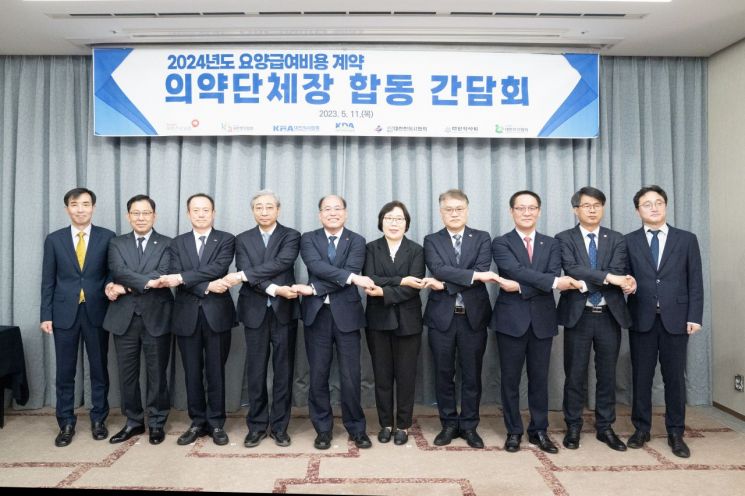 The National Health Insurance Service announced on the 11th that it held a meeting with the heads of six medical organizations at the Garden Hotel in Seoul. From the left, Sang-il Lee, Executive Director of Benefits at the Service; Kwang-hoon Choi, President of the Korean Pharmaceutical Association; Tae-geun Park, President of the Korean Dental Association; Dong-seop Yoon, President of the Korean Hospital Association; Hyeon-jaeryong, Acting Director of the Service; Soon-ok Lee, President of the Korean Midwives Association; Bong-cheon Kim, Vice President of External Cooperation of the Korean Medical Association; Ju-ui Hong, President of the Korean Oriental Medical Association; Nam-hoon Kim, Senior Director of Benefits Innovation at the Service; Jong-heon Park, Director of Big Data Operations at the Service, are posing for a commemorative photo. Photo by National Health Insurance Service
The National Health Insurance Service (NHIS) announced on the 11th that it met with heads of medical organizations regarding the 2024 long-term care benefit cost contracts at the Garden Hotel in Mapo-gu, Seoul.
Present at the meeting were Yoon Dong-seop, President of the Korean Hospital Association; Park Tae-geun, President of the Korean Dental Association; Hong Ju-ui, President of the Korean Oriental Medicine Association; Choi Kwang-hoon, President of the Korean Pharmaceutical Association; Lee Soon-ok, President of the Korean Midwives Association; and Kim Bong-cheon, Vice President of External Cooperation, attending on behalf of Lee Pil-su, President of the Korean Medical Association. They were joined by Hyeon Jae-ryong, Acting President (Planning Executive Director) of NHIS, and Lee Sang-il, Executive Director of Benefits, among others, to exchange opinions.
The NHIS plans to utilize models and negotiation structure improvement measures that can serve as objective criteria for setting fee adjustment rates, reflecting the demands for system improvements raised so far, after gathering opinions from subscribers, providers, and experts.
First, the NHIS intends to diversify fee adjustment models so that the current healthcare status and economic conditions are reflected and fee bands can be set objectively. Along with the existing 'Sustainable Growth Rate (SGR) model,' four improved models including the Gross Domestic Product (GDP) model will be used to calculate results, which will then be presented to the Finance Subcommittee responsible for deciding the fee bands.
In addition, regarding the negotiation process, the NHIS plans to move away from the customary overnight negotiations by advancing the meeting time of the Finance Subcommittee held on the legal deadline day, the 31st, and to facilitate communication between providers and subscribers by arranging a meeting among providers, subscribers, and the NHIS soon after discussions with the Finance Subcommittee members.
Hyeon Jae-ryong, Acting President of NHIS, stated, “We will strive to find a reasonable balance by comprehensively considering the establishment of an essential medical system that allows all citizens to receive treatment within the golden time anytime and anywhere, maintaining medical infrastructure to guarantee the life and safety of the people against new infectious diseases, and the impact of fee increases on insurance premium burdens amid difficult economic conditions. We ask for the understanding and active cooperation of the organization heads.”
The full-scale negotiations are scheduled to begin next week, and the contract is expected to be concluded by the 31st in accordance with the legal deadline set by the National Health Insurance Act.
© The Asia Business Daily(www.asiae.co.kr). All rights reserved.

















