Professor Jaehoon Jeong of Gachon University MBC Radio Interview
"Ending Infectious Diseases is Impossible... Deaths Will Continue"
As the government has virtually declared the end of the COVID-19 pandemic (a global outbreak of infectious disease), Professor Jaehoon Jeong of Gachon University’s Department of Preventive Medicine said that the meaning of the 'end declaration' is "an expression that the situation has improved much more than before and that society has developed some capacity to respond."
Professor Jeong appeared on MBC Radio's "Kim Jong-bae's Focus" on the 11th and explained, "In the face of an infectious disease crisis, declaring an end is almost impossible. The virus continues to remain, and deaths and critically ill patients continue to occur."
He added, "COVID-19 will continue to rise and fall about twice a year. These are what we call regular outbreaks, and this is the new form of endemic (periodic infectious disease outbreaks). The number of confirmed cases may rise or fall slightly, but the most important point is that 'society is sufficiently prepared to respond.'"
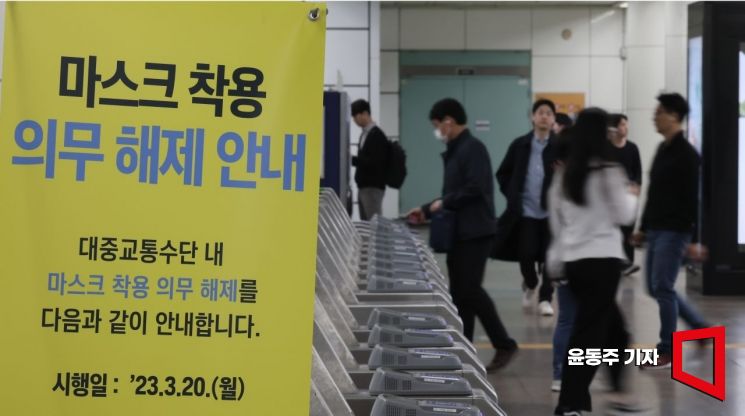 On the 11th, when the COVID-19 crisis alert level was lowered from "Severe" to "Alert" and the mandatory 7-day quarantine for confirmed cases was changed to a recommendation, effectively declaring the end of COVID-19, a notice about lifting the mask mandate was posted at the ticket gate of Gwanghwamun Station in Seoul. Photo by Dongju Yoon doso7@
Regarding the recent decision by the World Health Organization (WHO) to lift the Public Health Emergency of International Concern (PHEIC), he said, "Such decisions involve various factors, but the most representative is how well-prepared the means to respond are," adding, "For COVID-19, oral treatments are available, and vaccines are sufficiently supplied."
He continued, "The most important thing is that COVID-19 was once an unknown infectious disease, but now it has become one of the most researched infectious diseases," and "So it is no longer an unknown risk."
Concerning the lifting of the '7-day isolation requirement for confirmed cases,' Professor Jeong expressed concern that some people might not be able to rest even when sick. He said, "Our society has not well established a culture of resting when ill," and "The isolation requirement legally guaranteed rest in a way. However, when the isolation requirement changes from a legal obligation to a recommendation, some inconveniences are expected in this regard."
He added, "When the legal obligation existed, some livelihood and living supports were provided," and "The continued reduction of such supports will inevitably pose various threats to infectious disease response in the long term."
Furthermore, Professor Jeong stated, "New infectious diseases will continue to emerge," emphasizing the need to evaluate and reflect on the policies implemented during the past three years of COVID-19.
He said, "Currently, among the OECD countries, we have become one of the countries with the lowest trust in vaccination. The experiences of the people over the past three years are a significant obstacle to responding to the next pandemic."
Professor Jeong added, "Especially regarding whether people will actively participate if social distancing is applied again, or what the meaning of mask mandates will be in the next pandemic, we need to carefully review what happened over the past three years and establish scientific evidence."
© The Asia Business Daily(www.asiae.co.kr). All rights reserved.
![Clutching a Stolen Dior Bag, Saying "I Hate Being Poor but Real"... The Grotesque Con of a "Human Knockoff" [Slate]](https://cwcontent.asiae.co.kr/asiaresize/183/2026021902243444107_1771435474.jpg)















