The government has effectively declared COVID-19 as an endemic by lowering the crisis alert level from 'Severe' to 'Warning' and is analyzing the impact of policies over the past 3 years and 4 months while strengthening future health crisis response capabilities.
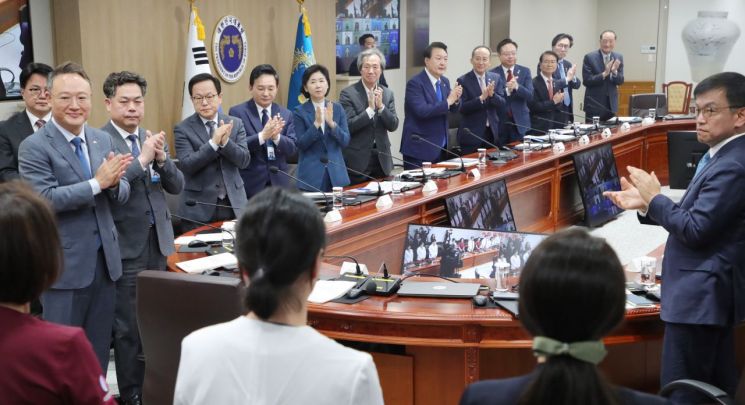 President Yoon Suk-yeol is applauding doctors, nurses, and nursing assistants who have been active on the front lines of COVID-19 prevention at the Central Disaster and Safety Countermeasures Headquarters meeting held on the 11th at the Yongsan Presidential Office building in Seoul.
 [Image source=Yonhap News]
The Central Disaster and Safety Countermeasures Headquarters (CDSCH) announced on the 11th that it received and discussed the 'Post-COVID-19 Whole-of-Government Policy Task Establishment Plan' from the Ministry of Health and Welfare.
Since the outbreak of COVID-19 in 2020, the government has implemented various measures to minimize damage. The establishment of this policy task plan is being carried out as conditions have been created to manage COVID-19 at an endemic level, analyzing the impacts so far, evaluating government policies, and expanding future health crisis response capabilities, the CDSCH explained.
Evaluations in each sector were also disclosed. First, in the medical response sector, a large number of confirmed cases caused an overload on the medical system. The government self-assessed that it responded with scientific quarantine measures based on expert consultations and introduced new systems such as temporary non-face-to-face medical treatment; however, it noted inadequacies in the regional medical response system and inefficiencies in securing hospital beds through compensation for losses, suggesting the need to establish a regionally self-contained medical system.
In the social and employment sector, income inequality and a decline in employment rates were observed, along with new social issues such as care gaps. Accordingly, the government strengthened public responsibilities such as income support and emergency care, and supported employment stability. However, it evaluated that some cash support effects were temporary and care blind spots still remain, indicating the need for improvements in income security systems and enhancement of care sustainability in the future.
In the economic and industrial sector, the economy contracted more than during the 2009 global financial crisis, and damage persisted in certain classes and industries. The government has provided loss compensation funds through fiscal support. The need to promote the establishment of a permanent safety net for small business owners in preparation for future health crises has increased.
Based on these evaluations, the government plans to announce policy tasks through consultations with related ministries and expert advice centered on the Central Accident Response Headquarters. Minister of Health and Welfare Cho Kyu-hong said, "We will analyze the impact COVID-19 has had on various sectors of society and the policies implemented over the past three years to identify tasks," adding, "By discovering and implementing whole-of-government policy tasks, we will strengthen future health crisis response capabilities."
© The Asia Business Daily(www.asiae.co.kr). All rights reserved.
![Clutching a Stolen Dior Bag, Saying "I Hate Being Poor but Real"... The Grotesque Con of a "Human Knockoff" [Slate]](https://cwcontent.asiae.co.kr/asiaresize/183/2026021902243444107_1771435474.jpg)















