Yonsei University-International Joint Research Team "Foundation for New Material Development"
An international joint research team led by a South Korean scientist has succeeded in producing the world's thinnest one-dimensional glass measuring less than 1 nanometer (nm). One nanometer equals one billionth of a meter, which is one hundred thousandth the thickness of an adult human hair. It is an ultra-fine scale roughly equivalent to placing 3 to 4 atoms in a row. This achievement is regarded as laying the foundation for the development of new materials.
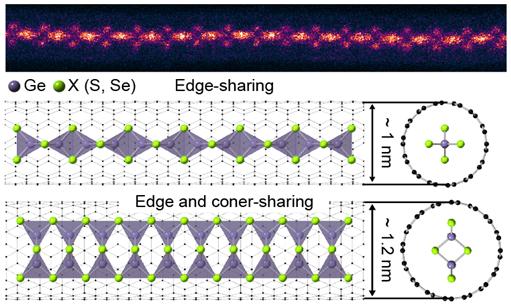 Atomic images and atomic model schematic of germanium chalcogenide compound experiment observation. (Top) Atomic image of germanium chalcogenide compound observed by transmission electron microscopy. (Bottom) Schematic diagram of one-dimensional chain structure with tetrahedral bonding mode according to nanotube diameter. Image source: Provided by Yonsei University
Yonsei University announced on the 10th that Professor Kim Kwan-pyo of the Department of Physics, together with Professor Alex Zettl’s research team at the University of California, Berkeley, USA, and other international collaborators, have synthesized for the first time a one-dimensional germanium (Ge)-sulfur (S) structure by controlling the bonding method of tetrahedral structures and reported it to the academic community.
Silicon dioxide (SiO2) has a structure where silicon-oxygen tetrahedra are connected to each other, and depending on changes in the bonding method between tetrahedra, various three-dimensional structures can be formed. When the bonding is regular, quartz crystals are formed, and when the bonding is highly irregular and amorphous, it becomes glass, which is widely used in everyday life. In other words, controlling the bonding method of tetrahedra and understanding changes in physical properties can lead to the development of new materials.
The research team synthesized a one-dimensional chain structure of germanium chalcogenide semiconductor by controlling the tetrahedral bonding method using a nanotube synthesis template. Germanium chalcogenides also form bonds between tetrahedra based on principles similar to silicon dioxide, allowing the formation of various structures. The team also succeeded in analyzing the new material structure using ultra-high resolution transmission electron microscopy at the Lawrence Berkeley National Laboratory (LBNL) in the USA and the Nano-Medicine Research Group at Yonsei University’s Institute for Basic Science. Through atomic-level imaging, they revealed the world’s thinnest one-dimensional single-chain structure of germanium chalcogenide with a thickness of less than 1 nanometer (nm).
The international joint research team also performed first-principles calculations to demonstrate that the stability of the tetrahedral bonding structure of germanium chalcogenides varies depending on the diameter of the nanotube. They synthesized a one-dimensional alloy chain structure by adjusting the composition ratio of germanium disulfide (GeS2) and germanium diselenide (GeSe2), confirming that bandgap tuning is possible through composition changes.
The international joint research team explained, "We experimentally demonstrated that the bonding method of tetrahedral structures can be controlled at the atomic level," adding, "This opens up possibilities for exploring new low-dimensional nanomaterials using nanotube synthesis templates."
The research results were published online on the 26th of last month in the international journal in the field of nanotechnology, ACS Nano (IF 18.027).
© The Asia Business Daily(www.asiae.co.kr). All rights reserved.
![Clutching a Stolen Dior Bag, Saying "I Hate Being Poor but Real"... The Grotesque Con of a "Human Knockoff" [Slate]](https://cwcontent.asiae.co.kr/asiaresize/183/2026021902243444107_1771435474.jpg)















