The U.S. government and Congress failed to reach an agreement to raise the debt ceiling, causing the U.S. credit default swap (CDS) premium to soar to levels approaching those of China. This indicates that the market views the risk of a U.S. default as dangerously high. Although past cases suggest the likelihood of an actual U.S. bankruptcy is low, if the debt ceiling increase agreement between the U.S. government and Congress is delayed or if financial market instability originating from the U.S. intensifies, the South Korean economy is also expected to face negative ripple effects.
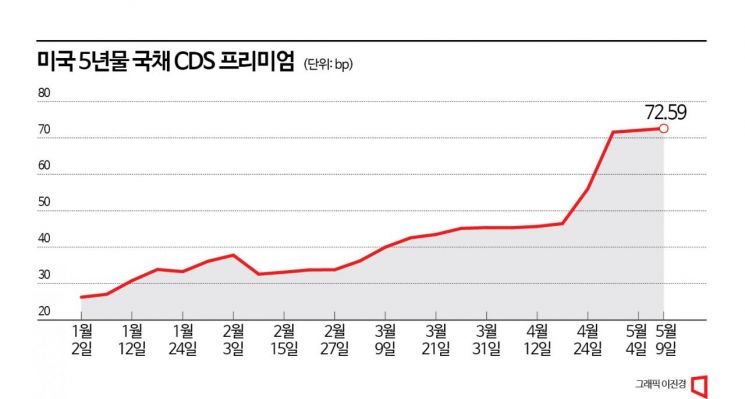
According to the financial market on the 11th, the U.S. CDS premium rose to 72.59 basis points (bp = 0.01 percentage points) as of the previous day, increasing by 1.02 bp in a single day to reach the highest level since 2011. A CDS is a contract made with a third party that guarantees the principal to bond investors even if the issuing country or company defaults. Investors pay a premium, which is like an insurance fee, in exchange for the guarantee that they will recover their principal even if the bond defaults.
Therefore, the sharp rise in the U.S. CDS premium means that the possibility of a U.S. default has increased, causing the insurance premium that must be paid to guarantee the principal to rise. The U.S. CDS premium, which stayed around 25 bp earlier this year, began rising from mid-January, surpassing South Korea (44.98 bp) and approaching China (76.18 bp). The difference is also significant compared to other advanced countries such as Japan (22.72 bp), the United Kingdom (20.80 bp), and Germany (13.27 bp).
The growing default concerns surrounding the U.S. stem from the sluggish progress in raising the debt ceiling between the U.S. government and Congress. The statutory debt limit is $31.4 trillion, which was already reached in January. The government insists that Congress must raise the limit unconditionally to avoid default, but the opposition Republican Party demands government spending cuts. President Joe Biden and Republican House Speaker Kevin McCarthy failed to reach an agreement again during their meeting the previous day.
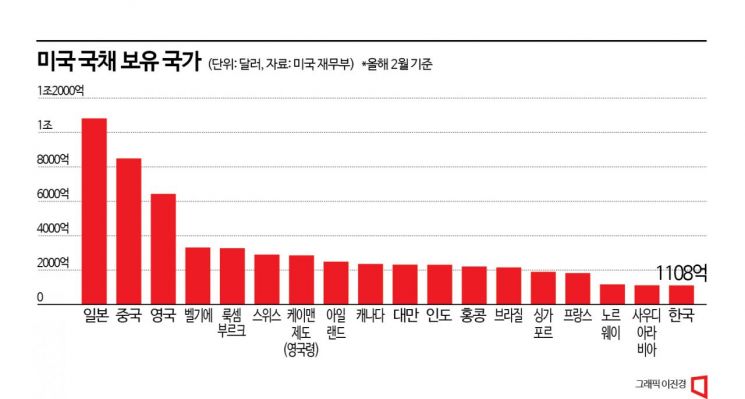
Of course, the possibility of an actual U.S. default is low. As the world's largest deficit country, the U.S. has used massive fiscal resources through wars and economic crises, financing itself by issuing government bonds to countries such as Japan, China, and South Korea. The debt ceiling, which was $10 trillion in 2008, has now exceeded $30 trillion. Although the government and Congress have clashed several times over raising the limit, they have always eventually compromised. The New York Times described the default crisis as a "familiar bad news" for this reason.
However, for neighboring countries like South Korea, the ongoing economic uncertainty originating from the U.S. is a burden. The International Financial Center pointed out in a report last February that "Although the current U.S. debt ceiling controversy is a political issue likely to be resolved eventually, attention must be paid to the uncertainty risk during the process," adding, "If default concerns are reflected or credit rating agencies downgrade ratings before the negotiation is settled, financial market instability could resume as it did in 2011."
If a default materializes next month, the suspension of U.S. Treasury interest payments would plunge the global economy into chaos. South Korea would not be able to escape the fallout. In 2011, the Democratic and Republican parties clashed over the debt ceiling limit and came close to default, and at that time, the global credit rating agency Standard & Poor's (S&P) took the drastic step of lowering the U.S. sovereign credit rating by one notch, causing sharp declines in stock prices not only in the U.S. but also in South Korea and Europe, and intensifying the debt crisis.
The market also fears a surge in demand for safe assets due to U.S. financial market instability could lead to a rapid outflow of foreign investment from emerging markets like South Korea. The U.S. Treasury market serves as a cornerstone of the global financial system. With the record-high interest rate gap between South Korea and the U.S. (1.75 percentage points) and turmoil in the U.S. banking sector already causing confusion in domestic and international financial markets, a U.S. default crisis could deliver a significant shock to South Korea's financial market.
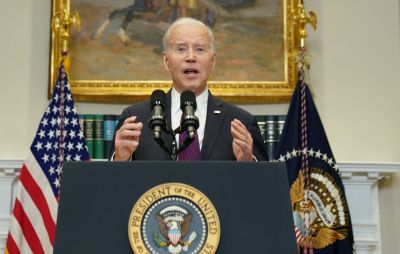 U.S. President Joe Biden held a press conference on the 9th (local time) at the White House in Washington, D.C., after discussing the debt ceiling issue with congressional leaders including House Speaker Kevin McCarthy and Republican Senate Majority Leader Mitch McConnell. [Image source=Yonhap News]
In particular, some voices warn that this situation could accelerate a global economic recession. The U.S. White House Council of Economic Advisers (CEA) predicted that the ongoing partisan deadlock alone could lead to a loss of 200,000 jobs and a 0.3% decrease in annual real gross domestic product (GDP). For South Korea, which is highly dependent on exports and heavily influenced by the global economy including the U.S., this is the biggest negative factor. South Korea, which has been experiencing a goods trade deficit for six consecutive months, needs a global economic rebound in the second half of the year.
Ilhyuk Kim, a research fellow at KB Securities, said, "The two sides (ruling and opposition parties) that engaged in a power struggle during this meeting have agreed to hold another meeting on the 12th, but the possibility of narrowing their differences is low," adding, "The standoff is expected to continue for some time, increasing market anxiety." Professor Sungjin Kang of Korea University’s Department of Economics emphasized, "Financial issues tend to spread widely once they occur," and added, "Since there are concerns such as real estate project financing (PF) in South Korea, close monitoring is necessary."
© The Asia Business Daily(www.asiae.co.kr). All rights reserved.
![Clutching a Stolen Dior Bag, Saying "I Hate Being Poor but Real"... The Grotesque Con of a "Human Knockoff" [Slate]](https://cwcontent.asiae.co.kr/asiaresize/183/2026021902243444107_1771435474.jpg)

















