Asahi Beverage Develops Vending Machine That Absorbs CO2
Used Absorbent Material Recycled as Industrial Raw Material
In Japan, known as the "vending machine country" due to its large number of vending machines, a vending machine equipped with a carbon dioxide (CO2) absorption function has been announced, attracting attention. It is expected to be distributed in major cities around the world, including South Korea, where vending machines are also widely used.
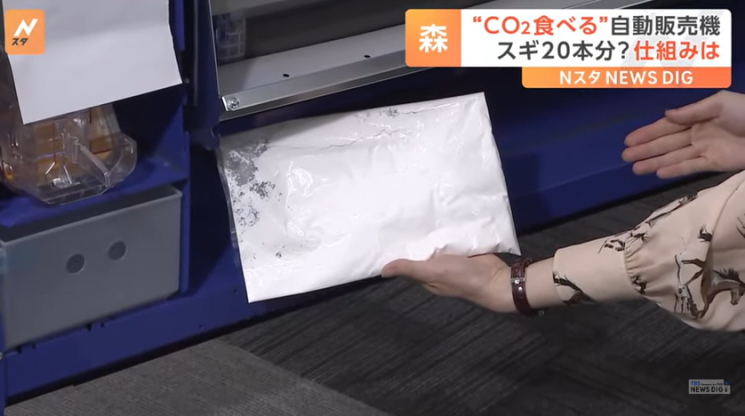
On the 10th, Nihon Keizai Shimbun (Nikkei) reported that Asahi Soft Drinks developed a "CO2-eating vending machine" that absorbs CO2 from the air. The vending machine is designed to suck in CO2 by placing a powdered absorbent material at the bottom, and Asahi Soft Drinks announced that it can reduce CO2 emissions caused by the vending machine's power consumption by up to 20%.
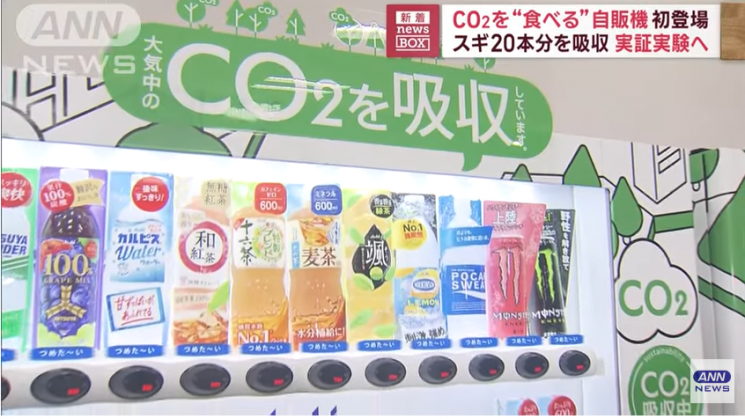
The absorbent powder developed in-house by the company is made from naturally derived minerals and is known to have nine times the absorption power compared to general absorbents. The CO2-absorbed powder will later be recycled as an industrial raw material by mixing it with fertilizers or concrete in collaboration with local governments or companies.
At a press conference, Taichi Yoneme, president of Asahi Soft Drinks, explained, "Vending machines are infrastructure familiar to customers. The idea of absorbing CO2 could change the perception of vending machines, which have so far been viewed negatively from a decarbonization perspective, into a positive one."
Nikkei reported that the company proceeded with this project under the concept of "creating forests in urban areas." When vending machines refrigerate or heat beverages, they draw in outside air, which is likened to trees in a forest. The annual CO2 absorption of one vending machine is equivalent to that of about 20 cedar trees aged 56 to 60 years. Since the absorbent material is installed in the empty space at the bottom of the vending machine and replaced twice a month, it reportedly does not affect the operation.
The CO2-eating vending machines are scheduled to be pilot-operated in the Kanto and Kansai regions starting next month. The company plans to install about 30 units in places predicted to have high CO2 concentrations, such as indoors or subway stations, to verify the amount and speed of CO2 absorption. A company official stated, "This vending machine is currently patent-pending as a 'vending machine that absorbs CO2 from the atmosphere.'"
In Japan, a country known for its large number of vending machines, the power consumption of beverage vending machines and the resulting CO2 emissions are common ESG (Environmental, Social, and Governance) challenges for the beverage industry. According to the Japan Vending System Manufacturers Association, as of December 2020, there were approximately 4.04 million vending machines in Japan, with more than half being beverage vending machines. The Japan Soft Drink Association's survey found that the number of operating beverage vending machines in 2021 was 2.19 million. The annual sales generated from vending machines alone amount to about 5 trillion yen (48 trillion won), which is 1 trillion yen (9.79 trillion won) higher than that of the United States.
Yukiaki Aida, head of CSV (Creating Shared Value) strategy at Asahi Soft Drinks, told Nikkei, "We will promote the development of materials with higher absorption capacity and aim for zero CO2 emissions from vending machines."
© The Asia Business Daily(www.asiae.co.kr). All rights reserved.
![Clutching a Stolen Dior Bag, Saying "I Hate Being Poor but Real"... The Grotesque Con of a "Human Knockoff" [Slate]](https://cwcontent.asiae.co.kr/asiaresize/183/2026021902243444107_1771435474.jpg)
















