After the Space Development Agency Inspection on the 18th of Last Month, a Long Hiatus
Strengthened Pressure Cooperation Among South Korea, the US, and Japan... North Korea Remains 'Quiet'
"They Must Be Deep in Thought... Might Aim for a South Korea-US-Japan Summit"
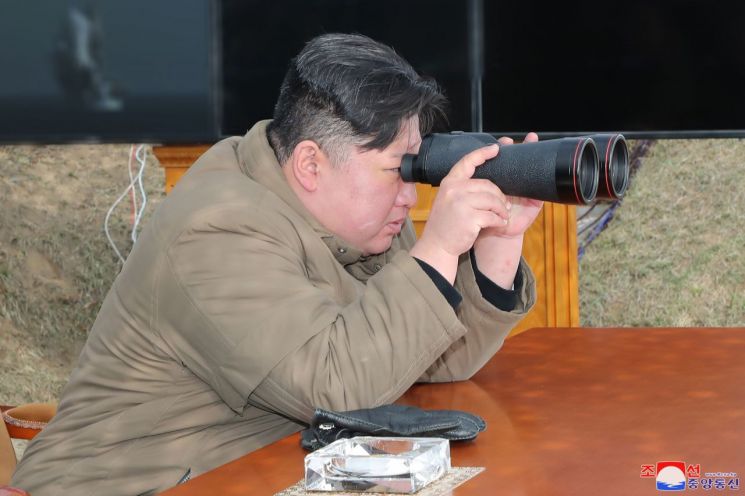
Amid strengthened pressure cooperation against North Korea's nuclear threat following a series of summit meetings between South Korea, the United States, and Japan, North Korean State Affairs Commission Chairman Kim Jong-un has remained absent from public for over three weeks. There are speculations that he is contemplating responses to strong remarks, including U.S. President Joe Biden's warning of the 'end of the regime,' and some predict that provocations may resume targeting the upcoming Group of Seven (G7) summit, where the South Korea-U.S.-Japan trilateral summit is scheduled.
According to authorities on the 10th, based on reports from North Korean state media, the last time Chairman Kim Jong-un appeared publicly was on April 18 during an inspection of the National Aerospace Development Administration. At that time, Kim ordered the launch of a military reconnaissance satellite, which was scheduled for April, to proceed "within the planned timeframe," but the launch has not yet occurred. Since then, he has been absent for 22 days.
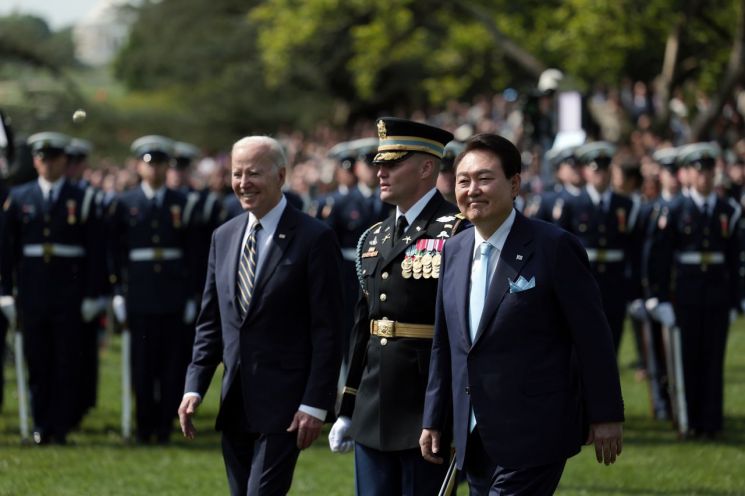
Meanwhile, President Yoon Suk-yeol met with U.S. President Joe Biden at the end of last month and adopted the 'Washington Declaration,' which includes measures to strengthen extended deterrence expected to provoke strong North Korean backlash, such as the establishment of the Nuclear Consultative Group (NCG) and the port call of U.S. strategic nuclear submarines (SSBNs) to the Korean Peninsula. Following this, a series of summit meetings with Japanese Prime Minister Fumio Kishida further elevated the trilateral pressure cooperation against North Korea.
However, North Korea has remained quiet. It responded to the Washington Declaration only three days after its adoption with a statement issued under the name of Kim Yo-jong, deputy director of the Workers' Party. Although some criticism has continued through propaganda media, including claims of a 'scarecrow burning ceremony' targeting the South Korean and U.S. leaders, there has been no official announcement reflecting a weighty stance from the authorities. The first reaction to the South Korea-Japan summit was limited to a claim through the pro-South propaganda outlet Uri Minjokki, under the Committee for the Peaceful Reunification of the Fatherland, stating that "the military alliance between South Korea and Japan has entered a reckless practical stage."
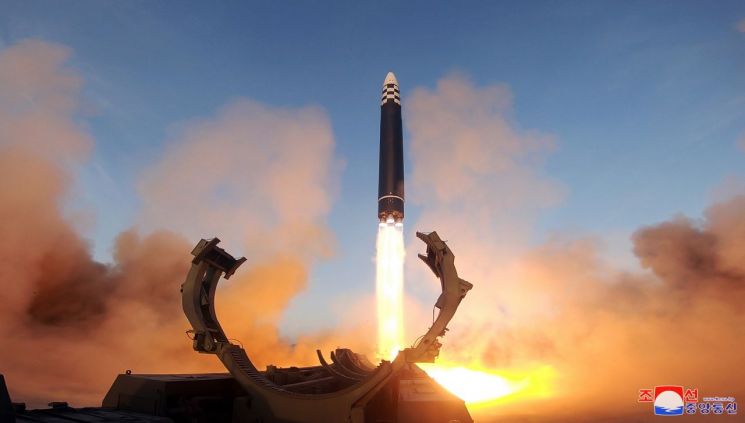
Military provocations have also entered a lull. The military reconnaissance satellite launch scheduled for April has shown no signs so far, and military demonstrations have been suspended for nearly a month since the launch of the new solid-fuel intercontinental ballistic missile (ICBM) 'Hwasong-18' on March 13.
Silent Kim Jong-un... Feeling the Burden of 'End of Regime' Warning?
Among experts, there is a view that the solidification of South Korea-U.S.-Japan security cooperation, including President Biden's direct warning of the 'end of the regime,' has placed a significant burden on Kim Jong-un. Previously, at the 54th Security Consultative Meeting (SCM) between South Korea and the U.S. in November last year, U.S. Secretary of Defense Lloyd Austin warned that the use of nuclear weapons would bring about the end of Kim Jong-un's regime, but a warning of regime end from the U.S. president himself is considered a different level of threat from Kim's perspective. The unusually long absence is seen as evidence of his sense of crisis.
Cho Han-bum, senior research fellow at the Korea Institute for National Unification, evaluated that "the port call of U.S. strategic nuclear submarines and strategic nuclear bombers to the Korean Peninsula, as stipulated in the Washington Declaration, is an agreement beyond North Korea's expectations." Moon Sung-mook, director of the Unification Strategy Center at the Korea Institute for National Strategy and a retired army brigadier general, said, "Kim Jong-un has unveiled many new weapons threatening South Korea and the U.S., such as the underwater nuclear torpedo 'Haeil,' but the results of the South Korea-U.S. summit could nullify them all at once, causing deep concern." He added, "If North Korea resumes provocations, it is likely to target the South Korea-U.S.-Japan summit during the G7 summit in the near future."
Signs of Nuclear Test Persist... "May Escalate Provocations"
There are also warnings that tensions cannot be eased as signs of nuclear test preparations continue to be detected. On this day, Radio Free Asia (RFA) analyzed satellite images of the Yongbyon area taken by the U.S. commercial satellite 'Planet Labs' on the 4th, concluding that North Korea is actively continuing plutonium and highly enriched uranium (HEU) production necessary for nuclear weapons manufacturing at nuclear facilities. Particularly, thermal infrared images taken on March 12 showed high temperatures at the radiochemical laboratory, uranium enrichment facility, and 5 MW reactor, indicating these facilities were operational.
New movements have also been observed at the West Sea Satellite Launching Station in Cholsan County, Pyonganbuk Province, where long-range rocket-related tests are conducted. The U.S.-based North Korea specialist media 38 North reported on the 5th that new construction work, apparently part of facility modernization, has begun at the West Sea Satellite Launching Station. This site has hosted engine combustion tests for North Korea's first ICBM 'Hwasong-13,' unveiled in April 2012, as well as various tests of ICBM-class missiles. However, no work directly related to the launch pad has been detected.
Jung Sung-jang, head of the Unification Strategy Research Division at the Sejong Institute, stated, "Kim Yo-jong's backlash mentioning the establishment of the NCG and 'decisive actions' suggests a policy of responding with an ultra-hardline stance going forward." He predicted, "North Korea may escalate its response by conducting nuclear torpedo drills targeting the U.S., including solid-fuel ICBM launches and nuclear submarine deployments, and by raising the level of tactical nuclear use drills simulating full-scale war against South Korea."
© The Asia Business Daily(www.asiae.co.kr). All rights reserved.



















