Minister's Office: "Premature Recognition of Accident Is Not a Reasonable Claim"
National Assembly: "Questioning Minister's Post-Event Negligence Responsibility as Stated in Law"
Regarding the response to the Itaewon disaster, it has been decided to proceed with the examination of some witnesses in the impeachment trial of Minister of the Interior and Safety Lee Sang-min, requested by the National Assembly.
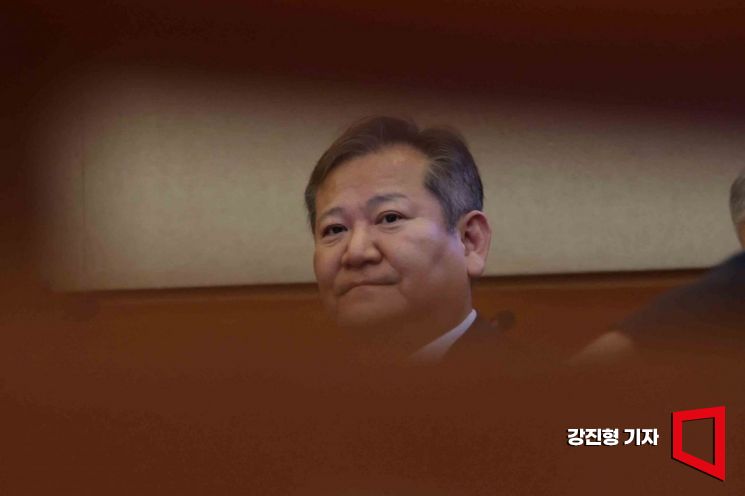 The formal constitutional court hearing for Lee Sang-min, Minister of the Interior and Safety, who was impeached over the inadequate response controversy to the Itaewon disaster, was held on the afternoon of the 9th at the Grand Bench of the Constitutional Court in Jongno-gu, Seoul. Minister Lee Sang-min is seated. Photo by Kang Jin-hyung aymsdream@
On the 9th, at the first hearing of the impeachment trial request against Minister Lee at the Constitutional Court, it was decided to proceed with the examination of witnesses requested by the petitioner, the National Assembly. However, the Constitutional Court decided to postpone the decision on whether to adopt bereaved families and survivors as witnesses and to conduct an on-site inspection.
The Constitutional Court recognized the necessity of examining witnesses including Kim Sung-ho, Director of the Disaster and Safety Management Headquarters at the Ministry of the Interior and Safety; Park Yong-soo, Director of the Central Disaster Situation Room at the Ministry of the Interior and Safety; Eom Jun-wook, Director of the Situation Room at the Fire Agency; and Hwang Chang-seon, Security Situation Manager at the National Police Agency. The examination of these witnesses will take place from the second hearing on the 23rd of this month to the third hearing on the 13th of next month.
The Constitutional Court summarized the issues as whether Minister Lee violated the obligations of pre-disaster prevention measures and post-disaster response measures, and whether there were inappropriate remarks or actions after the disaster occurred.
Specifically, the issues for Minister Lee include ▲whether there was an obligation to prepare plans and measures for accidents involving densely crowded crowds, and if so, whether this obligation was properly fulfilled ▲whether there was an obligation to establish and advance the disaster safety communication network ▲whether it is true that the Central Disaster and Safety Countermeasures Headquarters (Jungsu-bon) was not established, and if so, whether this constitutes a legal violation ▲whether it is true that the Central Disaster and Safety Countermeasures Headquarters (Jungdaebon) was not immediately activated, and if so, whether this constitutes a violation of official duties under the law ▲whether the national disaster management system was not properly utilized during the response process after the disaster, and if so, whether this constitutes a violation of obligations ▲whether police forces and other response personnel were not deployed in a timely manner during the disaster ▲and whether remarks made after the disaster damaged the dignity of public officials or violated the duty of dignity.
At the trial, Minister Lee’s side argued that it is not appropriate to hold the Minister of the Interior and Safety responsible for disaster safety. The Minister’s representative questioned, "Should the Minister be impeached if he did not anticipate that people would gather in steep and narrow alleys and did not instruct Yongsan District Office and Yongsan Police Station to prepare in advance and control access?"
He continued, "It is an exaggerated logic to say that the state must unilaterally prevent disasters and that failure to do so constitutes a crime," adding, "It is not reasonable to expect a minister overseeing the entire country to anticipate (the accident) in advance. After investigating the entire system following the incident, deficiencies were found, but it is not correct to attribute all faults to the Minister of the Interior and Safety."
In response, the National Assembly’s side countered that it is sufficient to prove how the Minister of the Interior and Safety, who holds the authority for overall coordination of disaster safety management, exercised his powers and functions. The National Assembly’s representative stated, "This is not about making abstract demands that the public expects in general," and argued, "While unpredictable disasters may occur, the Disaster and Safety Act was created to prepare for such cases, and the Minister of the Interior and Safety, as the head of the relevant ministry, is legally required to take measures whether or not the disaster was anticipated."
He added, "What the public expects and what the Disaster and Safety Act stipulates is that the Minister of the Interior and Safety must take some form of action," emphasizing, "In that regard, I want to stress that Minister Lee violated the law."
© The Asia Business Daily(www.asiae.co.kr). All rights reserved.
![Clutching a Stolen Dior Bag, Saying "I Hate Being Poor but Real"... The Grotesque Con of a "Human Knockoff" [Slate]](https://cwcontent.asiae.co.kr/asiaresize/183/2026021902243444107_1771435474.jpg)
















