Hyundai Motor Invests 2 Trillion Won in Ulsan... Establishes Electric Vehicle Dedicated Factory
Kia Begins Construction of Hwaseong Electric Vehicle Factory... Gwangmyeong Factory Production Line Also Changed
The government has designated electric vehicle production facilities as a national strategic technology and increased investment tax credits. In response, Hyundai Motor Group is expanding electric vehicle production lines at Hyundai Motor's Ulsan plant and Kia's Hwaseong plant, and increasing new investments.
On the 9th, the Ministry of Economy and Finance announced the legislative notice of the amendment to the Enforcement Decree of the Restriction of Special Taxation Act, which includes electric vehicle production facilities as targets for national strategic technology and facility investment tax credits. In line with this, Deputy Prime Minister and Minister of Economy and Finance Choo Kyung-ho visited Hyundai Motor's Ulsan plant.
During the visit, Hyundai Motor Group explained plans to establish a dedicated electric vehicle factory in Ulsan and to further expand domestic electric vehicle production capacity starting this year. Deputy Prime Minister Choo toured the electric vehicle production line at Ulsan Plant 1 and the site for the new dedicated electric vehicle factory. Through an on-site meeting with the electric vehicle industry, he heard various opinions from Hyundai Motor Group and parts industry officials.
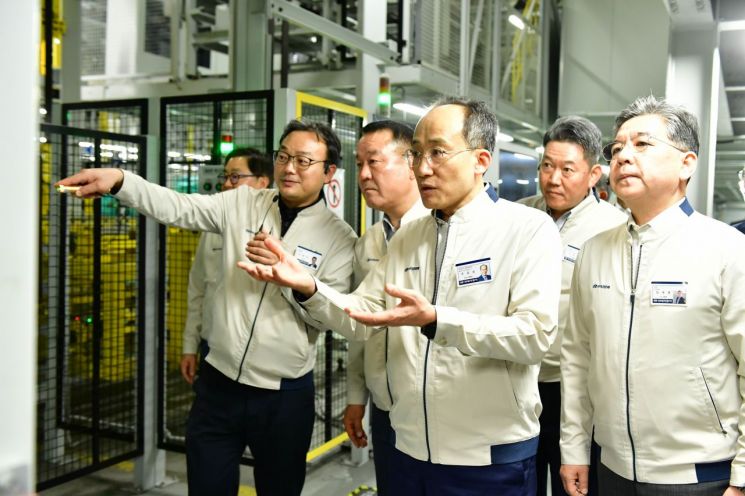 Deputy Prime Minister and Minister of Economy and Finance Choo Kyung-ho (center) is visiting Hyundai Motor Company's Ulsan plant on the 9th, touring the production line of the electric vehicle Ioniq 5 together with Hyundai Motor President Jang Jae-hoon (far right).
 [Photo by Ministry of Economy and Finance]
Hyundai Motor plans to establish a dedicated electric vehicle factory at the Ulsan plant. Kia began construction of a customer-customized electric vehicle factory at Autoland Hwaseong in April. Autoland Gwangmyeong will also start converting internal combustion engine production facilities to electric vehicle dedicated lines within the first half of the year.
The Hyundai Motor Ulsan dedicated electric vehicle factory is the first new domestic factory in 29 years since the Asan plant began operations in 1996. Hyundai Motor will invest 2 trillion won for this. Covering an area of 71,000 pyeong, full-scale construction is scheduled to begin in the fourth quarter of this year. Completion is expected in 2025.
In April, Hyundai Motor Group held a groundbreaking ceremony for the 'customer-customized electric vehicle factory' at Kia Hwaseong Autoland. This is Hyundai Motor Group's first newly established dedicated electric vehicle factory in Korea. Approximately 1 trillion won will be invested on a site of about 30,000 pyeong. Mass production will begin in the second half of 2025, securing an annual production capacity of up to 150,000 units. As an innovative factory pursuing flexible production, low carbon, intelligence, and human-friendliness, it is expected to become a representative hub for future car production in Korea.
On this day, Hyundai Motor Group announced plans to make Korea a global innovation hub for the future automobile industry through large-scale investments. To this end, they will have a total of 31 electric vehicle lineups by 2030 and invest 24 trillion won in the domestic electric vehicle sector. They plan to expand electric vehicle production to 1.51 million units annually, exporting 60% (920,000 units) of production. Hyundai Motor Group's specific goal is to increase global electric vehicle production to 3.64 million units and achieve a top 3 global ranking in electric vehicle sales by 2030.
Additionally, Hyundai Motor Group will simultaneously strengthen the domestic electric vehicle parts supply chain. They plan to support continued global leadership in electrification by cooperating with electric vehicle parts companies recently included in national strategic technologies.
Moreover, electric vehicles are directly linked to creating power demand through storage functions such as V2L and V2G, as well as generating various new services and industries connected with connected and autonomous driving.
A Hyundai Motor Group official said, "The expansion of electric vehicle factories and production lines promoted by Hyundai Motor Group is an essential prerequisite for creating an electric vehicle industry ecosystem," adding, "We will lead a virtuous cycle structure that enhances the competitiveness of related industries, such as expanding investments by domestic parts companies and accelerating technology development."
© The Asia Business Daily(www.asiae.co.kr). All rights reserved.
![Clutching a Stolen Dior Bag, Saying "I Hate Being Poor but Real"... The Grotesque Con of a "Human Knockoff" [Slate]](https://cwcontent.asiae.co.kr/asiaresize/183/2026021902243444107_1771435474.jpg)
















