Shortage of Public School Teachers Emerges as Social Issue
Increasing Overbearing Parents Amid Poor Conditions Leads to Rising Mid-Career Resignations
Teacher shortages at public schools across Japan have become a serious social issue. Some classrooms have no homeroom teacher assigned on the first day of school, forcing students to study independently, while in many cases, vice principals have to step in to teach due to the inability to find substitute staff. As working conditions fail to improve and the number of parents making unreasonable demands or complaints increases, schools have become so-called "black companies"?workplaces to be avoided.
According to the Asahi Shimbun on the 9th, last month, at the start of the school year in Japan, some public elementary schools in the Tokyo metropolitan area were unable to assign homeroom teachers for first-grade classes. As a result, those classes had to spend the first day in self-study instead of lessons. There were even cases where a teacher had to take charge of physical education classes for classes without homeroom teachers, teaching as many as 70 children at once.
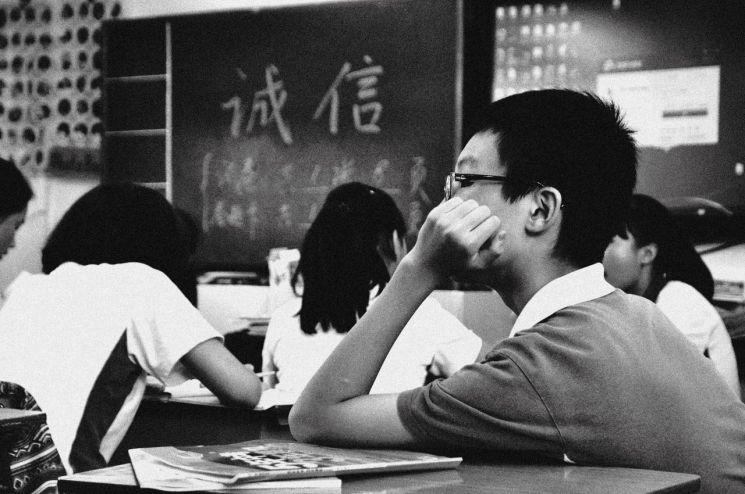
In another public elementary school in a different ward of Tokyo, vacancies appeared last month, and vice principals and other teachers took turns teaching classes. They even asked retired teachers to come back as substitutes, but after the first day, one declined, saying, "I think quitting was the right decision after all."
This shortage of staff is happening nationwide. In a municipal elementary school in Chiba Prefecture, the number of classes was increased due to an influx of transfer students, but the vice principal had to teach because they could not secure enough teachers. Even the head of the teaching staff, who does not normally take homeroom duties, is handling homeroom responsibilities alongside other work, leading to a serious overload, Asahi reported.
In fact, according to the Tokyo Metropolitan Board of Education, as of the school opening day on the 7th of last month, there were about 80 vacancies at 1,269 public elementary schools in Tokyo. This number is about 50 more than the same period last year. Asahi analyzed that "although the number of successful candidates in the teacher employment exam was increased, more teachers retired due to illness or career changes, resulting in vacancies."
This problem is not limited to elementary schools. Asahi conducted a survey in April this year targeting 68 institutions, including 47 prefectural and municipal boards of education with teacher personnel authority and 20 designated cities (government-designated major cities with populations over 500,000). The survey found that 34 institutions reported a total of 1,494 teacher vacancies across elementary, junior high, and high schools.
This is because teaching has become a completely avoided profession. There have been no reforms in work style or improvements in treatment, and working conditions are worsening. A board of education official told Asahi, "Many young teachers face unexpectedly difficult situations and retire mentally exhausted."
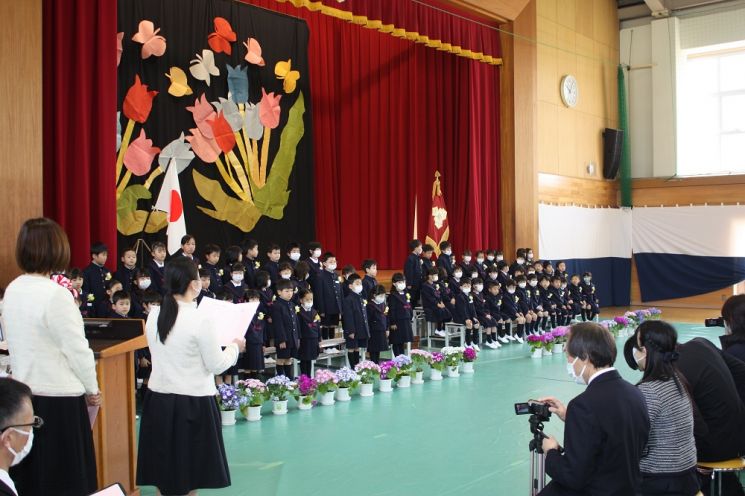 Entrance ceremony of Tottori University Affiliated Elementary School in Japan. (Photo by Tottori University Affiliated Elementary School website)
In Japan, "monster parents"?parents who frequently complain or make unreasonable demands at schools due to overprotectiveness of their children?have long been a social problem. An interview with a retired teacher featured by a Japanese online media outlet revealed various forms of monster parents, from demands like "My child has a sensitive personality, so please keep the same homeroom teacher next year" to parents visiting schools saying "Do not scold my child." Last month, at a prestigious private school in Tokyo, monster parents repeatedly demanded a change of homeroom teacher, leading to a teacher’s disciplinary action and subsequent voluntary resignation. Other parents then collected signatures to request the teacher’s reinstatement, which was reported in the media.
Due to these factors, the number of public school teachers taking leave for mental health reasons is rapidly increasing. According to the Ministry of Education, Culture, Sports, Science and Technology’s "2021 Public School Staff Personnel Administration Survey" released last year, 5,897 teachers took leave due to mental illness in 2021, the highest number ever recorded. Including those who took sick leave for more than a month, the total reached 10,944, surpassing 10,000 for the first time. Compared to 1,017 teachers who took leave for mental illness in 1990, this is nearly a fivefold increase. Considering the decline in active teachers, this indicates a rapid rise in those experiencing mental stress.
While mid-career resignations increase, the number of new teachers is also declining. According to a survey by Tomonokai, a company dispatching instructors, more than half of university students aspiring to become teachers gave up midway. The top reason, cited by 53.6%, was "long working hours and frequent holiday work due to events and club activities," followed by 9.2% who said "public schools do not pay overtime allowances."
As a result, efforts are underway to recruit so-called "paper teachers"?those who hold teaching certificates but have never taught. Okinawa Prefecture held paper teacher seminars in February and March, explaining school circumstances and offering individual recruitment consultations. Saitama Prefecture also held three seminars last year and hired some certificate holders without teaching experience.
Retired former teachers are also frequently asked to return. Asahi introduced the case of a 72-year-old teacher who retired at the mandatory retirement age and has been receiving two to three phone calls daily since last month. Another 73-year-old teacher took on a homeroom position at an elementary school in Tokyo after 10 years of retirement. He said, "After becoming a principal, my junior colleagues kept calling saying they needed teachers, so I couldn’t refuse."
However, there are limits to how well retired teachers can adapt to the changed educational environment. This elderly teacher told Asahi, "I learned how to use tablet devices from my son, who is a company employee, and since I find it difficult to demonstrate physical education myself, I have students who are good at it come forward to demonstrate during class."
© The Asia Business Daily(www.asiae.co.kr). All rights reserved.
![Clutching a Stolen Dior Bag, Saying "I Hate Being Poor but Real"... The Grotesque Con of a "Human Knockoff" [Slate]](https://cwcontent.asiae.co.kr/asiaresize/183/2026021902243444107_1771435474.jpg)
















