3345 Cases of Advanced Budget Use in the First Half of This Year
About 1000 More Than 2499 Cases Last Year
Deteriorating Revenue Conditions, Is Advanced Use Possible?
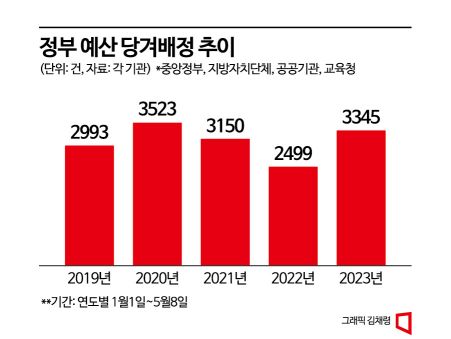
Due to the government's policy of early budget execution, it has been revealed that not only government ministries but also local governments and affiliated public institutions have used planned budgets in advance. This strategy aims to stimulate the deteriorating economy by injecting the budget ahead of schedule, but there are forecasts that it will be difficult to meet the original targets due to a shortage of tax revenue.
On the 9th, Asia Economy examined the budget settlement details of central government ministries, metropolitan and basic local governments, public institutions, and education offices, and found that a total of 3,345 cases of "early allocation" budgets were recorded from January 1 to early this month. Compared to only 2,499 cases during the same period last year, this is an increase of nearly 1,000 cases. Except for 2020, when large-scale expansionary fiscal policies were implemented due to the outbreak of COVID-19 (3,523 cases), this is the highest number in the past five years.
Early allocation refers to a system where budgets are allocated ahead of the originally planned schedule. It usually occurs when plans change or conditions differ during the actual execution of projects, requiring adjustment of the expenditure timing.
The Ministry of Economy and Finance, which oversees the budget, has significantly advanced budgets for eco-friendly related projects. Representative examples include the overseas expansion support project for renewable energy, the carbon-neutral urban forest creation project, the Saemangeum Smart Green National Pilot Industrial Complex construction, and the resource circulation cluster. The Ministry of Trade, Industry and Energy advanced the budget for the energy policy promotion project, and the Ministry of Health and Welfare used the budget for the National Health Promotion Fund project in advance.
Deteriorating Revenue Conditions... Is Early Budget Spending Feasible?
The sharp increase in early allocations is influenced by the government's strategy to respond to the economic downturn. The government has predicted that the economy will show a "high in the first half, low in the second half" pattern this year and has announced plans to concentrate a significant portion of the total budget in the first half. The goal is to spend 158 trillion won (65%) of central government finances and 171 trillion won (60.5%) of local government finances in the first half. The total target, including local education finances, public institutions, and private investment projects, reaches about 383 trillion won. This is about 40 trillion won more than the initial target of 340 trillion won announced at the beginning of the year, marking the largest scale ever.
Given the large scale, procedural improvements have also been made to ensure rapid execution. For projects with total amount accounting or occasional allocation, work will begin immediately once the project plan is confirmed, and financial support incentives and awards will be given to excellent local governments or central ministries that manage execution well. It is also known that affiliated public institutions were ordered to speed up budget and project execution.
The problem lies in the revenue conditions. According to the Ministry of Economy and Finance's national tax revenue status, cumulative national tax revenue as of March was 87.1 trillion won. This is 24 trillion won less than last year's 111.1 trillion won. The decrease is the largest ever recorded as of March. In response, the Ministry of Economy and Finance has reportedly ordered the Tax Policy Bureau to devise measures to secure tax revenue and instructed the Budget Office to prepare "expenditure reduction plans for lower-priority projects." It is difficult to maintain the intensive budget usage policy for the remaining period of the first half.
On the 4th, Deputy Prime Minister and Minister of Economy and Finance Choo Kyung-ho held a press conference at the 56th Annual Meeting of the Asian Development Bank (ADB) in Songdo, Incheon, stating, "We will carry out expenditures related to people's livelihoods without fail," but also said, "If it is confirmed that fiscal execution does not proceed properly within the year, we can respond in terms of improving execution efficiency."
However, he drew a line by saying that procedures for immediate budget cuts are not being taken. A Ministry of Economy and Finance official explained, "We probably need to prepare (budget reduction plans) gradually," but added, "We need to execute a bit more before making a judgment, and it is still too early now."
© The Asia Business Daily(www.asiae.co.kr). All rights reserved.
![Clutching a Stolen Dior Bag, Saying "I Hate Being Poor but Real"... The Grotesque Con of a "Human Knockoff" [Slate]](https://cwcontent.asiae.co.kr/asiaresize/183/2026021902243444107_1771435474.jpg)
















