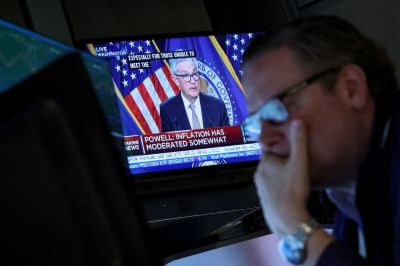
The U.S. Federal Reserve (Fed) indicated at the May Federal Open Market Committee (FOMC) meeting that the more than one-year-long streak of interest rate hikes is nearing its end. Now, the key question is whether the cumulative effects of the tightening policies will be reflected in the economic indicators. This is why investors are closely watching the U.S. April Consumer Price Index (CPI) and Producer Price Index (PPI) data scheduled for release this week. Ahead of these indicators, the expected inflation rate, which reflects how much U.S. consumers anticipate prices will rise over the next year, has shown a slight slowdown.
Wall Street experts estimate that the U.S. April CPI, to be released on the 10th (local time), will show a 5% increase year-over-year and a 0.4% increase month-over-month. While the year-over-year figure is expected to remain the same as in March, the month-over-month inflation rate is projected to rise compared to March’s +0.1%. The market remains cautious about sticky core inflation as well. The core CPI, which excludes volatile energy and food prices, is forecasted to rise 5.5% year-over-year and 0.4% month-over-month. Since the core CPI rebounded in March (5.6% year-over-year), fueling inflation concerns, the key question is whether it will return to a downward trend this time.
The following day, on the 11th, the April PPI, representing wholesale prices, is also scheduled for release. Considering that increases in wholesale prices are eventually passed on to consumer prices, a slowdown in the PPI is interpreted as a signal that inflationary pressures are easing. In March, the PPI fell by 0.5% in a single month, marking the largest drop in about three years. Additional declines are expected this time as well. Forbes noted, "Inflation is decreasing, but not as quickly as the Fed desires," adding that "(The CPI) is one of the important indicators released before the Fed’s June rate decision."
Investors are expected to use these indicators not only to assess the cumulative impact of the tightening monetary policy but also to glean hints about future economic prospects. Following the strong April employment report released on the 5th, if these inflation indicators also exceed expectations, the expectations for rate cuts within the year surrounding the Fed will inevitably be further dampened.
According to the FedWatch tool from the Chicago Mercantile Exchange (CME), as of this afternoon, the federal funds futures market is pricing in over a 90% probability that the Fed will hold rates steady at the June FOMC meeting. The chance of an additional baby step (a 0.25 percentage point rate hike) has slightly increased to around 9% compared to the previous day. However, despite Fed Chair Jerome Powell’s firm assertion that there will be no rate cuts this year, the futures market still places weight on the possibility of cuts as early as between July and September.
The New York Federal Reserve Bank released data showing that the expected inflation rate over the next year is 4.4%, down 0.3 percentage points from the previous month. This indicates that U.S. consumers’ short-term inflation expectations are somewhat easing. However, the expected inflation rates for the next three years and five years have each risen by 0.1 percentage points to 2.9% and 2.6%, respectively. This suggests that consumers believe the Fed will struggle to achieve its 2% inflation target even three and five years from now. In this survey, the outlook for consumer spending one year from now increased by only 5.2%, marking the smallest rise since September 2021.
© The Asia Business Daily(www.asiae.co.kr). All rights reserved.
![Clutching a Stolen Dior Bag, Saying "I Hate Being Poor but Real"... The Grotesque Con of a "Human Knockoff" [Slate]](https://cwcontent.asiae.co.kr/asiaresize/183/2026021902243444107_1771435474.jpg)
















