Kishida Expresses Regret Over 'Forced Labor' for the First Time
Evaluated as First Step to Restore 'Shuttle Diplomacy'
Criticism for Lack of Sincere Response
Japanese Prime Minister Fumio Kishida expressed regret for the first time on the issue of forced labor compensation on the 7th, saying he "feels deeply pained." However, there was no direct expression of "apology" or "reflection." Instead, he added that it was "an honest expression of his own feelings." Although there was mention of the victims of forced labor, he somewhat downplayed the significance by framing it as a personal expression of regret rather than one on behalf of the Japanese government.
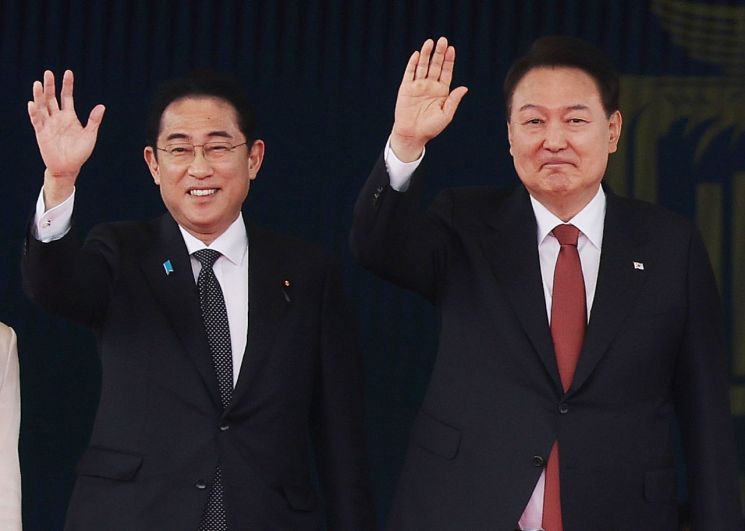
President Yoon and Prime Minister Kishida held a 102-minute summit at the Yongsan Presidential Office that afternoon and announced these results at a joint press conference. This summit was the first bilateral meeting in 52 days since the Korea-Japan summit held in Tokyo on March 16, and the first visit by a Japanese prime minister in 12 years.
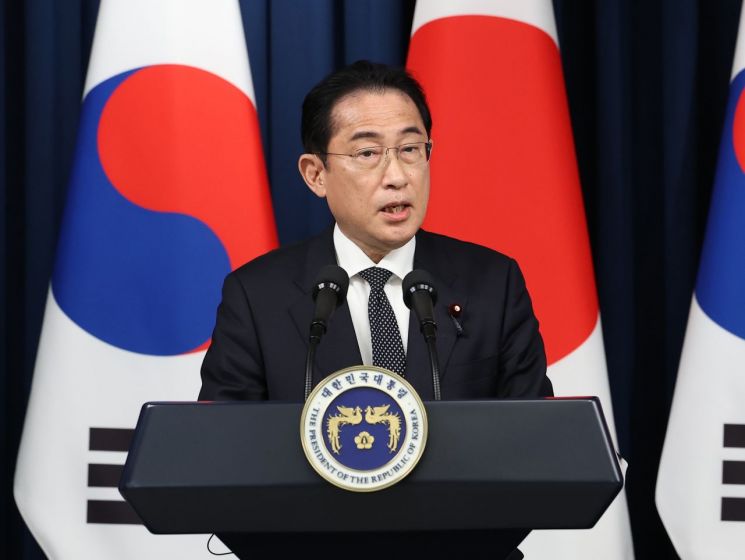
Regarding the highly sensitive issue of past history, there was a mention of regret while inheriting the stance of previous cabinets on the advanced apology part. At the press conference, Prime Minister Kishida said, "During President Yoon's visit to Japan in March, I clearly stated that I fully inherit the stance of previous cabinets on historical awareness, including the Korea-Japan Joint Declaration announced in October 1998," adding, "This government stance will remain unwavering going forward."
Kishida said, "I feel deeply pained that many people had very difficult and sorrowful experiences under those difficult circumstances." When asked by a Korean reporter whether the phrase "feel deeply pained" was directed at the victims of forced labor, he did not give a clear answer.
Kishida explained, "This statement honestly expresses my own feelings toward those who had difficult experiences at that time." He added, "We want to inherit the efforts of our ancestors who overcame difficult times and, truly for the future, cooperate with President Yoon and the Korean side to build a cooperative relationship that benefits the people of both countries."
Opinions are divided across various sectors on whether Prime Minister Kishida's remarks constitute a "corresponding response" to the bold concession of "third-party compensation" made by the Yoon Seok-yeol administration.
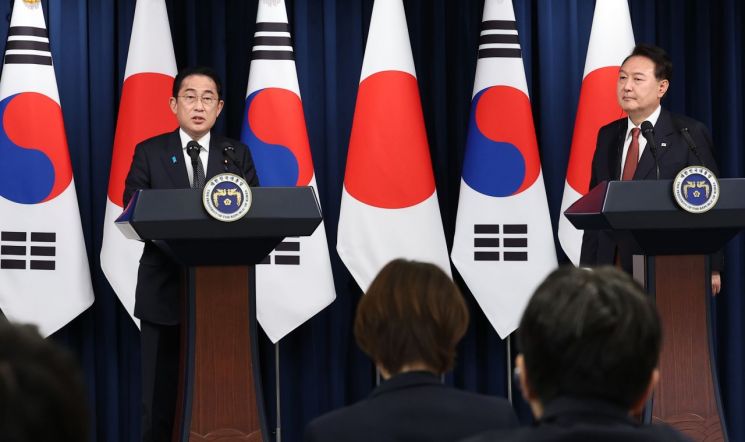
An official from the Presidential Office said, "It is presumed that Prime Minister Kishida voluntarily expressed his own perception and prepared remarks when he came to Korea," and noted, "There was an inheritance of historical awareness and mention of a solution for forced labor victims." The official added, "Going forward, in order for Korea-Japan relations to move toward the future, it is meaningful to reflect on the past, engage in self-reflection if necessary, and to propose joint visits to Hiroshima as a promise for the future."
Choi Eun-mi, a research fellow at the Asan Institute for Policy Studies, said, "The lack of an official apology from the Japanese prime minister falls short of our expectations," but also noted, "It is commendable that the expression was sincere and heartfelt, and that this schedule marked the first step toward restoring shuttle diplomacy."
Evaluations from ruling and opposition parties sharply diverged. Yoo Sang-beom, chief spokesperson for the People Power Party, said, "Prime Minister Kishida clearly stated that the stance of inheriting the historical awareness of regional cabinets will remain unwavering," adding, "Now, through shuttle diplomacy that is on track, we can resolve difficult issues one by one through sincere dialogue and communication." Jang Ye-chan, the party’s youth supreme council member, evaluated, "There were significant achievements such as Prime Minister Kishida’s apology to forced labor victims and the Korean inspection team’s visit to the Fukushima contaminated water site."
On the other hand, Kang Sun-woo, spokesperson for the Democratic Party, criticized, "There was no reflection or apology from Prime Minister Kishida. There was also no acknowledgment of coercion," adding, "Regarding the forced labor issue, Kishida vaguely said, 'I feel deeply pained that many people had difficult and sorrowful experiences working under difficult circumstances at that time.' He was quick to downplay even this by saying it was just his personal opinion."
© The Asia Business Daily(www.asiae.co.kr). All rights reserved.
![Clutching a Stolen Dior Bag, Saying "I Hate Being Poor but Real"... The Grotesque Con of a "Human Knockoff" [Slate]](https://cwcontent.asiae.co.kr/asiaresize/183/2026021902243444107_1771435474.jpg)


















