Ahead of the Third Flight on the 24th
First 'Real-World' Mission Carrying Practical Satellite Worth Hundreds of Billions
Success Needed to Prove Performance, Stability, and Reliability
On the 24th, Korea's independently developed space launch vehicle, Nuriho, will undergo its third launch. Unlike the first test launch in October 2021 and the second in June 2022, this launch will verify the performance, reliability, and stability of the vehicle as a full-fledged space launch vehicle. Since most space launch vehicles show an initial failure rate of around 30%, Nuriho, which demonstrated successful flights in the first and second launches, is now facing its biggest challenge. Notably, it will perform its first operational mission by deploying one practical small satellite, developed with hundreds of billions of won in development costs, and seven public and private CubeSats into orbit. Failure would mean a huge budget wasted. Let us examine the significance of this launch.
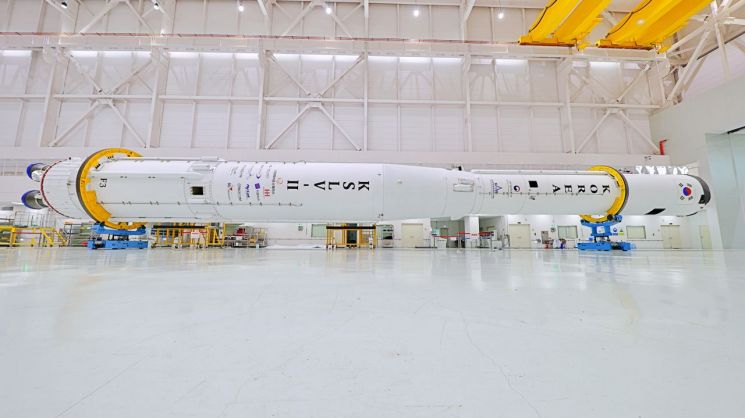 On the 3rd, the Nuri rocket's 1st and 2nd stages were stored combined in the total assembly building of the launch vehicle at Naro Space Center in Goheung, Jeonnam. Photo by KARI
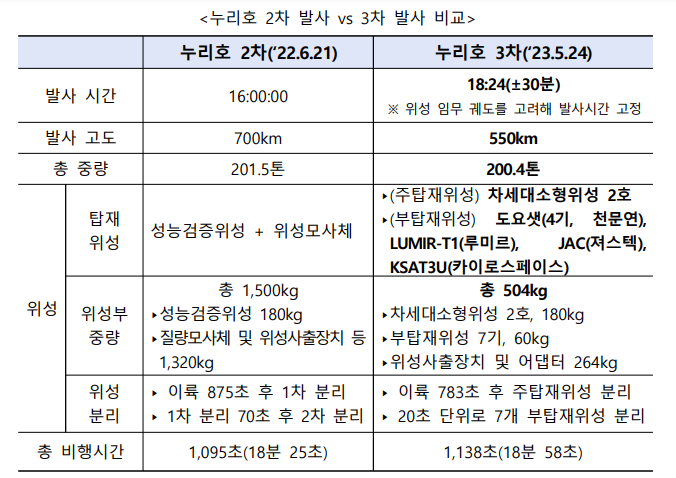
The third Nuriho launch holds great significance as Korea's first actual mission deployment of its independently developed space launch vehicle. During the first launch, a 1.5-ton dummy satellite (mock-up) was carried to verify thrust, i.e., cargo transport capability itself. The second launch successfully placed a satellite mock-up, a performance verification satellite, and four CubeSats into orbit. Although it was Korea's first successful satellite launch using an independently developed space launch vehicle, it was primarily a performance test.
This time is different. The main payload, Next-Generation Small Satellite No. 2, is a state-of-the-art practical satellite equipped with a synthetic aperture radar (SAR) developed by KAIST Satellite Technology Research Center at a cost of 24 billion won. Using an X-band SAR with 5m resolution and 40km observation width, it can observe the ground day and night and in adverse weather. It also carries near-Earth orbit space radiation observation equipment to monitor solar activity. To verify core space technologies, it is equipped with ▲ thermal control devices using phase change materials ▲ X-band GaN-based power amplifiers ▲ combined navigation receivers for the US Global Positioning System (GPS) and Europe's Galileo ▲ solar array panels. Specifically, it will perform missions such as space verification of SAR hardware localization technology, Arctic sea ice change detection, forest ecosystem change measurement, and observation of marine environmental pollution and coastal conditions.
The SNIPE satellite, developed by the Korea Astronomy and Space Science Institute (KASI) with an investment of about 10 billion won, operates in a formation of four satellites and carries out near-Earth space weather observation missions. It is equipped with instruments such as a particle detector (SST), Langmuir probe (LP), and magnetometer (MAG). Initially, it was planned to be launched using a Russian launch vehicle, and 65% of the launch cost was already paid. However, the Russia-Ukraine war in February last year caused delays, and it secured a launch slot on the third Nuriho launch. Additionally, three CubeSats are included: 'Lumir-T1,' developed by private company Lumir for demonstrating space radiation measurement technology; 'JAC,' a 4m resolution Earth observation optical satellite by Justec; and 'KSAT3U' by Kairospace, designed for weather observation through ground surface polarization identification and demonstration of space debris mitigation technology.
To respond to the NewSpace era, where the private sector leads space development, Korea has actively involved private companies in the third launch process. Hanwha Aerospace was selected in October last year as the system integrator for the Korean launch vehicle advancement project covering launches 3 to 6, taking on roles such as overall production management and joint launch operation. Hanwha Aerospace, which led the development of the 75-ton class engine for Nuriho, naturally acquires all know-how and technology related to space launch vehicle manufacturing, operation, and launch through this process. From the fourth launch onward, its role will expand further, and after the sixth launch, it plans to lead almost the entire Korean launch vehicle launch process, except for some core missions.
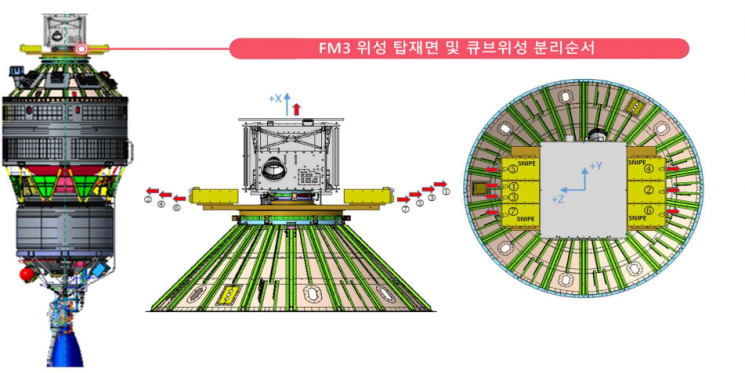 Internal view of the third stage of the Nuriho 3rd launch vehicle and the sequence of satellite separation. Image source: Provided by KARI
While the first and second launches took place at 4 p.m., the third launch is scheduled for around 6:24 p.m. (±30 minutes), near sunset. If it fails on the day, another opportunity will be sought between the 25th and 31st. The reason for the evening launch time is due to the payload satellites. The time was chosen so that the satellites onboard the launch vehicle can reach their target orbits, safely stabilize, deploy their solar panels, and generate power efficiently.
Some have questioned whether frequent repeated launches are a waste of budget. The Korea Aerospace Research Institute (KARI) explains that this is necessary to optimize, stabilize, and improve reliability. Noh Hyung-il, head of KARI's public relations office, stated, "Even advanced spacefaring countries conduct repeated launches after the first successful launch to enhance performance and reliability before operational deployment," adding, "With system integrators overseeing launch vehicle production, the domestic industrial ecosystem’s technological level can also improve."
© The Asia Business Daily(www.asiae.co.kr). All rights reserved.
![Clutching a Stolen Dior Bag, Saying "I Hate Being Poor but Real"... The Grotesque Con of a "Human Knockoff" [Slate]](https://cwcontent.asiae.co.kr/asiaresize/183/2026021902243444107_1771435474.jpg)

















