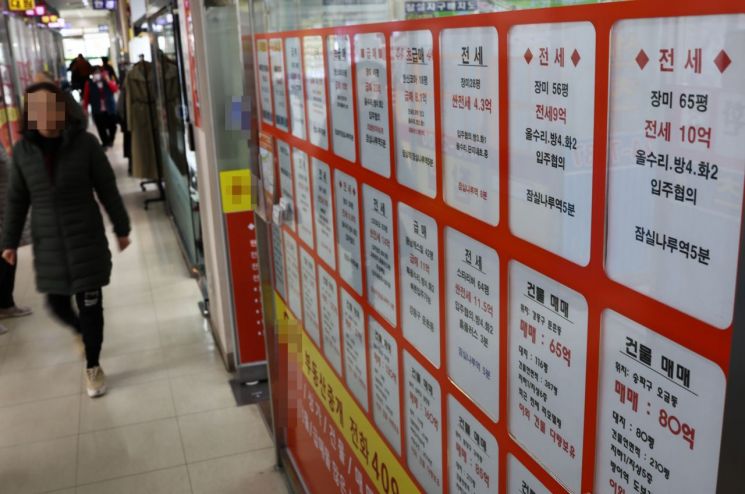
The balance of jeonse deposit loans at commercial banks continues to decline. This is due to the ongoing impact of the real estate market slump and the frequent jeonse fraud cases occurring nationwide.
According to the financial sector on the 7th, the balance of jeonse deposit loans at the five major commercial banks (KB Kookmin, Shinhan, Hana, Woori, NH Nonghyup) stood at 124.8792 trillion won as of last month. This represents a decrease of 1.7346 trillion won compared to the previous month.
The decline in the balance of jeonse deposit loans is clear. Based on the five major banks, it peaked at about 134.2 trillion won around September last year and has continued to fall, decreasing by more than 10 trillion won in half a year.
The primary reason for the reduction in jeonse loan volume is the sharp rise in interest rates. Due to the rapid increase in the base interest rate last year, borrowers’ interest burdens grew, leading many to shift from jeonse to monthly rent. In fact, the proportion of monthly rent transactions in the housing rental market last year reportedly reached around 50%.
Concerns about reverse jeonse or “empty jeonse” due to the aftermath of the gap investment craze also discourage taking out jeonse loans. According to the Court Registry Information Plaza, the number of applications for tenant registration orders nationwide in the first quarter of this year (January to March) surged by about 340% year-on-year to 8,294 cases.
Tenant registration is a system designed to protect tenants who have not received their jeonse deposit back from landlords even after the jeonse period has expired. The increase in tenant registrations indicates a rise in disputes related to non-return of jeonse deposits.
Especially, recent jeonse fraud cases erupting across the country further fuel this avoidance sentiment. A financial sector official said, “In a low-interest rate phase and during rising house prices, jeonse can be a win-win for both tenants and landlords, but the situation is different otherwise,” adding, “From the tenant’s perspective, it may be more advantageous to choose monthly rent despite rising prices rather than bearing both interest and risk.”
The outlook for the jeonse market is not very bright. Although the rapid sale of urgent properties has been exhausted and interest rates have stabilized, slowing the decline in jeonse prices, the large volume of new housing supply, high interest rates, and concerns about reverse jeonse remain.
In a recent report, KB Financial Group Management Research Institute stated, “Considering the new housing supply waiting mainly in the metropolitan area and some parts of Seoul, and the still high interest rate level, the contraction of the jeonse market may continue for the time being,” and added, “Large-scale new housing supply is expected in the Gangnam area and some parts of Incheon, so concerns about reverse jeonse may persist mainly in those areas.”
© The Asia Business Daily(www.asiae.co.kr). All rights reserved.
![Clutching a Stolen Dior Bag, Saying "I Hate Being Poor but Real"... The Grotesque Con of a "Human Knockoff" [Slate]](https://cwcontent.asiae.co.kr/asiaresize/183/2026021902243444107_1771435474.jpg)















