274 Million People Set Out on Travels
Chinese Media "Showing Economic Potential"
During the five-day Labor Day holiday (April 29 to May 3), travelers within China spent 148.056 billion yuan (approximately 28.54 trillion KRW) on tourism. Chinese media praised the consumption activity, which has fully recovered to pre-COVID-19 levels, as demonstrating "economic potential."
According to local media including the state-run Xinhua News Agency on the 3rd, the Ministry of Culture and Tourism released final figures showing that tourism revenue during the five-day Labor Day holiday reached 145.6 billion yuan. This represents a 128.9% increase compared to last year and slightly (0.66%) exceeds the scale of 2019 before the COVID-19 outbreak. The number of travelers was counted at 274 million (person-times). Compared to last year, this is a 70.83% increase, and compared to 2019, a 19.09% increase.
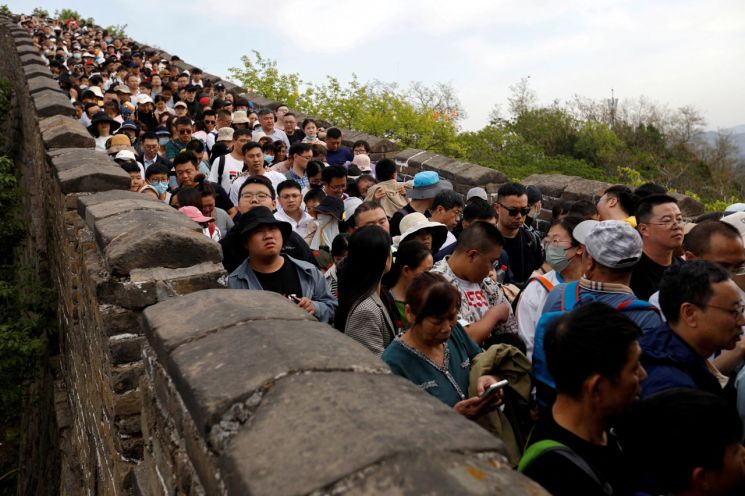
This holiday was the first five-day or longer holiday since China transitioned to a with-COVID-19 policy. Local governments and the tourism industry in China made every effort to stimulate the economy by reducing or waiving entrance fees to tourist attractions and road tolls, as well as issuing consumption coupons.
According to Chinese travel booking site Qunar, flights from Beijing to Shanghai sold out in 38 seconds after opening, Chengdu to Xi'an tickets sold out in 41 seconds, and Shanghai to Wuhan tickets sold out in 46 seconds. Following the announcement of various records, expressions such as "the hottest Labor Day ever" emerged among Chinese people.
Chinese media emphasized the sharply rebounded consumption scale and traveler numbers, self-assessing them as "indicators showing China's potential." The state-run Global Times (GT) reported, "The massive consumption boom shows China's tremendous economic growth potential," adding that it "serves as a barometer of the economy." Furthermore, it explained, "This will be reflected not only in various economic data but also in people's intuitive consumer sentiment."
However, there were also voices of self-reflection regarding disorder and price gouging observed at some major scenic spots and popular tourist destinations. GT emphasized, "During the Labor Day holiday test, some places experienced price gouging and contract violations," adding, "On the other hand, it reminds us of the need to regulate tourism chaos."
China is expected to lead economic growth in the Asia-Pacific region this year, supported by the transition to a with-COVID-19 policy, the base effect from last year's sluggish economic trend, and the government's decisive policy support. The International Monetary Fund (IMF) also forecasted in a recent report that the Asia-Pacific region will account for 70% of global economic growth this year, with China and India playing key roles in driving regional growth.
© The Asia Business Daily(www.asiae.co.kr). All rights reserved.
![Clutching a Stolen Dior Bag, Saying "I Hate Being Poor but Real"... The Grotesque Con of a "Human Knockoff" [Slate]](https://cwcontent.asiae.co.kr/asiaresize/183/2026021902243444107_1771435474.jpg)















