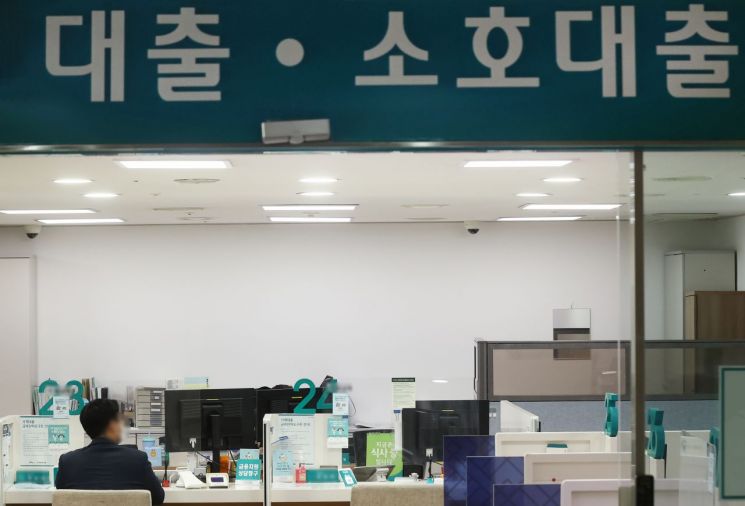
The corporate delinquency rate in the secondary financial sector has soared to its highest level in about seven years, and the overall bank delinquency rate has also reached its highest point in two and a half years.
According to the 'Corporate Loan Status' data submitted by the Bank of Korea on the 1st to Yang Kyung-sook, a member of the National Assembly's Planning and Finance Committee from the Democratic Party of Korea, as of the end of the fourth quarter last year, the total corporate loan balance in the domestic financial sector (banks + non-bank financial institutions) reached 1,874 trillion won. Banks accounted for 1,221.6 trillion won, and non-banks 652.4 trillion won.
This is not only the largest scale ever but also a 48.3% increase over three years compared to the fourth quarter of 2019 (1,263.5 trillion won), just before COVID-19. In particular, corporate loans in the secondary financial sector increased by 82.6%, from 357.2 trillion won to 652.4 trillion won during the same period.
The number of corporate loan borrowers in the banking sector also swelled to a record high of 3.5 million as of the fourth quarter last year, a sharp increase of 52.2% from 2.3 million three years ago.
The delinquency rate of corporate loans is also rising, centered on the secondary financial sector (savings banks, mutual finance, insurance companies, and specialized credit finance companies). The delinquency rate of corporate loans at non-bank financial institutions (based on principal and interest overdue by one month or more) was 2.24% as of the fourth quarter last year. This is a 0.43 percentage point increase from the previous quarter (1.81%) and the highest level in six years and nine months since the first quarter of 2016 (2.44%).
By sector, the delinquency rates are 2.83% for savings banks, 3.30% for mutual finance, 0.15% for insurance companies, and 1.01% for specialized credit finance companies (cards, capital, etc.). In particular, mutual finance's delinquency rate exceeded 3% in the fourth quarter last year for the first time since the first quarter of 2020 (3.19%). The delinquency rate of specialized credit finance companies is also at its highest level since the third quarter of 2019 (1.16%).
The bank delinquency rate also recorded its highest level in two and a half years. According to the Financial Supervisory Service, the delinquency rate on won-denominated loans at domestic banks at the end of February this year was 0.36%, up 0.05 percentage points in one month. This is the highest level since August 2020 (0.38%).
The savings bank industry is also raising concerns about soundness as the ratio of non-performing loans (NPLs) exceeds 5%. NPLs are bad debts with overdue periods of three months or more. According to the Korea Federation of Savings Banks, the NPL ratio of the savings bank industry was 5.1% at the end of the first quarter this year. This is about 1.1 percentage points higher than the end of last year (4.04%).
© The Asia Business Daily(www.asiae.co.kr). All rights reserved.
![Clutching a Stolen Dior Bag, Saying "I Hate Being Poor but Real"... The Grotesque Con of a "Human Knockoff" [Slate]](https://cwcontent.asiae.co.kr/asiaresize/183/2026021902243444107_1771435474.jpg)















