Introduction to Divergent Domestic and International Evaluations of the Korea-US Summit Meeting
President Yoon Suk-yeol returned home after a 5-night, 7-day state visit to the United States, where he was warmly received by President Joe Biden, but the American daily The New York Times (NYT) predicted that he would face a different atmosphere in South Korea.
On the 29th (local time), the NYT introduced various reactions from North Korea and diplomatic experts in South Korea regarding President Yoon's visit to the U.S., stating, "Yoon's foreign policy, which is more closely aligned with the U.S. and Japan, has polarized his country." In particular, the media reported contrasting evaluations of the "Washington Declaration," which the Yoon administration considers the greatest achievement of this visit.
The Washington Declaration centers on the establishment of a "Nuclear Consultative Group (NCG)" between South Korea and the U.S. to share and discuss the U.S.'s extended deterrence plans, regularly deploying U.S. strategic assets such as strategic nuclear submarines (SSBNs) on the Korean Peninsula, while South Korea commits not to develop its own nuclear weapons.
Jeon Seong-hoon, former president of the Korea Institute for National Unification, told the NYT, "History will remember the Yoon Suk-yeol administration as the first South Korean government to recognize North Korea's nuclear threat as urgent and to prepare countermeasures."
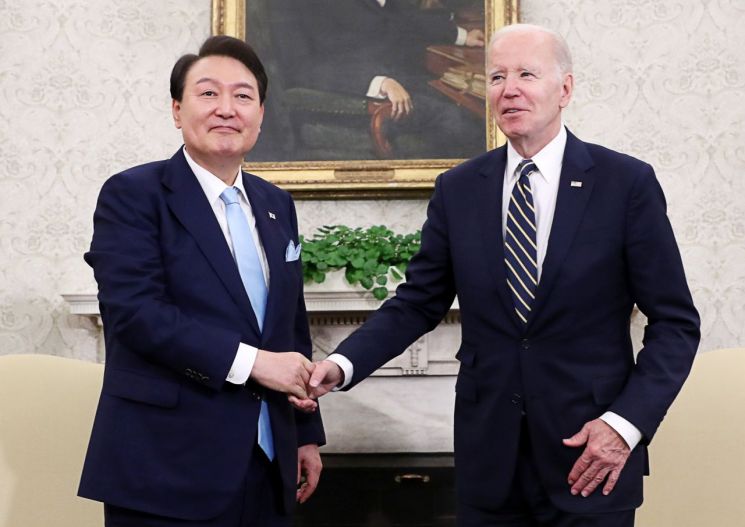 President Yoon Suk-yeol, who is on a state visit to the United States, and U.S. President Joe Biden are shaking hands during a small-scale summit meeting between South Korea and the United States held on the 26th (local time) at the Oval Office of the White House in Washington, DC.
 [Image source=Yonhap News]
Kim Doo-yeon, a researcher at the U.S. Center for a New American Security (CNAS), also gave a positive assessment, saying, "South Korea was able to discuss nuclear deterrence, which it had not been able to discuss with Washington before, for the first time. The Washington Declaration is a big victory for South Korea."
However, the NYT also reported that public opinion claiming the Yoon administration has "penny wise, pound foolish" is not insignificant. Kim Dong-yeop, a professor at the University of North Korean Studies, pointed out, "The Washington Declaration may seem substantial and fantastic, but in reality, it is an empty shell," adding, "There is no change in U.S. policy."
The NYT noted concerns that the deployment of U.S. strategic nuclear submarines on the Korean Peninsula under the Washington Declaration could further escalate tensions in Northeast Asia and provide North Korea with another justification for expanding its nuclear arsenal. Citing experts, the media reported, "There is also a view that sees the Washington Declaration not as 'extended deterrence' but as an 'expansion of crisis.'"
Quoting a public opinion poll conducted in South Korea last year, the NYT reported that 49% of respondents believed the U.S. would not exercise nuclear deterrence in the event of a contingency on the Korean Peninsula. It also introduced the diagnosis of Professor Lee Byung-chul of the Kyungnam University Institute for Far Eastern Studies, who said, "In such a strongly skeptical public opinion environment, the U.S.'s extended deterrence promises will be regarded as 'mere rhetoric.'"
Above all, the NYT pointed out that the achievements of the Washington Declaration are inevitably perceived as insufficient by South Korea's younger generation, who are struggling with job losses. Despite concerns over disadvantages to Korean companies due to the U.S. Inflation Reduction Act (IRA) and the CHIPS and Science Act in recent months, the joint statement from the Korea-U.S. summit only agreed to "continue close consultations," which the NYT criticized.
Regarding this, Professor John Dillery of Yonsei University said, "Korean youth may not know the lyrics of 'American Pie' (which President Yoon sang), but they know the Inflation Reduction Act."
© The Asia Business Daily(www.asiae.co.kr). All rights reserved.
![Clutching a Stolen Dior Bag, Saying "I Hate Being Poor but Real"... The Grotesque Con of a "Human Knockoff" [Slate]](https://cwcontent.asiae.co.kr/asiaresize/183/2026021902243444107_1771435474.jpg)















