POSCO-Icheon City-Korea Ceramic Technology Institute
Establish MOU for Circular Economy Model of Ceramic Materials
POSCO Group will support the revitalization of the ceramic and craft industries by utilizing by-products generated during steel and lithium production processes.
On the 27th, POSCO signed a business agreement with the Korea Ceramic Technology Institute in Icheon, Gyeonggi Province, to establish a cooperative system for supplying materials in the ceramic field. POSCO Group will supply steelmaking by-products such as water-quenched slag generated during molten iron production in blast furnaces, iron oxide produced during the hot-rolled coil pickling process, and lithium residue generated after lithium extraction from lithium ore to the Korea Ceramic Technology Institute for joint research and development to use them as ceramic materials. Icheon City plans to support the use of the developed materials by local potters and factories producing ceramic materials within the city.
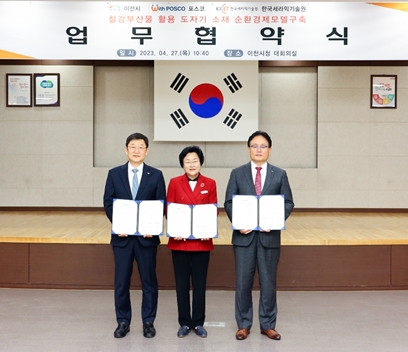 POSCO, Icheon City, and the Korea Ceramic Technology Institute signed a business agreement on the 27th at Icheon City Hall to establish a circular economy model for ceramic materials using by-products. (From left) Jeong Yeon-gil, Director of the Korea Ceramic Technology Institute; Kim Kyung-hee, Mayor of Icheon; Ban Don-ho, Head of Hot Rolled Wire Marketing at POSCO Steel Division. Photo by POSCO Group
Water-quenched slag can replace limestone, which is added to clay to enhance the durability of ceramics, and is expected to contribute to improving the profitability of ceramic companies. Iron oxide is used as a coloring pigment that can realize various colors of ceramics. Lithium residue will be supplied by POSCO Group’s lithium production subsidiary, POSCO Philbar Lithium Solution, and is expected to help resolve material supply shortages faced by ceramic manufacturers struggling with plant operations due to resource nationalization measures recently implemented by major lithium mineral-holding countries. Lithium is an essential material for enhancing the heat resistance of ceramics.
At the event, potter Kim Jin-hyun of Simcheon-yo in Icheon unveiled ceramics produced as a pilot using clay containing POSCO’s steel by-products. The ceramics contained 10% POSCO water-quenched slag and used iron oxide as a pigment, demonstrating the potential to utilize steel by-products in ceramic production. Going forward, POSCO, the Korea Ceramic Technology Institute, and Icheon City plan to collaborate with Icheon potters and ceramic manufacturers to launch a ceramic brand utilizing by-products.
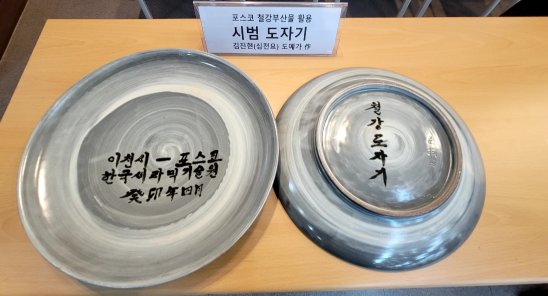 Ceramics artist Kim Jin-hyun from Icheon Simcheonyo produced a pilot batch of ceramics using steel by-products from POSCO.
 [Photo by POSCO Group]
Ban Don-ho, Head of POSCO’s Hot-Rolled Marketing Office, said, “We plan to support the continuous growth of the domestic ceramic field by supplying ceramic materials using various by-products generated by POSCO, as well as holding exhibitions and supporting sales of ceramics applied with these by-products.”
POSCO is promoting the development of eco-friendly, low-carbon, high value-added materials for agriculture, construction, and mining by utilizing steel by-products. Starting with this agreement, POSCO plans to continuously expand ESG management and carbon neutrality activities by applying by-products to various ceramic products, including ceramics, and establishing a circular economy model.
© The Asia Business Daily(www.asiae.co.kr). All rights reserved.
![Clutching a Stolen Dior Bag, Saying "I Hate Being Poor but Real"... The Grotesque Con of a "Human Knockoff" [Slate]](https://cwcontent.asiae.co.kr/asiaresize/183/2026021902243444107_1771435474.jpg)
















