As the bio and health industry continues to grow, establishing itself as the next-generation national key industry, the number of doctors starting businesses based on the technical expertise they have accumulated in actual medical settings is increasing. However, many face hardships after launching their startups. Consequently, some advise that "medical school professors should avoid starting businesses," yet the number of those bravely taking on the challenge continues to rise steadily.
At the '1st Korea University Medical Center Startup Research Meeting' held on the 27th at Korea University Guro Hospital in Seoul, a session was organized to emphasize the importance of doctor-led startups and discuss strategies necessary for actual success.
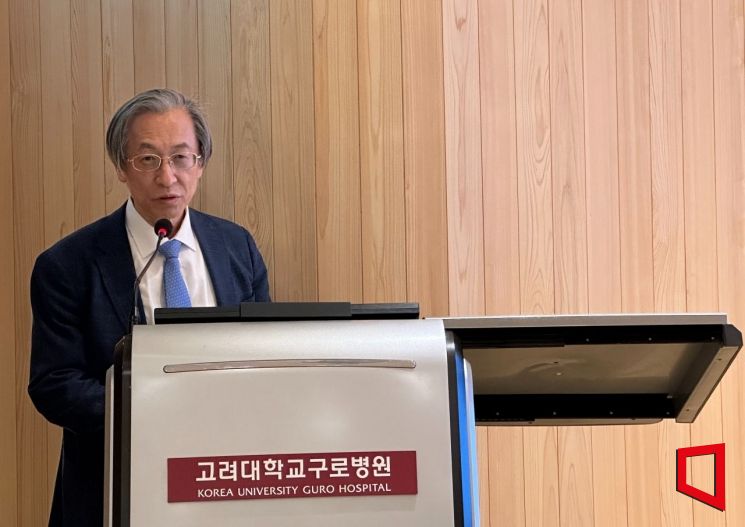 On the 27th, Song Haeryong, Chairman of the Korean Medical Startup Research Association, is giving a lecture at the '1st Korea University Medical Center Startup Research Meeting' held at Korea University Guro Hospital in Seoul.
 [Photo by Lee Chunhee]
In the keynote speech, Song Haeryong, President of the Korea Doctor Startup Association and Medical Director of Bucheon New Daeseong Hospital, stressed the importance of doctor entrepreneurship by stating, "Doctor entrepreneurs developed COVID-19 vaccines, and overseas, there are cases where doctors have bought media companies with the money earned from startups." Notably, Ugur Sahin and Ozlem Tureci, who co-founded BioNTech in 2008 and jointly developed Pfizer's 'Comirnaty,' are exemplary physician-scientists. Patrick Soon-Shiong, a surgeon turned biotech entrepreneur, made headlines by acquiring the LA Times, one of the top six daily newspapers in the U.S., in 2018.
He also emphasized the need for hospital-level support and government efforts to activate physician-scientist entrepreneurship. Song stated, "Overseas, hospitals jointly establish investment companies or create their own accelerators. We need to follow suit."
Yoon Honggeun, CEO of Dasol Ventures, highlighted the importance of securing technological capabilities and devising strategies to effectively showcase them during a lecture on the KOSDAQ technology special listing system, which many biotech companies recently adopt as their listing strategy. Yoon explained, "The main question during the listing stage is 'Where can you sell your product?'. The technology special listing means that financial scale is not considered, but everything else is the same as a general listing, so one should not harbor illusions." He added that securing technology with competitive advantages and high success potential, along with meticulous strategies to expand market size, is essential for successful listing. He also advised, "It is necessary to set the direction of the listing well and assess the company's stage. It is also good to undergo a preliminary technology evaluation before the official technology assessment," emphasizing that rigorous objectivity must accompany the listing process.
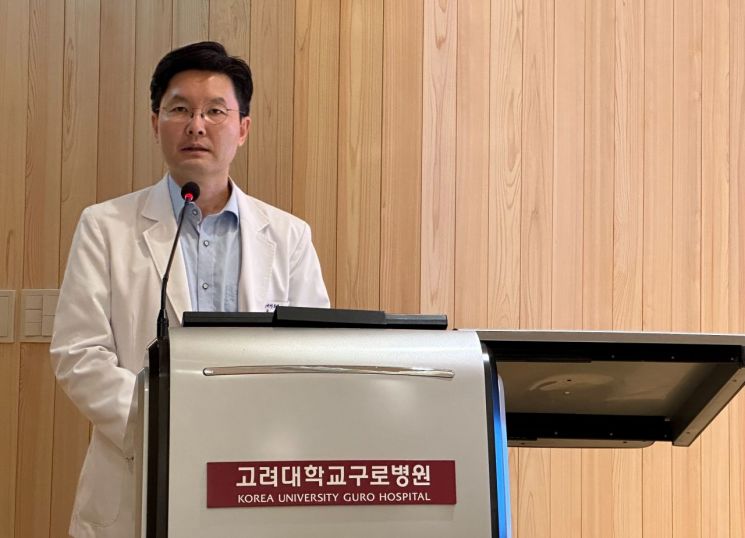 On the 27th, Song Jae-jun, CEO of NewLive, is giving a lecture at the '1st Korea University Medical Center Startup Research Society' held at Korea University Guro Hospital in Seoul.
 [Photo by Lee Chun-hee]
Following this, there was a presentation of cases where startups were launched based on solid technological capabilities. Song Jaejun, CEO of NewLive and an otolaryngology professor at Korea University Guro Hospital, is developing the electronic medicine 'Soricle,' which non-invasively stimulates the vagus nerve targeting degenerative brain diseases such as tinnitus, along with the wellness device 'HealOn' and the digital therapeutic device (DTx) 'Soriclear.' All are either partially commercialized or undergoing clinical trials, indicating that development is on track.
Soricle is currently in clinical trials with plans to seek product approval within the year. Song explained, "Research has shown that it has superior brain stimulation effects compared to other direct stimulation medical devices. As a non-invasive wearable device, patients can receive treatment at their preferred time and place." Similarly, HealOn, a wellness device that stimulates the vagus nerve to activate the parasympathetic nervous system, reducing stress and enhancing concentration, is being sold through business-to-government (B2G) transactions. The DTx Soriclear has completed development and submitted an Investigational New Drug (IND) application to the Ministry of Food and Drug Safety. As it digitalizes cognitive behavioral therapy (CBT) for tinnitus, it enables customized sound therapy and is currently used as an adjunct to CBT sound therapy, generating sales.
Professor Song emphasized, "A different mindset is needed for entrepreneurship." He advised, "Starting a business is not a solo endeavor; it involves networking with people from various unrelated fields. Additionally, one must immerse themselves in new areas at every moment, requiring a wide range of capabilities."
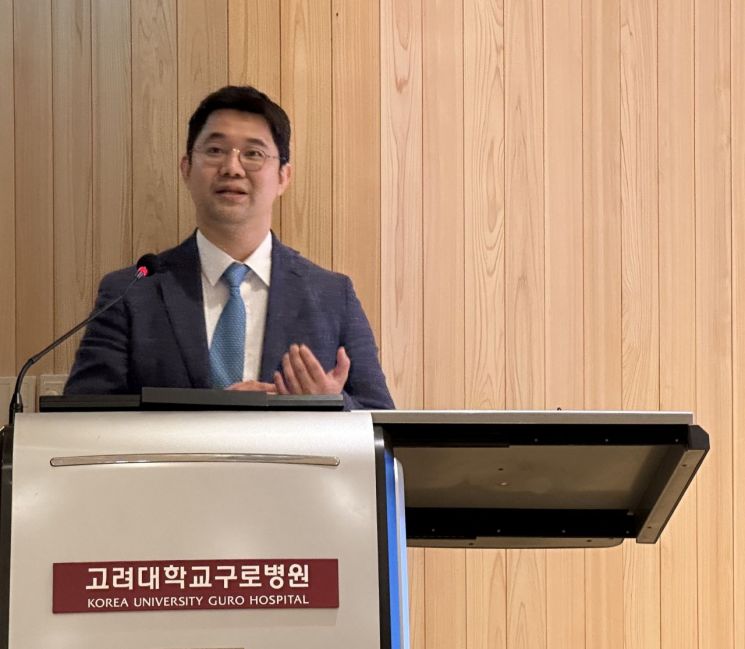 On the 27th, Shin Jae-yong, CEO of Evertly, is giving a lecture at the '1st Korea University Medical Center Startup Research Society' held at Korea University Guro Hospital in Seoul.
 [Photo by Lee Chun-hee]
Finally, Shin Jaeyong, CEO of Evertry and a professor of preventive medicine at Yonsei University College of Medicine, noted that with the government’s recent active support for new medical technologies such as Software as a Medical Device (SaMD), various institutional changes are occurring, which should be closely observed.
As a representative example, Professor Shin cited the 'Integrated Review and Evaluation System for Innovative Medical Devices.' Previously, reviews and evaluations related to innovative medical devices were conducted separately by the Ministry of Food and Drug Safety, the Health Insurance Review and Assessment Service, and the National Evidence-based Healthcare Collaborating Agency (NECA). This system integrates these processes, significantly reducing the time required for product launch. Since December last year, insomnia treatment DTx by AimMed and Welt, and brain imaging detection and diagnostic software by JLK have been the first beneficiaries of this system. A total of six products have been designated as innovative medical devices through this integrated review and evaluation system. Shin emphasized, "What matters more than the duration is the change in the evaluation system. Previously, if something was deemed insufficient during the review, the product was rejected. Now, the biggest advantage of this system is that integrated review is granted first, and conditional results are requested to be resubmitted."
Professor Shin advised that for successful doctor entrepreneurship, one must remember that healthcare is a regulated industry and proceed cautiously. He stressed, "General consumers are reluctant to spend large amounts on health management. It is essential to clearly target whether you are managing patients or their lifestyles and to firmly establish demonstration projects under various government supports to succeed in entrepreneurship."
© The Asia Business Daily(www.asiae.co.kr). All rights reserved.
![Clutching a Stolen Dior Bag, Saying "I Hate Being Poor but Real"... The Grotesque Con of a "Human Knockoff" [Slate]](https://cwcontent.asiae.co.kr/asiaresize/183/2026021902243444107_1771435474.jpg)


















