US Largest Diplomatic Event 'State Banquet'
Controversy Over Hidden Meanings
"Showcase Presenting US Ingredients"
State dinners in the United States are always a hot topic for visiting countries. The menu for the state dinner attended by President Yoon Suk-yeol and First Lady Kim Keon-hee alongside U.S. President Joe Biden and the First Lady also became a subject of discussion on social media (SNS) and online communities.
Some claimed that the 'crab cake' enjoyed by former President Moon Jae-in during his luncheon with President Biden in 2021 was served again at this dinner, suggesting it might carry a kind of political implication. So, do state dinners and luncheons actually contain highly political messages? How do Americans view the 'White House dinner'?
Is the Crab Cake a "Crab" (Nonsense)? What Is the Truth?
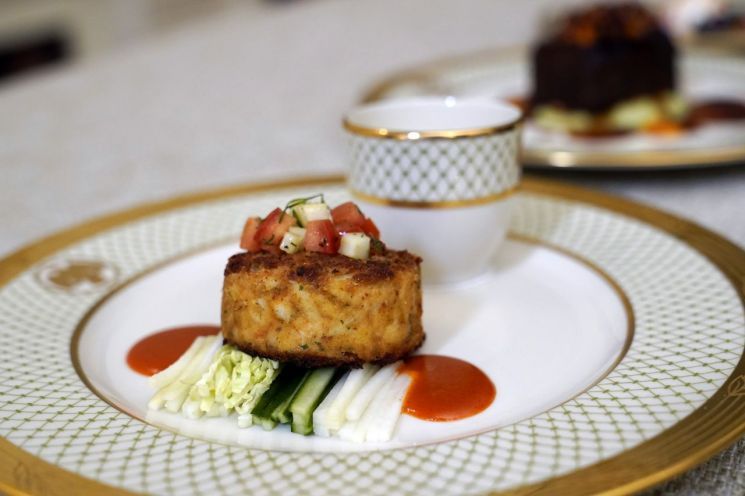 On the 24th (local time), Maryland crab cakes, the dinner menu, were displayed at the White House in Washington DC, USA. [Image source=Yonhap News]
On the evening of the 26th (local time), the White House state dinner is scheduled to feature crab cake, braised short ribs, and for dessert, ice cream and banana split. The White House had previously described the dinner menu as a "harmonious blend of Korean and American cultures."
Reactions among netizens were divided over the dinner menu. In particular, some pointed out that the food former President Moon ate during the 2021 Korea-U.S. summit luncheon with President Biden was also crab cake.
Crab cake is a popular dish made by mixing cooked crab meat with mayonnaise and other ingredients, then frying it. At that time, some YouTubers argued that the U.S. served a dish that was beneath the dignity of the Korean president. Because the word "crab" can also mean "nonsense," the so-called "Korea snub theory" emerged.
The controversy over dinners and luncheons is not unique to Korea. Before former President Moon’s 2021 luncheon, there was also a luncheon for former Japanese Prime Minister Yoshihide Suga. The menu then was hamburgers, which sparked claims of a "Japan snub theory" within Japan.
"America's Greatest Showcase" State Dinners Added Pride in Difficult Times
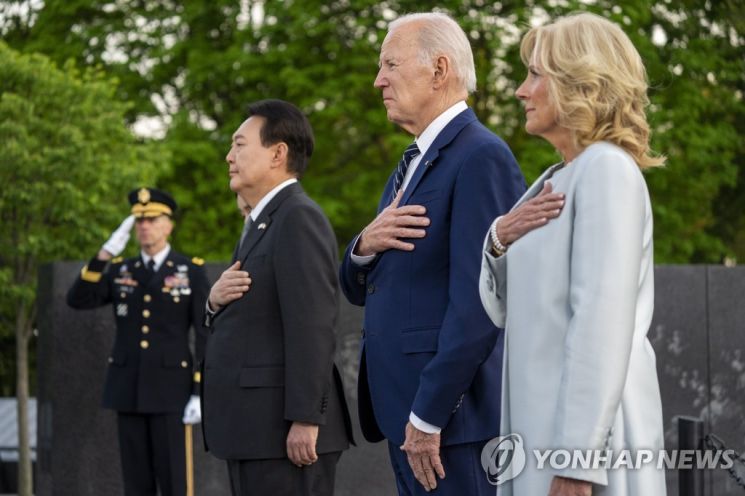 President Yoon Suk-yeol, U.S. President Joe Biden, and First Lady Jill Biden attended a wreath-laying ceremony at the Korean War Veterans Memorial in Washington, D.C., on the 25th (local time).
 [Image source=Yonhap News]
So, do state dinners and luncheons actually carry highly sophisticated messages intended to distinguish the rank of visiting heads of state or government? On February 7, veteran American journalist Alex Prud’homme published a book titled Dinner with the President, which comprehensively covers the history of White House dinners. The book details how the state dinner, the White House’s most significant diplomatic event, has evolved over time.
According to Prud’homme, state dinners are events that the White House regards as very important. They serve to strengthen national relations and celebrate everyone involved in the event.
However, this importance differs somewhat from what the general public might think. Prud’homme emphasizes that state dinners are important because they reflect "American food culture, history, and traditions."
In fact, White House dinners were first made public in the 1960s. During the Lyndon B. Johnson administration, the U.S. was exhausted by the Vietnam War, the Cold War, and racial conflicts. President Johnson decided to fully open diplomatic events to the public as a way to ease political crises.
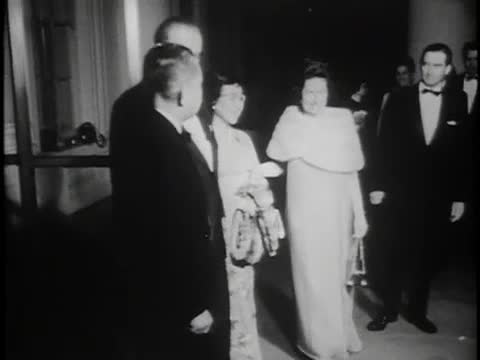 A scene from the documentary "White House Red Carpet." Opening the state dinner to the public increased pride in American food culture and ingredients. [Image source=American Public Broadcasting Archive]
During a state visit by Japan in 1967, a small broadcast team spent three days inside the White House filming the event. They focused especially on capturing the dinner made with the finest American ingredients and the guests’ impressed reactions. This footage was later released as a documentary titled White House Red Carpet.
The audience’s response to the documentary was enthusiastic. Since then, American politicians have focused on attracting public interest by humanizing diplomatic events. In other words, state dinners are important not because the White House sends hidden messages to other countries, but because they are a "showcase of White House chefs’ skills and the finest American ingredients."
This attitude was also evident at the state dinner with French President Emmanuel Macron and his spouse last December. According to CNN, the White House spokesperson described the criteria for a "successful state dinner" as "organically combining elements of both the U.S. and the visiting country to offer hospitality without appearing overly artificial."
Different Hospitality Traditions by Country Can Lead to Misunderstandings
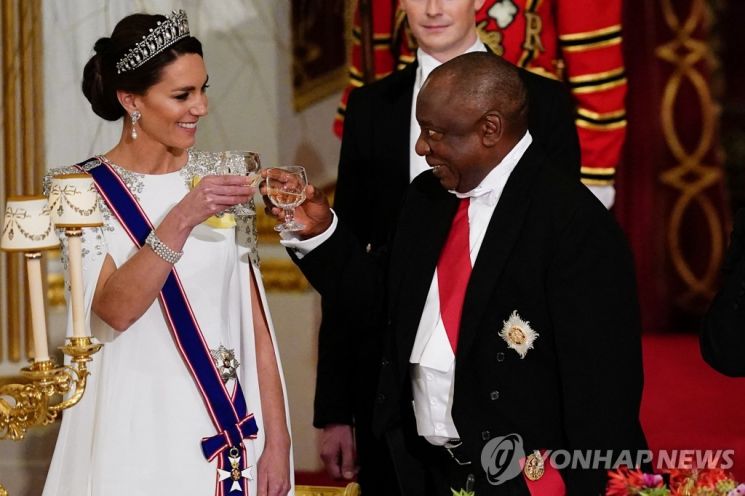 Crown Princess and South African President Toasting at the State Banquet at Buckingham Palace, UK
 Photo by Reuters
However, it is also true that state dinners sometimes cause misunderstandings among the citizens of visiting countries. For example, on November 24 last year, King Charles III, who ascended the British throne following the late Queen Elizabeth II, hosted South African President Ramaphosa and his spouse for his first state dinner.
The dinner featured rare wines from the UK and France, a meat dish made from wild pheasant hunted in the Windsor Castle area?known as the "Royal Forest"?and a premium Portuguese port wine produced in 1983 and aged for about 40 years. Serving wild pheasant with rare wine is a long-standing European hospitality tradition. From the British perspective, this was a way to honor the South African leader, a member of the Commonwealth, with great respect.
However, some South African media expressed dissatisfaction, pointing out that not a single bottle of South African wine, despite the country being one of Africa’s largest wine producers, was served at the table. This incident highlights how vastly different hospitality traditions across continents and cultures can lead to unexpected situations.
© The Asia Business Daily(www.asiae.co.kr). All rights reserved.
![Clutching a Stolen Dior Bag, Saying "I Hate Being Poor but Real"... The Grotesque Con of a "Human Knockoff" [Slate]](https://cwcontent.asiae.co.kr/asiaresize/183/2026021902243444107_1771435474.jpg)

















