Serandos Promises $2.5 Billion Investment After Meeting President Yoon
Currently About $600 Million Annually... Enjoying Significant Benefits
Concerns Over IP Ownership, Exclusive Contracts, and Domestic OTT Weakening
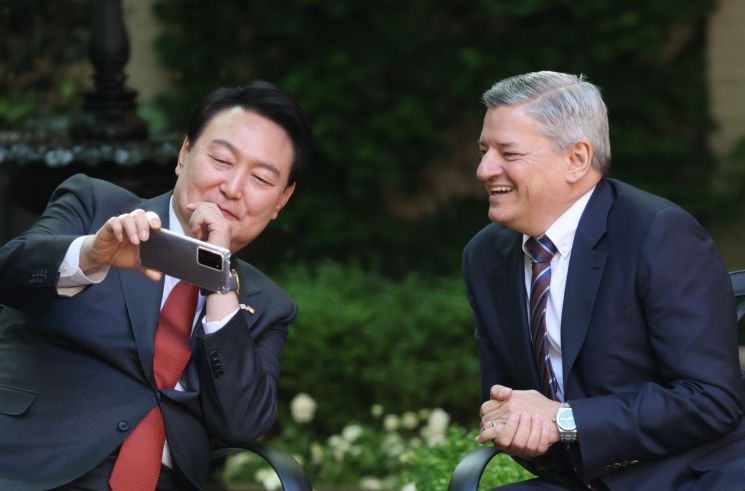
Ted Sarandos, CEO of Netflix, met with President Yoon Suk-yeol on the 24th and pledged to invest $2.5 billion (3.3413 trillion won) in K-content over the next four years. The Ministry of Culture, Sports and Tourism emphasized that this is the largest investment ever attracted in the video content industry. Minister Park Bo-gyun stated, "Netflix's decision is a symbolic outcome of President Yoon's focus on revitalizing the K-content industry," adding, "It will create about 68,000 jobs and serve as a turning point for the content industry favored by the MZ generation to make a leap forward."
The response from the content industry has been lukewarm, as investments of this scale are already underway. Netflix began investing in K-content starting with the 2017 film Okja. The officially disclosed investment amount in 2021 was 500 billion won, during which they produced fifteen original series. Although there have been no official announcements since, the content industry estimates that last year, with twenty-five productions, the investment reached 800 billion won. This year, with twenty-eight productions, the amount is expected to be even higher. This means approximately $600 million (about 799.8 billion won) is invested annually. If this scale continues for four years, the total investment would amount to $2.4 billion.
The reason for the high interest in K-content is its excellent cost-effectiveness. Last year, Netflix began focusing on strengthening its fundamentals, laying off 450 employees and promising wise investments. K-content was largely unaffected. The belt-tightening was a regional choice based on practicality. While North America experienced a wave of subscription cancellations in the second quarter of last year, Asia saw an increase of 1.1 million subscribers. The key incentive was undoubtedly K-content. With production costs about one-tenth of those for American dramas, K-content has extended its influence to Europe and South America.
An industry insider said, "Asia's OTT subscriber ratio has not yet reached maturity. Netflix has identified it as a growth market and will target it," adding, "To secure subscribers in countries like Indonesia and Vietnam, they have no choice but to continue acquiring K-content." The insider further noted, "If investment in K-content decreases, it would signal a rapid contraction of the global OTT market as a whole." Another industry expert said, "I believe overseas capital, especially global OTT investments, will continue to increase," explaining, "K-content has passed the stage of proving its competitiveness in the global market. It has also demonstrated its influence in the Asian market, where OTT subscriber growth is prominent. It is an essential weapon in competitive strategy." They predicted, "With its elevated status, the environment will become more specialized and branded, centered around production companies."

The Ministry of Culture, Sports and Tourism stated, "Despite excellent production capabilities, the domestic video content industry has chronically suffered from a lack of funds due to the high risk of investment and the small scale of operations," expressing hope that "this investment will serve as a catalyst to resolve the financial difficulties of domestic production companies with creative ideas and capabilities." They also anticipated that "the increase in content production demand will lead to expanded production infrastructure and the advancement of production technology."
However, the ministry did not take a particular stance on the long-standing issue of content IP. This is because there is virtually no way to prevent the trend of IP being owned by Netflix. A production company CEO said, "Even now, production companies wanting to collaborate with Netflix are lining up," adding, "Most are bound by buyout contracts that specify recovering production costs and a 5-10% profit share." He emphasized, "There need to be more cases like Extraordinary Attorney Woo, which rejected Netflix's original series production proposal and secured the IP."
Concerns have also been raised that the competitiveness of relatively vulnerable domestic OTT platforms could weaken further. A domestic OTT official predicted, "As production costs continue to rise, content production for Netflix and Disney+ will be prioritized over in-house content," adding, "This government announcement seems likely to exacerbate the concentration on Netflix." Last year, TVING recorded an operating loss of 119.2 billion won, about a 50% increase from the previous year's 76.2 billion won. Wavve posted a loss of 121.7 billion won, more than double the previous year.
© The Asia Business Daily(www.asiae.co.kr). All rights reserved.
![Clutching a Stolen Dior Bag, Saying "I Hate Being Poor but Real"... The Grotesque Con of a "Human Knockoff" [Slate]](https://cwcontent.asiae.co.kr/asiaresize/183/2026021902243444107_1771435474.jpg)
















