BTS, Quick Share, Popup Store, and More
Leading Japanese Gen Z Cultural Content
Samsung Electronics, which launched the S23 last February, is accelerating its efforts to target the Japanese market by leveraging cultural content popular among the MZ generation. Currently, Samsung holds the third-largest market share in Japan, but it is analyzed that the company aims to change the market landscape starting with the S23.
According to statistics from the Japanese market research firm MDD Institute reported by Nihon Keizai on the 24th, Samsung Electronics recorded a 10.2% share of the Japanese smartphone market based on last year's shipment volume, significantly trailing Apple (48.8%). Considering Samsung's global market share of 21.6% (ranked first), it is struggling particularly in Japan. Age group statistics show that among teenagers, 84.1% of female adolescents and 70.1% of male adolescents use iPhones.
Samsung's strategy to overturn this trend is to target Generation Z. Samsung actively incorporated cultural content that these generations are interested in into its marketing to effectively appeal the technological capabilities embedded in its products to customers.
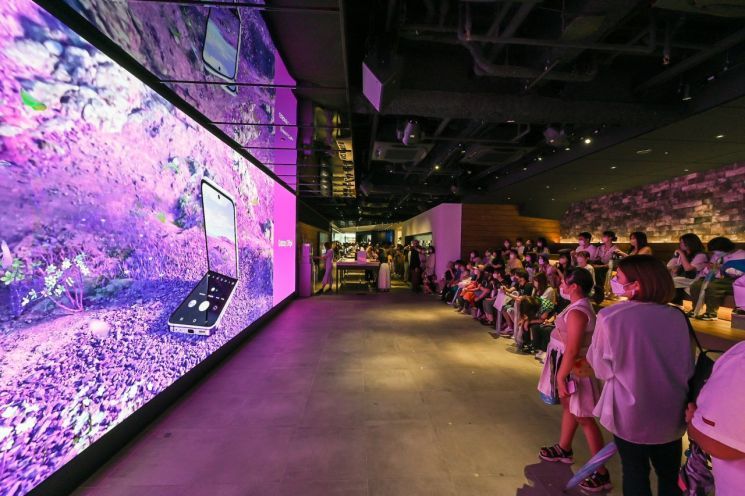 Consumers are watching the digital video of 'Galaxy Z Flip4 X BTS' at Galaxy Harajuku (Showcase) in Tokyo, Japan. (Photo by Samsung Electronics)
First, to promote hardware technology, Samsung utilized Korea's soft power, K-POP. A representative example is the 'Harajuku Galaxy' experience center opened in Tokyo, Japan, in 2019. Recently, Samsung set up an exhibition space for BTS fans on the 6th floor of this center. Visitors can watch Galaxy commercials featuring BTS and take photos at a photo spot where large panels of the members' pictures are displayed. Nihon Keizai reported, "This place is now called a sacred site attracting attention from young women," adding, "An average of 2,000 customers visit daily, 90% of whom are female."
The Galaxy Harajuku experience center goes beyond simple advertising by providing high-quality experiential content that allows visitors to naturally notice the product's functional improvements. Last year, Samsung collaborated with the Japanese artist group teamLab to hold an exhibition where visitors created a nature guidebook using the Galaxy camera. Visitors rented Galaxy smartphones to photograph cherry blossoms under dim lighting and take selfies, naturally experiencing how much the Galaxy smartphone's night camera function has improved.
Additionally, to capture the attention of Generation Z, Samsung opened pop-up studios?temporary experience centers?across Japan. Last year, Samsung held 130 pop-up studios in the Kanto and Kansai regions. Starting in April, Samsung plans to set up similar temporary experience centers related to the S23 series in Nagoya and Fukuoka as well.
Samsung also paid attention to the fact that Generation Z in Japan forms peer cultures centered around specific Apple features like AirDrop. AirDrop is a wireless communication function that allows sharing photos, videos, documents, and more between Apple devices. Nihon Keizai explained that Japanese Generation Z feels that if they cannot use AirDrop alone, they cannot blend in with their peers. The unique iPhone feature acts as a medium for maintaining peer relationships.
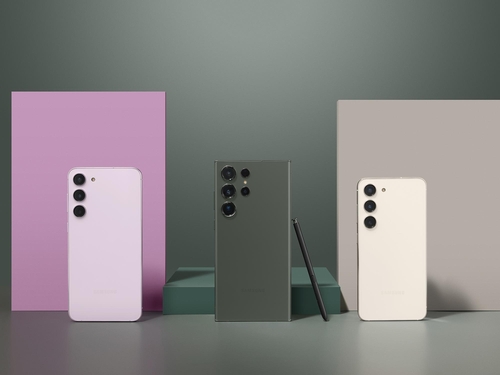
Noticing this, Samsung recently focused on smooth content sharing between Galaxy series devices through a feature called 'Quick Share.' Nihon Keizai explained, "The Galaxy S23's catchphrase, 'Let's share what matters,' is known to have been created with Generation Z, who enjoy sharing content and socializing, in mind."
Kobayashi Kenichi, Chief Marketing Officer (CMO) of Samsung Electronics Japan, told Nihon Keizai, "We are trying to increase awareness among Generation Z," adding, "We want to break the fixed notion that smartphones mean Apple."
© The Asia Business Daily(www.asiae.co.kr). All rights reserved.
![Clutching a Stolen Dior Bag, Saying "I Hate Being Poor but Real"... The Grotesque Con of a "Human Knockoff" [Slate]](https://cwcontent.asiae.co.kr/asiaresize/183/2026021902243444107_1771435474.jpg)

















