Interest Groups Beyond the Law... Must Be Thoroughly Supervised
Improving University Enrollment Regulations to Foster SW Talent
Proposal to Hire Foreign Workers... Aiming for Venture Globalization
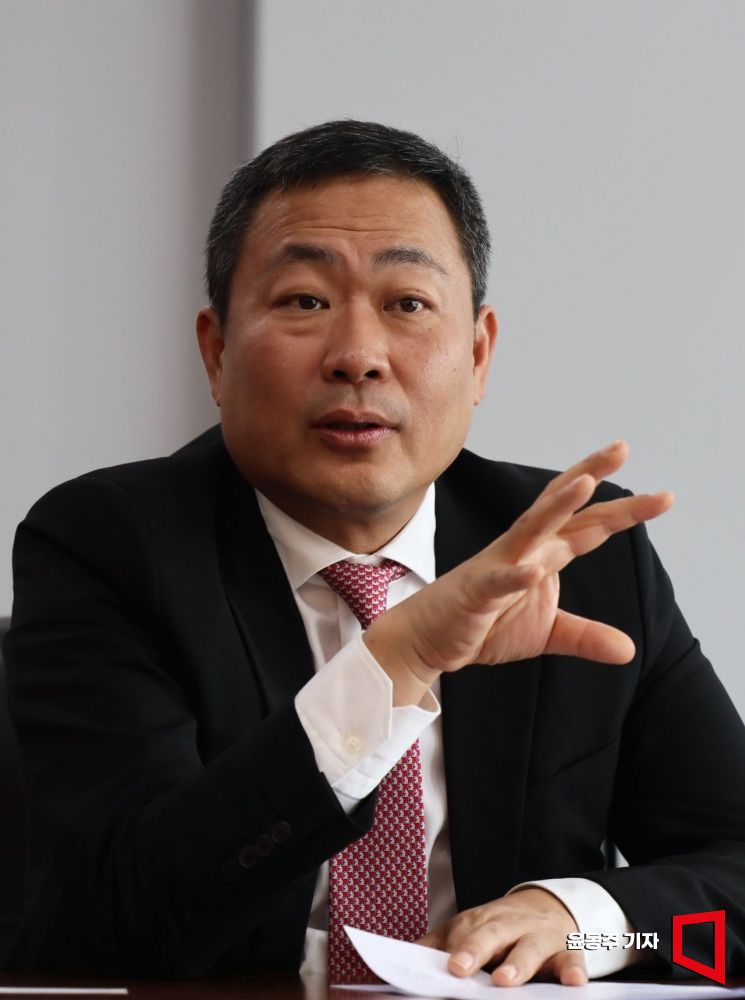 Seong Sang-yeop, Chairman of the Korea Venture Business Association, is being interviewed by Asia Economy in Yeouido, Seoul. Photo by Dongju Yoon doso7@
"We must remove obstacles that hinder the emergence of new industries and allow innovative companies to freely realize their business ideas."
Seong Sang-hyeop, chairman of the Korea Venture Business Association, said this in a recent interview with Asia Economy. He emphasized, "Regulations that do not exist in advanced countries such as the United States and Europe or those that are excessive should be boldly abolished." This statement came after a luncheon meeting with small and venture business owners hosted by President Yoon Seok-yeol. The word most frequently mentioned by the entrepreneurs attending the meeting was also 'regulation.' They appealed for speeding up regulatory improvements in line with rapidly advancing technologies.
Chairman Seong is the CEO of Intellian Technologies, a company specializing in satellite antennas. Having succeeded early in global expansion, the company has five overseas subsidiaries in the United States, the United Kingdom, Singapore, and other countries. He said, "We gave stock options to foreign executives, but it took four weeks to open securities accounts in Korea. The number of transactions is also limited." Seong argued, "Except for what is explicitly prohibited by law, a negative regulation system that allows everything else should be the basis, and a broad and proactive 'prior permission principle' should be applied." He explained that venture companies should be allowed to freely conduct business using the domestic market as a testbed, and if problems arise, the public and private sectors should work together to improve them one by one.
Another factor holding back venture companies is friction with existing interest groups. Conflicts continue between the Korean Bar Association and LawTalk, the Korean Association of Tax Accountants and Samzzumzzum, the Korean Medical Association and remote medical service providers, among others. Seong pointed out, "Many regulations, contrary to their original purpose of protecting the public, function as means to protect specific interest groups." He urged, "The government must thoroughly supervise so that interest groups cannot exercise authority beyond the law," and called for "the establishment of fair guidelines to prevent existing regulations from being used as tools to restrain venture companies." He noted that although many innovative ventures are seeking to enter overseas markets in the era of the Fourth Industrial Revolution, it is still difficult for them to establish themselves even in the domestic market.
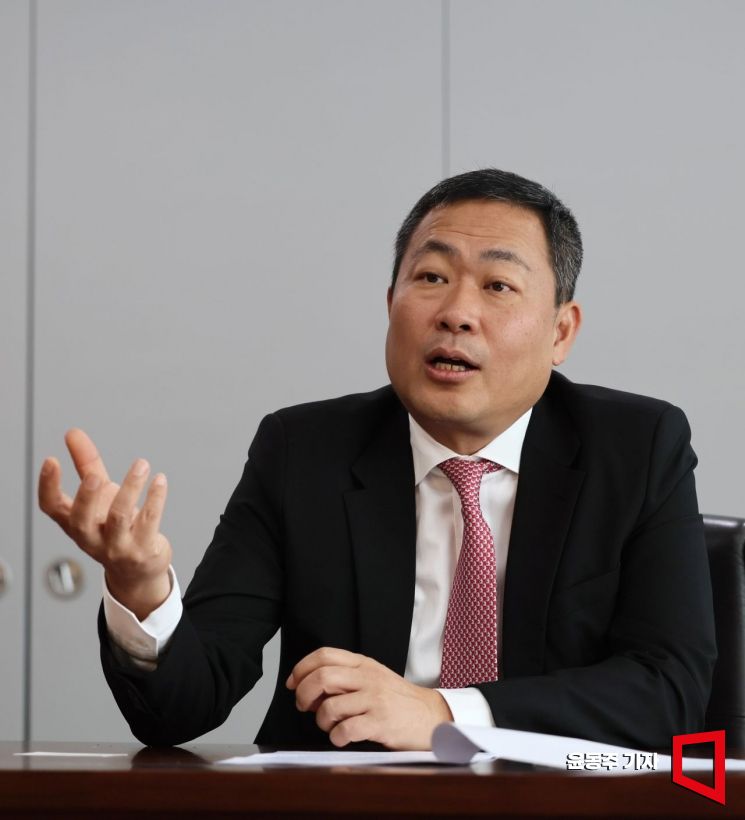
Chairman Seong stated that the Serious Accident Punishment Act and the 52-hour workweek system should be eased to facilitate smooth business operations for companies. While large corporations with relatively abundant capital and manpower respond quickly to new laws, it is true that small and venture companies face difficulties. Seong said, "We will strive to establish legislation that clearly defines the punishment requirements under the Serious Accident Punishment Act and improves sanction methods so that the focus is on 'prevention' rather than 'punishment'." Regarding the 52-hour workweek, he emphasized, "For venture companies that find it difficult to hire technical experts in the short term, a flexible working system based on autonomous agreements between labor and management is essential to achieve efficiency and performance by breaking away from rigid systems."
With developer salaries rising significantly and the economy entering a downturn phase, labor costs have become a heavy burden for companies. This is why venture entrepreneurs are closely watching the discussions of the Minimum Wage Commission ahead of next year's minimum wage decision. Hiring freelancers or short-term workers for tasks such as program development could be directly impacted by the minimum wage increase. Seong said, "At a time when the economic situation is severe due to rising interest rates and soaring public utility charges, I hope a reasonable level of minimum wage will be decided after listening to voices from all sectors."
The IT sector's manpower shortage is also a chronic problem faced by venture companies. Seong proposed two solutions to address the manpower shortage. One is improving the regulation on university enrollment quotas in the metropolitan area. Due to the total enrollment quota regulation under the Capital Region Readjustment Planning Act, sufficient talent is not being cultivated. Seong said, "The enrollment quota for the Computer Engineering Department at Seoul National University has been fixed at 55 for 16 years, whereas Stanford University increased from 141 in 2008 to 745 in 2019." The association has continuously proposed amending the law so that advanced fields related to the Fourth Industrial Revolution, such as artificial intelligence (AI) and big data, are exempt from the total university enrollment quota regulation. Another solution Seong suggested to solve the manpower shortage is hiring foreign talent. He stated, "There are many software (SW) talents in southern countries such as the Philippines, Vietnam, and India," and added, "A more aggressive policy to attract them is needed to meet on-site demand."
One of Chairman Seong's inaugural statements is the globalization of venture companies. He said, "Although the venture ecosystem has expanded, it still cannot escape the domestic market, which accounts for about 1% of the global GDP," and added, "Globalization is a task that must be solved for the quantitative and qualitative growth of domestic venture companies." Chairman Seong will accompany a large-scale economic delegation led by President Yoon on a visit to the United States this week. He said, "Since the government is focusing on global expansion policies, comprehensive support for activating venture company exports is necessary," and emphasized, "It is time for active cooperation between countries, including the supply of global professionals and attracting investment."
▲ Born in 1972 in Mungyeong, Gyeongsangbuk-do ▲ Graduated from Daegu Dalseong High School and Yonsei University, Department of Electronic Engineering ▲ Founded Intellian Technologies in 2004 ▲ Senior Vice Chairman of the Korea Venture Business Association in 2020 ▲ 11th Chairman of the Korea Venture Business Association in 2023
© The Asia Business Daily(www.asiae.co.kr). All rights reserved.
![Clutching a Stolen Dior Bag, Saying "I Hate Being Poor but Real"... The Grotesque Con of a "Human Knockoff" [Slate]](https://cwcontent.asiae.co.kr/asiaresize/183/2026021902243444107_1771435474.jpg)

















