Incheon City installed a 'Climate Crisis Clock' at the city hall on the 22nd to commemorate the 53rd Earth Day. It is the first of its kind in a public government building in South Korea.
The Climate Crisis Clock displays the remaining time until the global average temperature rises by 1.5 degrees Celsius above pre-industrial levels (1850?1900) due to worldwide carbon dioxide emissions.
As of the 22nd, the remaining time until a 1.5-degree increase is approximately 6 years and 91 days. If temperature rise is reduced through carbon neutrality efforts, the clock's remaining time will increase.
According to the 6th report by the Intergovernmental Panel on Climate Change (IPCC) released in August 2021, if the global average temperature rises by 1.5 degrees, the frequency of heatwaves will increase 8.6 times, droughts 2.4 times, precipitation 1.5 times, and typhoon intensity by 10%.
Additionally, in the oceans, sea water temperature is expected to rise by 0.26 to 0.77 meters, putting 70 to 90% of coral reefs at risk. In ecosystems, it is predicted that more than half of the habitats of 6% of insects, 6% of plants, and 4% of vertebrates will be lost.
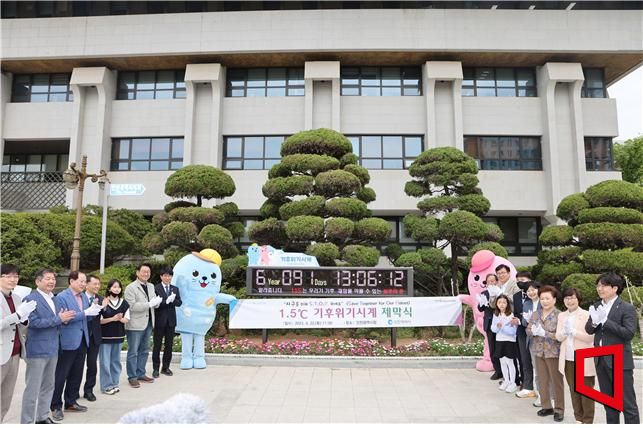 On the 22nd, to commemorate the 53rd Earth Day, a 'Climate Crisis Clock' was installed at the Incheon City Hall.
 [Photo by Incheon City]
This year, the city set the theme for Earth Day as 'S.T.O.P. for the Earth (Save Together for Our Planet)'. It signifies stopping energy overconsumption, single-use products, carbon emissions, and the climate crisis clock for the sake of the planet.
The event included the unveiling ceremony of the Climate Crisis Clock, a performance by 'Pureulnai Job Con', the representative brand of Namdong-gu youth job projects, screening of UCC video contest entries, and operation of environmental and carbon neutrality experience booths, providing citizens with programs to feel the impact of climate change and the realization of carbon neutrality.
Earth Day was established by environmentalists to raise awareness of the seriousness of global environmental pollution issues. It is now celebrated worldwide on April 22 with various commemorative events.
Meanwhile, Incheon City declared a '2045 Carbon Neutral Vision' last December, five years ahead of the government's Nationally Determined Contribution (NDC) target for greenhouse gas reduction.
To achieve this, the city plans to pursue four major policy directions and 15 tasks: ▲creating a low-carbon economy and ecological city ▲expanding customized citizen climate actions ▲activating global climate cooperation systems ▲strengthening safe climate crisis adaptation.
The city will expand renewable energy sources such as hydrogen, wind power, and fuel cells, and establish an eco-friendly transportation system including the transition to hydrogen buses.
It also plans to prepare for a green energy transformation by phasing out coal power plants that have reached the end of their lifespan, support the development of new climate industries and technological innovation, and strengthen resource circulation.
Furthermore, the city will promote the construction of the GCF (Green Climate Fund) Complex, discover Official Development Assistance (ODA) projects, enhance low-carbon MICE capabilities, implement climate change living labs, expand carbon sinks through tidal flats and tree planting, conduct climate crisis vulnerability assessments, and select and disclose greenhouse gas environmental indicators.
© The Asia Business Daily(www.asiae.co.kr). All rights reserved.
![Clutching a Stolen Dior Bag, Saying "I Hate Being Poor but Real"... The Grotesque Con of a "Human Knockoff" [Slate]](https://cwcontent.asiae.co.kr/asiaresize/183/2026021902243444107_1771435474.jpg)















