The Japanese Ministry of Defense announced that the object launched by North Korea on the 13th may have separated from North Korea's intercontinental ballistic missile (ICBM)-class ballistic missile.
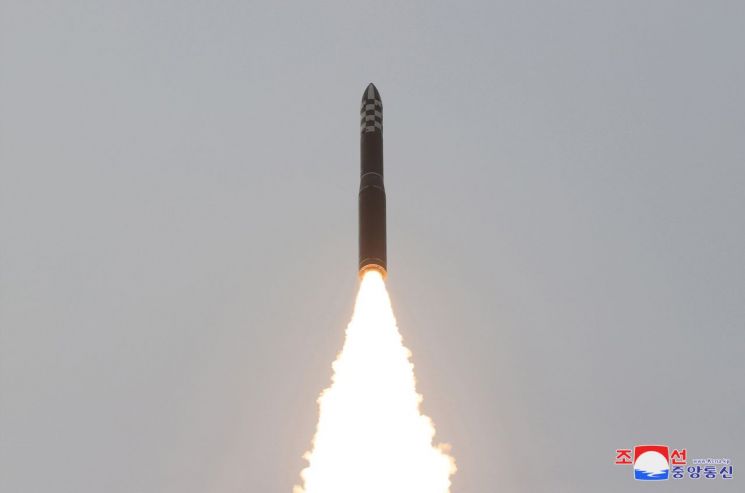
On the 21st (local time), the Ministry of Defense stated in a press release, "The object initially predicted to fall in Japan is likely to have separated during an emergency from a North Korean missile, according to additional analysis," and added, "It has been confirmed that this object no longer has the possibility of falling within Japanese territory."
Earlier, at 7:22 a.m. on the 13th, North Korea launched a ballistic missile into the Sea of Japan. In response, the Japanese government issued an evacuation alert through the nationwide warning system (J-ALERT) around 7:55 a.m., about 30 minutes later, stating, "A missile is expected to fall near Hokkaido around 8 a.m."
However, 20 minutes later, the Japanese government announced, "After verifying the information, it has been confirmed that the missile is no longer likely to fall in or around Hokkaido, and this is a correction."
The Ministry of Defense stated that the ballistic missile launched by North Korea at that time was a new type of three-stage solid-fuel propelled ICBM-class ballistic missile. This aligns with the official announcement on the 14th that North Korea conducted the first test launch of the new solid-fuel ICBM 'Hwaseong-18.' This ICBM is known to have flown approximately 1,000 km, with an apogee below 3,000 km.
© The Asia Business Daily(www.asiae.co.kr). All rights reserved.
![Clutching a Stolen Dior Bag, Saying "I Hate Being Poor but Real"... The Grotesque Con of a "Human Knockoff" [Slate]](https://cwcontent.asiae.co.kr/asiaresize/183/2026021902243444107_1771435474.jpg)
















