The Seoul Conference Hosted by Choi Jonghyun Academy and CSIS
Regarding the U.S. Inflation Reduction Act (IRA), experts suggested that it is worth discussing short-term extensions of the regulation implementation schedule or providing incentives by distinguishing between the mining and refining of critical minerals.
Professor Ki-Seok Kang of the Department of Materials Science and Engineering at Seoul National University said on the 21st during a virtual Seoul conference hosted by the Choi Jong-hyun Academic Foundation and the U.S. think tank Center for Strategic and International Studies (CSIS), in response to the question, "What short-term tasks related to the IRA could be discussed during President Yoon Suk-yeol's state visit to the U.S. next week?" that “the schedule is the most important issue because there is not enough time to create a situation where IRA benefits can be received.”
Professor Kang stated, “According to the data and figures presented in the current IRA, there are no cars eligible for tax reductions.” He explained, “This is because China controls all mining and refining of essential battery manufacturing minerals such as cobalt and lithium,” and added, “At the very least, it might be possible to consider adding countries like Indonesia, which have not yet signed a Free Trade Agreement (FTA).” Indonesia is the world's largest producer of nickel, a critical mineral.
Professor Ki-Tae Nam of the Department of Materials Science and Engineering at Seoul National University, who was also present, said, “We understand and agree with the direction of the IRA, but the schedule is important,” and added, “We also need to listen to advice from industry partners.”
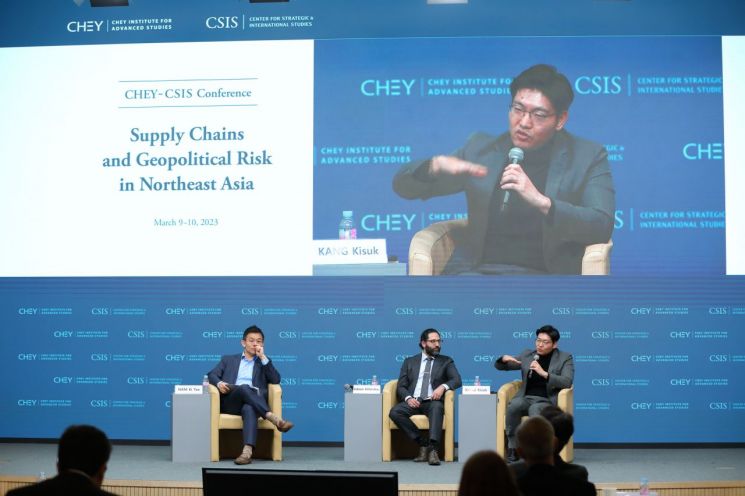 At the Seoul conference hosted by the Choi Jonghyun Academic Institute and the U.S. think tank Center for Strategic and International Studies (CSIS), Nam Gitae, Professor of Materials Science and Engineering at Seoul National University (far left), and Dr. Fabian Villarobos from the RAND Corporation (center) are listening to remarks by Kang Giseok, Professor of Materials Science and Engineering at Seoul National University (far right).
 [Photo by Choi Jonghyun Academic Institute]
There was also an opinion that applying different standards regarding regulations on critical minerals or mining and refining production sites could be a method. Professor Kang said, “Even if raw materials are produced in a specific region, if 50%, 65%, or 70% of added value is created, it could be recognized as produced in the country that generated the added value.”
Dr. Fabian Villarobos of the RAND Corporation in the U.S. also said, “When giving incentives for critical minerals, it is necessary to distinguish between where they are mined and where they are refined,” adding, “Currently, both are understood to be 50%, but giving the same incentives means viewing the diversification potential of mining and refining equally.”
He argued that regulations on mining and refining regions should be applied differently. Dr. Villarobos said, “Looking at market shares, mining is diversified, but refining is concentrated in China,” and added, “Incentives should vary according to market share.”
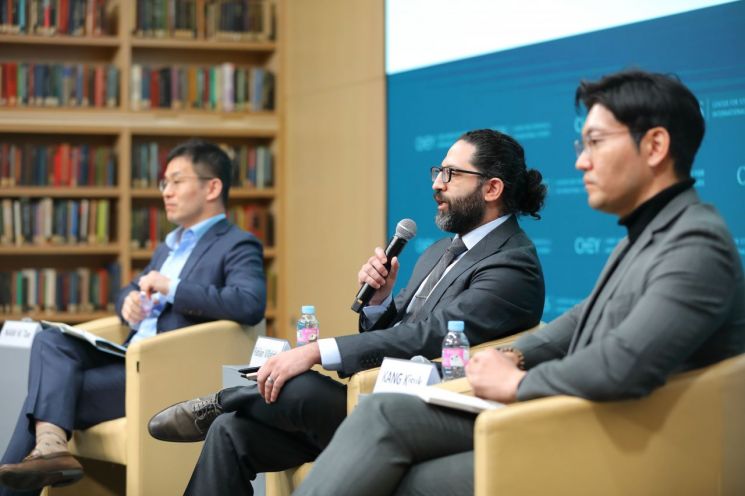
Discussions on standardization of electric vehicle batteries also continued. Professor Kang said, “Currently, supply cannot keep up with demand, and battery production is exploding, so there is no time to consider such issues,” adding, “In the future, standardization work should be done so that batteries can be used for different car models or vehicles from different automakers at any time.”
He also said that standardization is necessary for recycling used batteries. He explained, “In 10 to 20 years, a huge number of batteries used in electric vehicles will be discarded, and the biggest problem in recycling used batteries is that all battery types are different.”
Professor Kang said, “It takes enormous labor and cost to disassemble and extract chemical substances,” but added, “However, automakers are reluctant about battery standardization.” He continued, “This is because they would lose their advantage,” and said, “Automakers want to fully control the battery and have their own unique car models. This is also a kind of political issue.”
© The Asia Business Daily(www.asiae.co.kr). All rights reserved.
![Clutching a Stolen Dior Bag, Saying "I Hate Being Poor but Real"... The Grotesque Con of a "Human Knockoff" [Slate]](https://cwcontent.asiae.co.kr/asiaresize/183/2026021902243444107_1771435474.jpg)
















