'Possibility of Occurrence Confirmed' and 'Estimation' Throughout the Report
Expert: "Cause Misidentified and Conclusion Strange"
Lithium Byproducts Can Form Even Without Tab Lead Folding
Under Harsh Conditions, They Appear in Normal Batteries Too
"Increased Battery Operation to Extend Driving Range Is the Cause"
A report investigating the cause of Kona electric vehicle (EV) fires that have occurred over the past four years has been released, but the specific cause was ultimately not identified. Experts believe the issue lies in the battery system, which allows conditions that can be excessively demanding during charging and discharging processes.
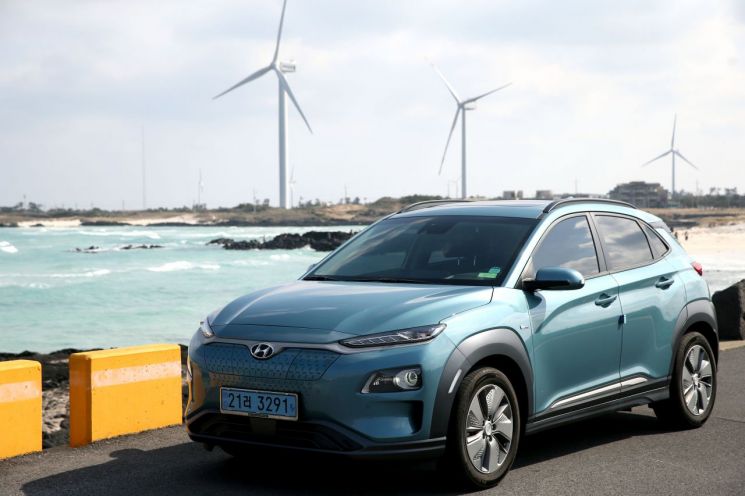
The Korea Transportation Safety Authority’s Automotive Safety Research Institute pointed to internal short circuits within the battery cells as the cause of the Kona EV fires. The institute first conducted a comprehensive investigation of Kona EV vehicles that had caught fire domestically. Through this, they confirmed the conditions at the time of the fires (such as battery remaining capacity above 90% and fires occurring within 4 hours after charging).
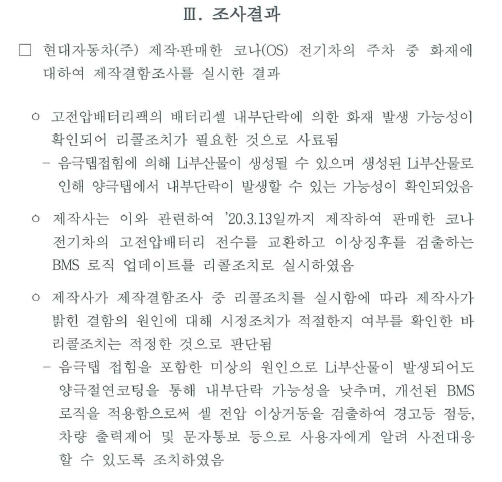
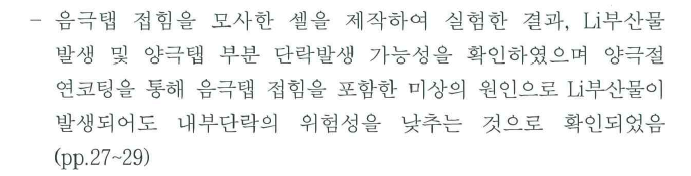
Subsequently, LG Energy Solution applied insulating coating to prevent short circuits in the battery cell’s positive tab leads, which led to a sharp decrease in defect rates and fire occurrences. Analysis of the retrieved batteries revealed the formation of lithium byproducts caused by the negative tab leads, which in turn caused short circuits, confirming the “possibility of fire occurrence.”
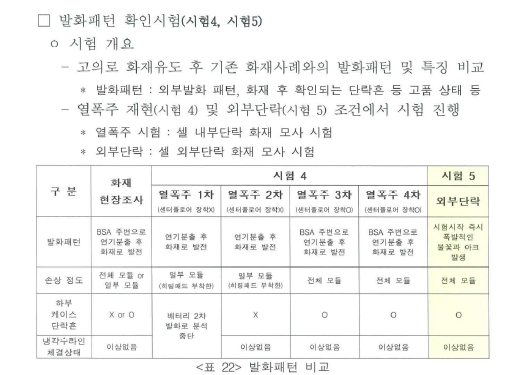
Fire reproduction tests were conducted using cells that replicated possible manufacturing defects. By comparing the internal and external ignition patterns with actual fire cases, they reaffirmed the “possibility of fire occurrence due to internal short circuits in the battery cells.”
However, the institute repeatedly used terms like “possibility of fire occurrence” and “assumption” in the report without clearly identifying the cause of the fires. In response, they explained, “Internal short circuits can have various causes, making it difficult to pinpoint the exact cause of the fire.”
Experts have been critical of these findings, arguing that the cause was misidentified or that unrelated factors were concluded as causes of the fire. Park Cheol-wan, a first-generation battery expert and professor in the Department of Smart Automotive at Seojeong University, stated, “Even in normal cells, harsh battery usage produces lithium byproducts at each tab lead or corner.”
He further argued that internal short circuits cannot occur at the positive tab leads due to these byproducts. Professor Park explained, “The distance between the negative tab leads and positive tab leads is quite large. For byproducts to move, a medium is required, but such a medium does not exist. It’s as if they concluded that the byproducts moved to the positive tab leads causing the fire, which could be prevented by insulating coating.”
He pointed to battery system design, rather than battery cell defects, as the cause of the fire. Batteries used in electric vehicles typically reserve about 8?12% of their capacity unused for safety. Additionally, the battery management system (BMS) generally limits the battery’s charge rate. This is called a “safety margin.” Reducing the safety margin can increase driving range but also increases battery instability.
If a large safety margin is maintained, battery cell defects could be suspected. However, if the safety margin is small, defects generated during vehicle operation are more likely, according to Professor Park.
The battery operating range of the Kona EVs that caught fire was revealed to be 97?98% in a past report by the National Forensic Service. In other words, the battery was operated under harsh conditions to increase driving range, likely causing damage to the cells, resulting in short circuits and fires.
Professor Park emphasized, “Since a battery pack is made by connecting hundreds of battery cells in series and parallel, ensuring safety is crucial.”
© The Asia Business Daily(www.asiae.co.kr). All rights reserved.
![Clutching a Stolen Dior Bag, Saying "I Hate Being Poor but Real"... The Grotesque Con of a "Human Knockoff" [Slate]](https://cwcontent.asiae.co.kr/asiaresize/183/2026021902243444107_1771435474.jpg)

















