[At a Crossroads: Korean AI]①
Full-Scale AI Ecosystem Development... Opportunities for Domestic Companies
"Trillion-Won Sales Expected Like Early App Market"
Last year, domestic AI companies in South Korea nearly reached 4 trillion won in sales. This is the result of an increase in the number of AI-related companies and their entry into the product commercialization stage. However, overseas expansion is still at a nascent stage. Companies like Microsoft (MS) and Google have begun actively building AI ecosystems. It is pointed out that domestic companies must quickly seize these opportunities.
AI Company Sales Soar... Overseas Share Only 6%
According to the '2022 Artificial Intelligence Industry Survey' released on the 20th by the Software Policy Research Institute under the Ministry of Science and ICT, domestic companies engaged in AI-related businesses recorded total sales of 3.9702 trillion won last year. This more than doubled from 1.9506 trillion won in 2020.
This is the result of both quantitative and qualitative growth of AI companies. First, the number of companies in AI fields such as AI technology development, AI-applied hardware (HW), and software (SW) increased. The number rose from 933 in 2020 to 1,915 last year. Among them, the proportion of companies generating sales reached 84.8% last year. This means that the money and effort invested in AI research and development have begun to reflect in performance. This proportion increased by about 20 percentage points from 62.6% in 2020.
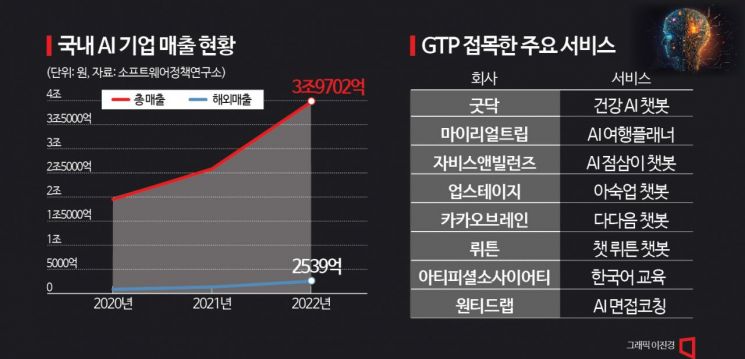
The share of overseas sales was less than 10%. Last year, overseas sales amounted to 253.9 billion won, accounting for 6.5% of total sales. It grew from 85.9 billion won (4.5%) in 2020 and 134.2 billion won (5.3%) in 2021, but the analysis suggests that overseas expansion is still in its infancy. This is because most companies first verify their success potential domestically before going abroad. Of course, there are cases of success starting from overseas markets. AI business solution company Allganize and video translation solution company XL8 are representative examples.
Kwon Oh-hyung, CEO of FuturePlay, a venture capital (VC) investing in future technology startups such as AI and big data, explained, "More companies have commercialized services developed through AI research," adding, "As AI gained attention, more people started utilizing AI."
AI Market Laid Out... "Trillion-Won Sales Expected"
The industry views the AI market's blossoming as just beginning. This is because global big tech companies like MS, Google, and Meta are competing to unveil ultra-large AI models, laying the groundwork. Especially since the launch of ChatGPT, services incorporating it have been pouring out.
Domestically, Naver and Kakao plan to launch AI search services based on their own AI models within the year. Startups are introducing services using the ChatGPT application programming interface (API). An API is a tool needed to create programs. Depending on the service to be implemented, multiple APIs are combined like Lego blocks. AI travel planner (MyRealTrip), tax filing service (Jarvis & Villains), and writing service (Lytton) have utilized ChatGPT.
With the AI development race underway, it is seen as an opportunity for domestic companies. Just as the application market opened after the release of smartphones like the iPhone and Android phones, new services can emerge in the AI field. Simply put, a second KakaoTalk or Line could appear.
No Tae-jun, partner at startup accelerator Primer, predicted, "First, AI will largely replace existing mobile services such as translation," adding, "Companies generating trillion-won sales overnight, like in the early app market, could emerge." Jeon Chan-seok, co-CEO of V-Cat, an AI marketing video generation company, said, "With the emergence of generative AI development tools like GPT and Stable Diffusion, the technology has begun to become mainstream," and forecasted, "Now, competitiveness will depend on how well the technology is internalized and how differentiated the services offered are."
However, concerns have also been raised that domestic companies might be dragged along by the AI ecosystem led by big tech. For example, if the cost of using ChatGPT suddenly rises sharply or if data control is taken over, domestic companies might have no choice but to accept it reluctantly. CEO Kwon said, "Since only a few big tech companies can develop large-scale AI models, there is no choice but to be partially dependent on infrastructure like GPT."
© The Asia Business Daily(www.asiae.co.kr). All rights reserved.
![Clutching a Stolen Dior Bag, Saying "I Hate Being Poor but Real"... The Grotesque Con of a "Human Knockoff" [Slate]](https://cwcontent.asiae.co.kr/asiaresize/183/2026021902243444107_1771435474.jpg)















