Pension Special Committee Holds Public Hearing on Retirement Pension Development
Low Returns Under Scrutiny
"Blind Spots for Small and Micro Businesses Must Be Addressed"
A proposal has been made to mandatorily convert severance pay into retirement pensions and to make it difficult to withdraw early or receive lump-sum payments, thereby encouraging receipt as a pension. The idea is to convert severance pay into quasi-public pensions to be used as retirement income. The National Pension Service also suggested a plan to operate retirement pensions to increase returns.
At the public hearing on "Measures for the Development of Retirement Pensions" held by the National Assembly's Special Committee on Pension Reform, Yang Jae-jin, a private advisory member of the committee and professor of public administration at Yonsei University, argued for the quasi-public pensionization of retirement pensions, stating, "Reforms are needed to diversify the costs of securing retirement income from a multi-layered system perspective."
Quasi-public pensionization of retirement pensions means mandating the conversion of severance pay into retirement pensions and making early withdrawal and lump-sum receipt difficult, so that payments are received as pensions.
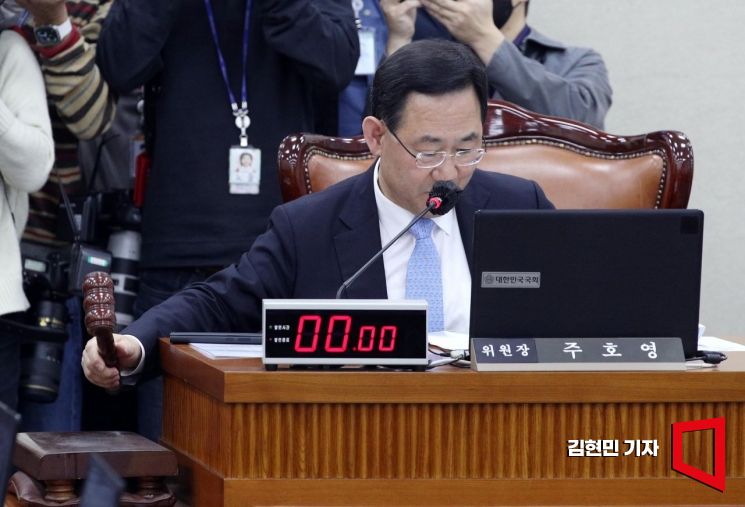 Joo Ho-young, Chairman of the National Assembly Special Committee on Pension Reform, is presiding over the plenary session held at the National Assembly in Yeouido, Seoul, on the 29th of last month. Photo by Hyunmin Kim kimhyun81@
Commissioner Yang said, "Opposition is expected because people prefer to receive severance pay as a lump sum," but explained, "Since pension systems are about forcing savings, pensionization of retirement pensions is necessary and a legitimate measure in this regard." He added, "It is possible to prevent early withdrawals by providing passive tax benefits or allow loans secured by one's pension assets. Allowing some lump-sum payments and gradually reducing their limits is also a method."
Nam Jae-woo, a private advisory member of the pension special committee and researcher at the Korea Capital Market Institute, also said, "Severance pay should be converted into retirement pensions to unify the system." He emphasized, "A system is needed to eliminate blind spots where severance pay cannot be accumulated," and stressed, "Small and medium-sized enterprises should also be included." He pointed to the case where the Korea Workers' Compensation and Welfare Service creates and operates a retirement pension fund for small businesses as an example to watch.
However, Commissioner Nam explained, "Early withdrawal or lump-sum payment of severance pay has been used as a financial resource due to the lack of social security devices and other social safety nets. If completely prohibited, it would remove a buffer for the social safety net, so people with small amounts should be allowed to take lump sums."
Members of the pension reform special committee expressed concerns about the mandatory retirement pension plan. Bae Jun-young, a member of the People Power Party, said, "Retirement pensions are deferred wages and a concept like mid-term settlement, so from the worker's perspective, it is like using their own money," and pointed out, "Forcing pensionization and legally prohibiting withdrawal is worrisome." He added, "Since the National Pension has no money, trying to combine it with other funds is not acceptable," and said, "Trying to do pension reform all at once is very difficult."
Kang Eun-mi, a member of the Justice Party, said, "The average retirement age of wage workers in Korea is 49.3 years, only 9.6% retire at the mandatory retirement age, and the period during which income can be saved without spending a penny on housing purchase is 13.2 years, twice that of London and New York," and criticized, "Claims to change only the retirement pension system without improving these issues feel like chasing clouds."
Kim Yong-ha, co-chair of the private advisory committee and professor of IT Financial Management at Soonchunhyang University, said, "There are practical difficulties in making it mandatory," but added, "In the mid-to-long term, we need to move toward pensionization."
The low returns of retirement pensions were also criticized. Commissioner Yang pointed out, "The average annual return of retirement pensions over the past five years is only 1.96%. Considering inflation, it actually recorded a negative return with asset reduction." The National Pension's return is 7.9%. Commissioner Yang said, "If the National Pension Service becomes a 'pioneer' in the retirement pension market and competes with private operators, returns will increase, fees will decrease, and products favorable to subscribers will increase."
However, Dr. Kim Sung-il of Kyung Hee University rebutted, saying, "If the National Pension Service participates, it will become a 'whale,' not a 'pioneer.'" Dr. Kim said, "To improve returns, asset management companies should actively participate and compete to generate returns," and added, "An asset advisory system for people close to financial illiteracy and education on the necessity of pensionization are needed."
Son Sung-dong, director of the Korea Pension Research Institute, said, "Retirement pensions have played a bridging role that allows individuals to flexibly respond to various situations," and added, "Viewing retirement pensions solely from a pension perspective may be problematic, but looking at it comprehensively, there is room for a different view." He also rebutted, saying, "Mandating pension payments and having the National Pension operate part of the retirement pension reserves infringes on subscribers' autonomy and is undesirable."
© The Asia Business Daily(www.asiae.co.kr). All rights reserved.
![Clutching a Stolen Dior Bag, Saying "I Hate Being Poor but Real"... The Grotesque Con of a "Human Knockoff" [Slate]](https://cwcontent.asiae.co.kr/asiaresize/183/2026021902243444107_1771435474.jpg)
















