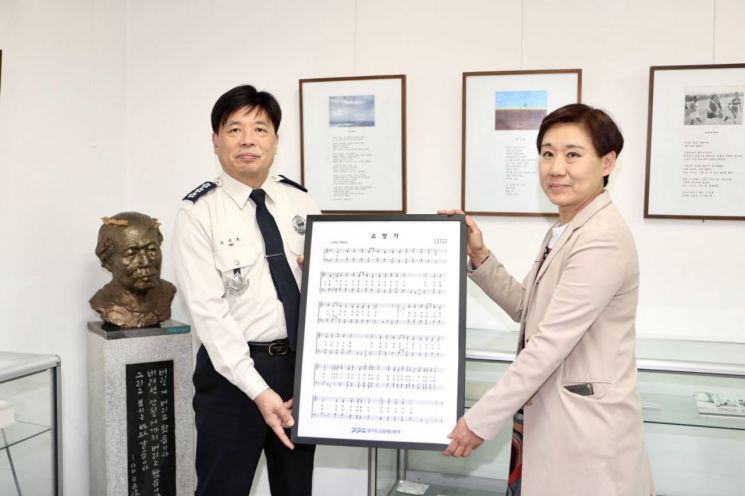
 Cho Sun-ho, Head of the Gyeonggi-do Fire and Disaster Headquarters (left), is presenting a framed fire song sheet music to Kim Mi-sook, a curator at the Jo Byung-hwa Literature Museum, on the 18th.
Who is the lyricist and composer of the 'Firefighting Song (소방가)', which proclaims Firefighting Day?
On the 18th, Cho Seon-ho, head of the Gyeonggi Fire and Disaster Headquarters, visited the memorial hall of poet Jo Byeong-hwa (Penun, 片雲) located in Anseong. Jo Byeong-hwa is the lyricist of the symbolic firefighting song 'Sobangga'.
'Sobangga' is a song symbolizing the responsibilities and duties of firefighting in the Republic of Korea and serves as the representative anthem of firefighting organizations, much like a school anthem.
Fire officials sing 'Sobangga' at various important events, including the Firefighting Day commemorations, reaffirming their commitment to protecting the precious lives and property of the people.
'Sobangga' encapsulates the spirit and soul of firefighters, including bravery, sacrifice, and service. However, not many people are well aware of the lyricist and composer of the song.
In 1982, at the earnest request of the Fire Department of the Ministry of the Interior, poet Jo Byeong-hwa (1921?2003), a native of Anseong, Gyeonggi Province, wrote the lyrics, and composer Kim Dong-jin (1913?2009), who left behind beloved national songs such as 'When Spring Comes' and 'I Want to Go', composed the music. Officially released to the public on August 18, 1982, through a performance by the Seoul Philharmonic Orchestra, 'Sobangga' was born from the hands of the era's greatest poet and composer.
Jo Byeong-hwa was born in May 1921 in Yangseong-myeon, Anseong-gun, Gyeonggi Province. After liberation, starting with his poetry collection 'The Heritage I Want to Abandon' in 1949, he published a total of 160 works, including 53 poetry collections and 37 essay collections, leaving behind numerous works until his passing in March 2003.
On this day, Cho Seon-ho, head of the provincial Fire and Disaster Headquarters, visited the Jo Byeong-hwa Literary Museum located in Nansil-ri, Yangseong-myeon, Anseong City, in front of the poet’s birthplace. He presented a framed musical score of 'Sobangga' to the curator (Kim Mi-suk) and expressed his gratitude before laying flowers at the poet’s grave.
Head Cho said, "It is a great honor for Gyeonggi firefighting that the spiritual symbol of all firefighters, the 'Sobangga', was written by a poet from Gyeonggi Province. We will faithfully uphold the firefighting spirit that poet Jo Byeong-hwa awakened and taught us and do our utmost for the safety of the country and its people."
The Jo Byeong-hwa Literary Museum carries on the late poet’s cultural spirit by holding an annual Jo Byeong-hwa Poetry Festival and various literary lectures. The current director is Jo Jin-hyeong, the eldest son of Jo Byeong-hwa.
© The Asia Business Daily(www.asiae.co.kr). All rights reserved.
![Clutching a Stolen Dior Bag, Saying "I Hate Being Poor but Real"... The Grotesque Con of a "Human Knockoff" [Slate]](https://cwcontent.asiae.co.kr/asiaresize/183/2026021902243444107_1771435474.jpg)















