①How to Choose the Right Putter
'Iljayeong' Blade Advantageous for Long Putting
'Dunggeun Moyang' Mallet Strong for Short Putting
Nothing is as important as putting in golf. It is a skill directly linked to the score. At the 87th Masters Tournament, the "Battle of the Masters," held at Augusta National Golf Club in Augusta, Georgia, USA, which concluded on the 10th, putting experts delivered impressive results. Here is a guide for amateur golfers to become putting masters.
The putter is the most frequently used club among the 14 golf clubs. Even with just two putts per hole, the total is 36 strokes. This is why choosing the right putter is crucial. No matter how good a putter is, it is useless if it does not fit your body. This is essential knowledge when selecting a putter.
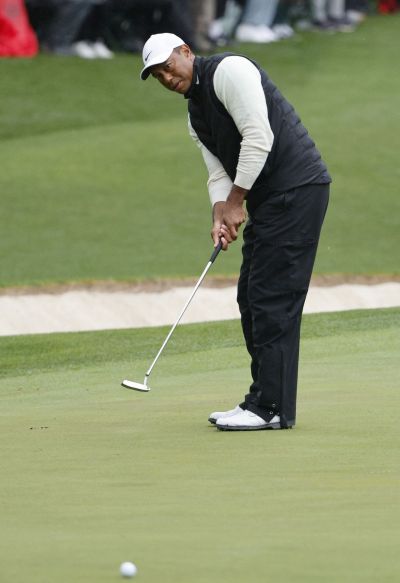
First, consider the head shape. The blade is straight, while the mallet is rounded. The choice depends on personal preference and stroke path. The blade traces a small arc, whereas the mallet maintains a straight line. In the past, experts preferred blades, but recently mallets have regained popularity.
The blade putter, when the middle part of the shaft is placed on the palm, has the toe of the head angled downward more than 45 degrees. The toe opens and then slightly closes toward the body during impact, naturally creating an arc. It is thin, with a relatively high center of gravity, requiring precise center hits and control. Tiger Woods (USA), the "Golf Emperor," is a representative user. Consistent practice is essential. The sweet spot is narrow and sensitive. It is advantageous for long putting, but if the backswing wavers, short putts can be missed easily.
The mallet putter has the face pointing upward when held on the palm, with the toe to heel forming a horizontal line. Originally crescent-shaped, it has evolved into semi-mallets with slightly larger blades, square shapes, and complex designs reminiscent of spaceships. It can be further subdivided by shaft position: T-shaped when inserted in the center of the head, and L-shaped when near the heel. The stroke is straight.
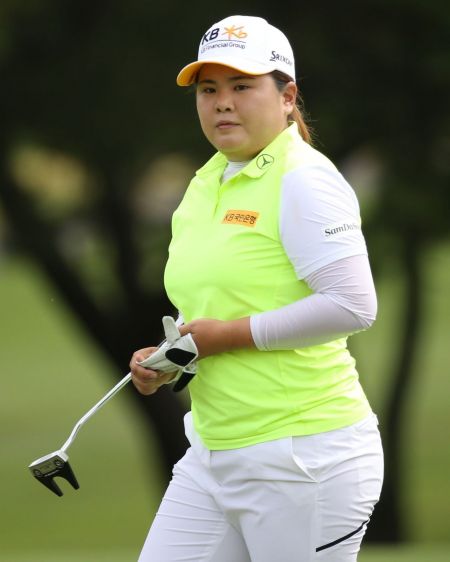 Mallet putters are easy to align with the target and move in a straight line, making them effective for short distances.
Mallet putters are recommended for golf beginners. The face is thicker than that of blades, resulting in a larger moment of inertia (MOI), and the wide back makes it easier to align the target during setup. If you use your wrists a lot, you can reinforce it with a heavier head or thicker grip. The larger grip area helps stabilize the stroke. Mallets excel in short putting but can be challenging for distance control.
The standard shaft length is 34 inches. For those under 170cm tall, 33 inches is suitable, and for those over 180cm, about 35 inches. Actually, arm length is more important than height for shaft length because the putting path needs to be comfortable. If too short, the line of sight shifts left; if too long, it shifts right.
Loft starts at 4 degrees. If the loft is too large, the ball lifts off the ground and backspins, shortening the distance; if too small, the ball bounces excessively. For fast greens, 3.5 degrees is appropriate. If the ball frequently goes left in actual play, a putter without offset is better. Although sensitive and challenging, it allows quicker contact and reduces left-side errors. If the ball often goes right, a putter with more offset is recommended.
The thicker the grip, the more it reduces unnecessary wrist movement. The principle is that a larger grip area held by the hands helps stabilize the stroke. For golfers who are unstable with short putts, a "Hongdukkye" grip can be powerful. Of course, there is a downside: it reduces feel compared to thinner grips. Golfers who frequently make long putts or prioritize putting feel should choose grips of normal thickness.
© The Asia Business Daily(www.asiae.co.kr). All rights reserved.
![Clutching a Stolen Dior Bag, Saying "I Hate Being Poor but Real"... The Grotesque Con of a "Human Knockoff" [Slate]](https://cwcontent.asiae.co.kr/asiaresize/183/2026021902243444107_1771435474.jpg)












