Legislation Flooded to Secure 'Jiyeokgu Pyo-sim'
Concerns Over Proliferation of Civil Complaints if Ye-ta Easing Law Passes
With the next year's National Assembly general election just one year away, a 'legislative war' is unfolding in the political sphere to win local votes. Both district representatives and proportional representatives are flooding the system with local grievance-related bills as they weigh their candidacies.
According to the National Assembly Legislative Information System on the 18th, Choi Chun-sik, a member of the People Power Party (representing Pocheon-si and Gapyeong-gun, Gyeonggi Province), officially proposed the "Gyeonggi Northern Special Autonomous Province Act" on the 13th. The bill aims to establish a special autonomous province directly governed by the central government in northern Gyeonggi Province, citing the need for division as about 26% of the total population is concentrated in Gyeonggi Province.
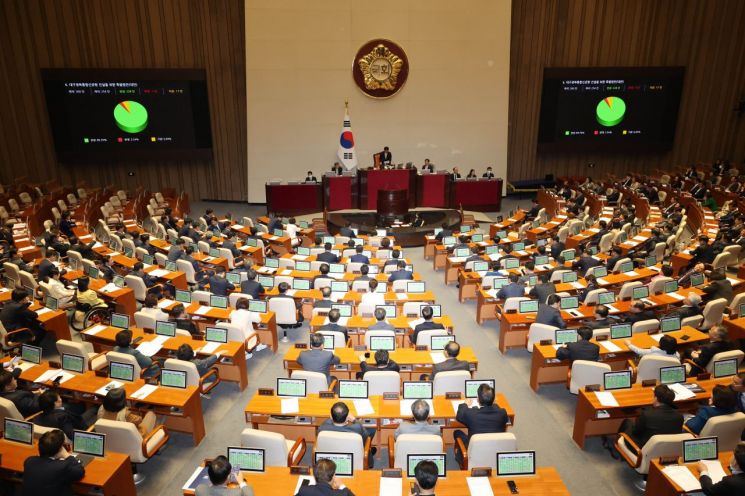
On the 22nd of last month, Yoon Young-chan, a member of the Democratic Party (representing Seongnam, Gyeonggi Province), proposed an amendment to the "School Site Act" that includes provisions allowing the expansion or reconstruction of nearby aging school facilities when development projects are undertaken. It is known that Representative Yoon proposed the amendment after personally visiting an elementary school located in his constituency.
Similarly, the "Daegu-Gyeongbuk Integrated New Airport Special Act" and the "Gwangju Military Airport Relocation Special Act," which recently passed the National Assembly plenary session, are both long-standing local projects. Although discussions had been stagnant for a long time, they gained momentum ahead of the general election.
Legislation supporting region-specific industries has also surged. Representative Lim Ho-seon of the Democratic Party (representing Jeungpyeong, Jincheon, and Eumseong, Chungbuk) proposed the "Bee Conservation Facility Installation Act" on the 11th, and Representative Joo Cheol-hyun of the Democratic Party (representing Yeosu, Jeonnam) proposed the "Kimchi Industry Promotion Institute Establishment Act" on the 27th of last month. The "Grain Management Act Amendment," which passed the National Assembly on the 23rd of last month, is also aimed at farmers.
In particular, concerns have been raised about the potential proliferation of populist grievance projects following the passage of the amendment to the National Finance Act, which relaxed the preliminary feasibility study (PFS) exemption criteria for the first time in 24 years. The bill, passed by the National Assembly's Planning and Finance Committee's Economic and Fiscal Subcommittee on the 12th, raises the exemption threshold for social overhead capital (SOC) and national research and development (R&D) projects from the current 50 billion KRW to 100 billion KRW, and the national budget threshold from 30 billion KRW to 50 billion KRW. Although the full Planning and Finance Committee meeting postponed the bill temporarily the day before, critics argue that if passed by the National Assembly, it will increase the fiscal burden.
Every Lawmaker's Office Told to "Prepare Election Bills"
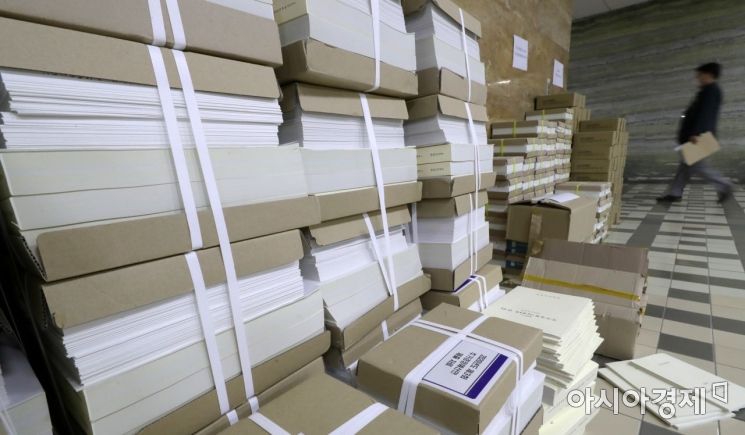
According to National Assembly aides, there have been continuous orders recently to prepare 'election-related legislation.' A Democratic Party aide, A, explained, "Each lawmaker's office is gradually preparing legislation for the general election," adding, "There is a tendency to value the act of proposing bills itself more than their actual passage." Another aide, B, from a different office, stated, "We have already submitted dozens of local issue bills since the early days of the term." Another aide, C, said, "We have proposed over 100 bills related to local issues," adding, "We received instructions from the lawmaker to start actively submitting bills related to the region from now on."
It is known that some lawmakers, focusing on the quantity of bills, flood the system with immature local grievance bills, many of which fail to even receive approval from the National Assembly's Legislative Office. Aide C explained, "Usually, bills are submitted to the Legislative Office, but absurd bills are rejected internally and sometimes returned by email."
Out of 20,777 bills proposed since the 21st National Assembly, only 6,211 have been processed, accounting for just 29.8%. About 70% of the bills remain pending.
Ministry of Economy and Finance: "Fiscal Deficit Already Surpassed 30 Trillion KRW... Concerns Over Year-End Budget Battle"
The government's fiscal capacity is not favorable. According to the Ministry of Economy and Finance's fiscal trends, as of February, the total government revenue collected was 90 trillion KRW, down 16.1 trillion KRW compared to the same period last year. The fiscal deficit is already approaching 30.9 trillion KRW, which is 10.9 trillion KRW larger than in February last year and exceeds the expected deficit of 58 trillion KRW for this year. Despite concerns about revenue shortfalls, the Ministry of Economy and Finance has stated that it is not considering supplementary budget (Chugyeong) formulation.
There are concerns that if major policies from both ruling and opposition parties are not properly reflected in next year's budget, severe conflicts over the budget, similar to last year, could arise. During the 2023 budget formulation, the government clashed with the Democratic Party by completely cutting the budget for local love gift certificates, a key policy of party leader Lee Jae-myung. The opposition party insisted on full restoration, leading to a confrontation with the government, and the budget was only passed three weeks past the legal deadline.
A Ministry of Economy and Finance official explained, "Although there were many issues during the previous administration, budget processing went relatively smoothly because the ruling party held the majority," adding, "Now, with a minority ruling party and the budget being prepared ahead of the general election, it is inevitably more difficult than usual."
© The Asia Business Daily(www.asiae.co.kr). All rights reserved.
![Clutching a Stolen Dior Bag, Saying "I Hate Being Poor but Real"... The Grotesque Con of a "Human Knockoff" [Slate]](https://cwcontent.asiae.co.kr/asiaresize/183/2026021902243444107_1771435474.jpg)

















