Air Pollution Creates Mutations Causing Lung Cancer
Inflammation Drives Cells to Develop into Tumors
The mechanism by which air pollution, including fine particulate matter, causes lung cancer has been revealed.
A research team led by Charles Swanton at the Francis Crick Institute in the UK discovered the mechanism by which fine particulate matter with a diameter of 2.5μm or less (PM2.5) causes lung cancer, and published their findings on the 5th (local time) in the international journal Nature.
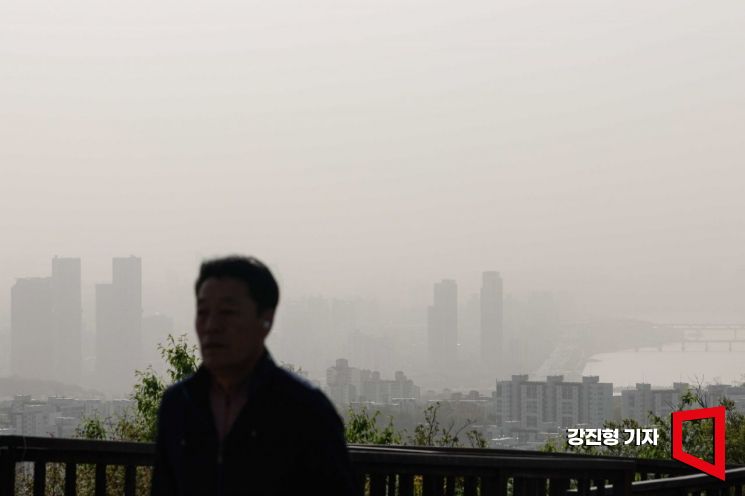 On the 12th, when a fine dust warning was issued across Seoul, the city center viewed from Namsan in Seoul was shrouded in fine dust accompanied by yellow dust. Photo by Jinhyung Kang aymsdream@
The analysis shows that air pollution creates gene mutations that cause lung cancer and worsens inflammatory responses, leading to lung cancer. This result comes from analyzing the levels of fine dust exposure in lung cancer patients from four countries: Korea, Taiwan, Canada, and the UK.
According to the World Health Organization, 90% of the global population breathes polluted air. The annual death toll from air pollution reaches 8 million. Among them, more than 250,000 deaths from lung cancer are estimated to be caused by fine particulate matter. According to the Institute for Health Metrics and Evaluation (IHME) at the University of Washington, air pollution is the third leading cause of death worldwide, following hypertension and smoking.
Serena Nik-Zainal, a professor of genetics at the University of Cambridge, said, “Not all carcinogens cause mutations, and this study shows that cancer can develop even if DNA is not affected upon exposure to carcinogens.”
Alan Balmain, a professor at the University of California, San Francisco, stated, “The main mechanism by which air pollution causes cancer is not by inducing new mutations, but by persistent inflammation promoting the progression of existing mutated cells into tumors.”
The attack of fine particulate matter does not stop here. The higher the exposure to PM2.5, the faster the brain’s degeneration progresses. The cerebral cortex, responsible for memory and learning, shrinks, increasing the risk of dementia.
As this health hazard has been proven, the World Health Organization (WHO) also classified fine particulate matter as a Group 1 carcinogen in 2013. It is known that for every 10μg increase in PM2.5 concentration per cubic meter, the probability of cancer increases by 12%, and the probability of giving birth to a malformed baby increases by 16%.
© The Asia Business Daily(www.asiae.co.kr). All rights reserved.
![Clutching a Stolen Dior Bag, Saying "I Hate Being Poor but Real"... The Grotesque Con of a "Human Knockoff" [Slate]](https://cwcontent.asiae.co.kr/asiaresize/183/2026021902243444107_1771435474.jpg)
















